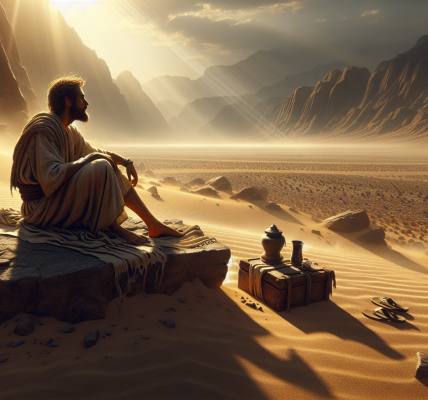
The land was not kind. Jacob felt its refusal in the soles of his feet, a persistent ache that travelled up his legs and settled into the small of his back. Each step away from Beersheba was a step into a vast, dry throat. The sun, past its zenith, was a hammer on the crown of his head, and the light bleached the world into shades of dust and pale, thirsty green. He carried little: a waterskin grown distressingly light, a pouch of parched grain, his staff, and the weight of a stolen blessing.
It was that weight, more than the heat, that truly exhausted him. The memory of his father’s trembling hands on his head, the smell of roasted meat and fine clothes meant for Esau, the sound of his brother’s grief—a raw, animal roar that seemed to chase him even here, in the empty places. He was a man fleeing, not an heir journeying. The promise of his mother’s people in Haran felt less like a destination and more like a faint, theoretical shadow on the edge of the world.
As the day bled into a softer, golden hour, the terrain began to change. Low hills rose around him, and he found a place where the stone broke through the earth in great, flat slabs. One stone, larger than the rest, lay apart from its brethren, pillow-shaped by some ancient weathering. It would do. Luz, the locals called this place, though Jacob did not know that. To him, it was simply a stop, a hard bed on the long road of his disgrace.
He performed the small, tired rituals of a traveller. He took a meagre sip of tepid water, chewed a handful of grain that tasted of nothing but dryness. The sounds of the wilderness deepened as the light failed: the whisper of a slight wind through scrub, the distant cry of a bird. He arranged his cloak, rolled it into a lumpy bundle, and placed it against the stone. It was a wretched pillow. He lay down, his bones protesting against the unyielding earth, and stared up at the emerging stars. They were cold, indifferent points. His last conscious thought was not of covenant or birthright, but of the deep, penetrating chill of the desert night.
Sleep took him roughly, and then it transformed.
It was no ordinary dream. There was no haze, no gradual slipping into nonsense. One moment he was in the darkness, and the next, he *saw*. Set upon the earth, its base planted in the dust beside his own head, was a ladder—a stairway, a vast and terrible ramp. It was not made of wood or stone but of a substance that held light and shadow within it, a living geometry. And it rose, not at a gentle slope, but straight up, ascending until it pierced the velvet cloak of the sky and was lost to sight.
And upon it, there was movement. A continuous, flowing stream of beings, ascending and descending. They were not winged cherubs of later tapestries; their forms were more profound, more unsettling. They were like concentrated purpose given shape—winds of fire, eyes in wheels, presences that seemed to fold and unfold the space around them as they moved. Their traffic was silent, ceaseless, and awesome. They passed him so close he could feel the disturbance in the air, a holy static that raised the hair on his arms.
Then, his gaze, drawn upward along the terrifying highway, beheld the One who stood above it. Not at the top, but *over* it. The figure of a man, yet vaster than the sky, foundational. The face was a radiance too severe to look upon directly, but in the periphery of his soul, Jacob knew. It was the God of his father Isaac, and of his grandfather Abraham. A God he knew from stories, from altar smoke and circumcision rites, but never from this—direct, unmediated, overwhelming.
The voice did not shake the air. It shook *him*. It was inside his bones, in the pit of his stomach, the core of his fleeing heart.
“I am Yahweh, the God of Abraham your father, and the God of Isaac.”
The words were identity, a claiming of lineage that now, irrevocably, included him, the deceiver.
“The land on which you lie, to you I will give it, and to your offspring. Your offspring shall be like the dust of the earth, and you shall spread abroad to the west and to the east and to the north and to the south. And in you and your offspring shall all the families of the earth be blessed.”
The promises. The ancient words spoken to Abraham, now spoken to him, here, on this stony, lonely ground. They were not soft comforts. They were immense, crushing in their scope. Dust of the earth? He was one man, alone, with nothing but a stolen blessing and a brother’s fury.
The voice continued, a firm, foundational tone. “Behold, I am with you. I will keep you wherever you go, and I will bring you back to this land. For I will not leave you until I have done what I have promised you.”
The words *I am with you* struck him with a physical force. They were the exact opposite of his reality. He was alone. He was *not* with anyone. He was fleeing. Yet the voice declared his solitude a fiction. The presence hovering above the ladder filled every direction—north towards Haran, south towards the home he fled, the east, the west. There was nowhere to go where this presence was not already, overwhelmingly, there.
The vision held him, suspended in that terrible traffic, beneath that foundational gaze, for a timeless interval. Then, as suddenly as it had come, it was gone.
Jacob awoke. The first grey light of dawn was seeping into the world, turning the shapes of the hills from black to deep purple. He sat up, stiff and cold. The ordinary world—the scrub, the stones, the distant cry of a waking bird—seemed now to be a thin veil over a reality he had just glimpsed. It all looked the same, and yet everything was altered.
A deep, trembling awe seized him. It was not a gentle reverence. It was fear—a raw, gut-level terror at the proximity of the Holy. He brushed his hand over the stone where his head had lain. It was just a rock, cold and rough. But now it was a witness. A seal.
“Surely,” he whispered, his voice a dry rasp in the quiet morning, “Yahweh is in this place… and I did not know it.”
He shuddered, hugging his arms around himself. “How fearsome is this place! This is none other than the house of God. This is the gate of heaven.”
The actions followed the awe, clumsy and urgent. He rose, his limbs protesting. He took the stone that had been his pillow—a common, brown, Luz-stone—and he stood it on its end. It was heavier than he expected. He grunted with the effort, setting it upright like a crude pillar. Then he gathered smaller stones, piling them around its base to keep it standing.
He needed oil for anointing, but he had none. Only his water and his grain. The ritual felt poor, insufficient. But it was all he had. He poured a little of his precious water over the top of the standing stone, a libation to the dust, watching it darken the rock and trickle down. He took a pinch of his grain and scattered it at the base.
Then he gave the place a new name, because the old one, Luz, no longer sufficed. It was no longer just a place of almonds. It was a place of encounter.
“Bethel,” he said to the dawn. *The House of God.*
The vow he made then was not the bargaining of a shrewd merchant, though the echo of that man was in it. It was the vow of a shaken man, grappling with a promise too vast to hold.
“If God will indeed be with me,” he began, the ‘if’ clinging from his old self, “and will keep me on this way that I go, and will give me bread to eat and clothing to wear, so that I come again to my father’s house in peace… then Yahweh shall be my God.” He looked at the crude pillar, now glistening wet in the new sun. “And this stone, which I have set up for a pillar, shall be God’s house. And of all that you give me, I will without fail give a tenth to you.”
He stood there for a long time, as the sun fully cleared the hills. The warmth on his face was ordinary, welcome. But the chill of the night’s vision was deep in his marrow. He picked up his staff, adjusted his cloak. He looked back once at the standing stone, a solitary sentinel in the wilderness. Then he turned his face towards the north, towards Haran. The road was the same. The dust was the same. But he was not. He was a man walking with a terror and a promise, and the earth beneath his feet hummed with a traffic he could no longer see.