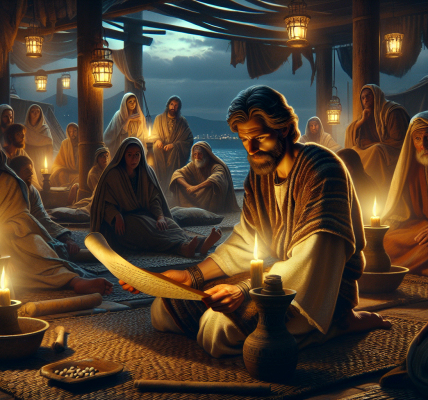

The air in Corinth always carried a scent of salt and commerce, a thick blanket that settled over the city even before the sun grew hot. In the house of Gaius, where the church gathered, the scent mingled with the smell of baking bread from the kitchen quarter and the faint, damp odor of the courtyard tiles. It was the first day of the week, and the believers were coming together.
Mara arrived with her husband, Lucius, her steps careful on the uneven street. Her mind, however, was a tangle of threads. The words of Paul’s letter had arrived weeks ago, read aloud by Stephanas, and since then, a quiet tension had hummed beneath the surface of their fellowship. It was about head coverings, about order, about the way they shared the meal. It felt, to her, like a question of breath—how to breathe freely in this new Spirit without offending the very community that was her life.
She watched Lydia, a widow of means who ran a purple-dye business, stride into the courtyard with her head bare, her grey hair a proud crown. She saw Chloe, whom Paul had mentioned, her head wrapped in a simple linen scarf, her eyes downcast as she helped arrange the benches. There was no uniformity, only a jarring patchwork of practice that seemed to whisper of deeper divisions.
The gathering was not like the solemn rituals of the old temples. It was a cacophony of life—greetings in Aramaic and Greek, the wail of an infant, the heated discussion between some of the Hellenistic Jews about the meaning of a prophecy. They moved into the *triclinium*, the dining room, where the couches were pushed aside to make space. The rich and the poor, the slave and the free, stood shoulder to shoulder, a physical fact that still sometimes startled Mara.
As they began to pray and praise, Mara felt the old confusion return. Paul had written of heads and coverings, of authority and glory. It wasn’t about mere cloth, she sensed that. It was about a story—a story that started before creation. “The head of every man is Christ,” Stephanas had read, “and the head of the woman is man, and the head of Christ is God.” The words had landed heavily. They spoke of a chain of glory, not of domination, but of a derived radiance. A man praying with his head covered dishonored his head, Christ, because he was the direct image and glory of God. But a woman… she was the glory of *man*. Created from him and for him. To pray uncovered was to lay that glory bare, as if it were her own source. The cultural sign of a shorn head, the mark of a woman caught in shame, pointed to a spiritual reality: they were not isolated individuals, but links in a sacred order.
Mara’s hand went to her own hair, braided and tucked, but uncovered. Was she asserting herself? Was she, in her heart, ashamed of being woman, of being glory derived? She saw Priscilla, who taught Apollos himself, praying fervently, a mantle over her head. It wasn’t weakness in her eyes, but a fierce, focused dignity. She was acknowledging the story. She was saying, “My glory is not my own; it is a gift, and it reflects the Giver.” Mara fumbled for the scarf in her pouch and drew it over her hair. It was not a cage. It felt, strangely, like a settling, a way to step into the narrative rather than fight it.
But the greater tension came with the meal. They called it the Lord’s Supper. It began well enough, with prayers of thanksgiving. But soon, the fractures of their everyday life split the table open. The wealthy, like Gaius, had brought substantial provisions: roasted meat, fine wine, soft cheeses. The slaves and day laborers had little—maybe a barley loaf, some olives. And they did not share. They formed their own clusters. The rich reclined early and began their feast, some even growing drunk, their laughter too loud for the prayerful space. The poor stood at the edges, or sat on the floor, eating their meager food quickly, shamefaced.
Mara’s heart sank. This was the body? This fragmentation? Paul’s words echoed in the gulf between the couches and the floor: “When you come together, it is not the Lord’s Supper you eat. For in eating, each one goes ahead with their own meal. One remains hungry, another gets drunk.” She watched a slave, a man named Linus who had been baptized the same day as her, turn away, his hunger unsatisfied, his place in the community negated by a full stomach across the room.
The blessing over the bread, when it finally came, felt hollow. “This is my body, broken for you,” the leader said, breaking a single loaf. But the body in the room was already broken by disregard. The cup, when passed, became a ritual afterthought, following a meal that had magnified their divisions rather than healed them. They were proclaiming the Lord’s death, Paul had warned, but in a way that courted judgment. Not sickness for some, but a discerning judgment—a calling to account for treating the sacred as commonplace, the unified as divisible.
After the final Amen, the dispersal was subdued. The rich left sated and perhaps uneasy; the poor left hungry in more ways than one. Mara lingered with Lucius near the courtyard fountain.
“It felt… wrong,” she whispered, the sound masked by the trickling water.
Lucius nodded, his face grave. “We have the apostle’s teaching. But knowing and doing are different countries.”
“It’s not about the scarf or the bread,” Mara said slowly, piecing it together as she spoke. “It’s about seeing the story we’re in. The covering reminds me I’m part of a glory that comes from beyond me. The Supper reminds us we’re part of a body that isn’t our own. To forget… is to eat and drink a judgment on ourselves.”
They walked home in the gathering twilight, the noisy life of Corinth swirling around them. The questions weren’t all answered. The practice would be messy. Some, like Lydia, might never cover her head. The wealthy might still struggle to share. But the word had been planted, a sharp, clarifying seed. It was a call to discern the body. Not just the historical body of Jesus, but the present, breathing, hungry body of believers around them. It was a call to see the story in the scarf, the unity in the loaf, and to let that story reshape them from the inside out, before the outside world ever could.
Mara touched her covered head once more. It was a small sign. But tomorrow, she would bring extra bread, and she would look for Linus, and she would make sure he had a place at the table. That, she understood, was where the theology began to breathe.