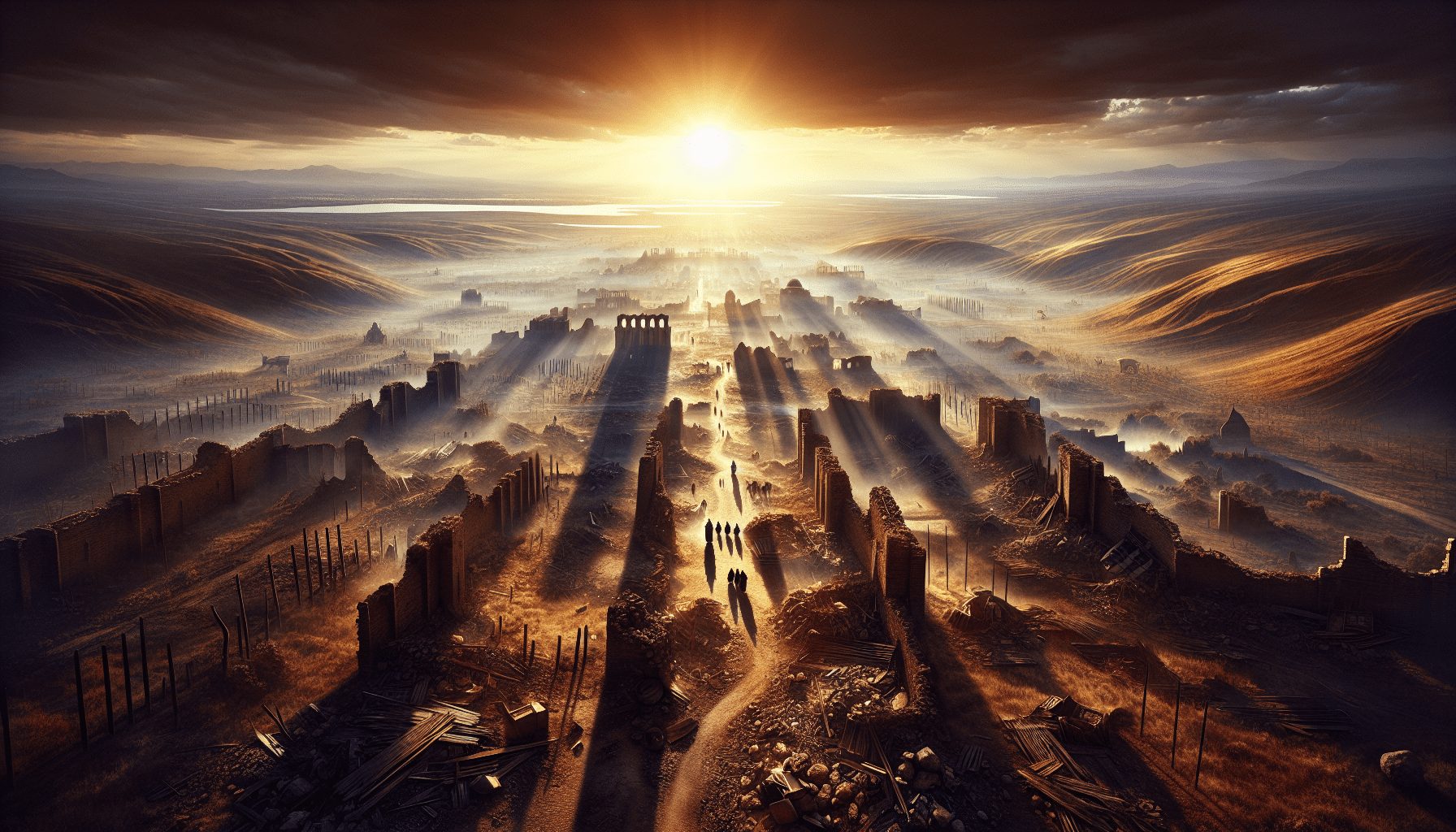

The memory of that day never left Peter. Not in the years of walking dusty roads, not in the thick silence of a Roman prison cell. It was etched into him, a strange scar of light and confusion. He’d tell it later, haltingly, never quite capturing the sheer weight of it, the way the air had changed.
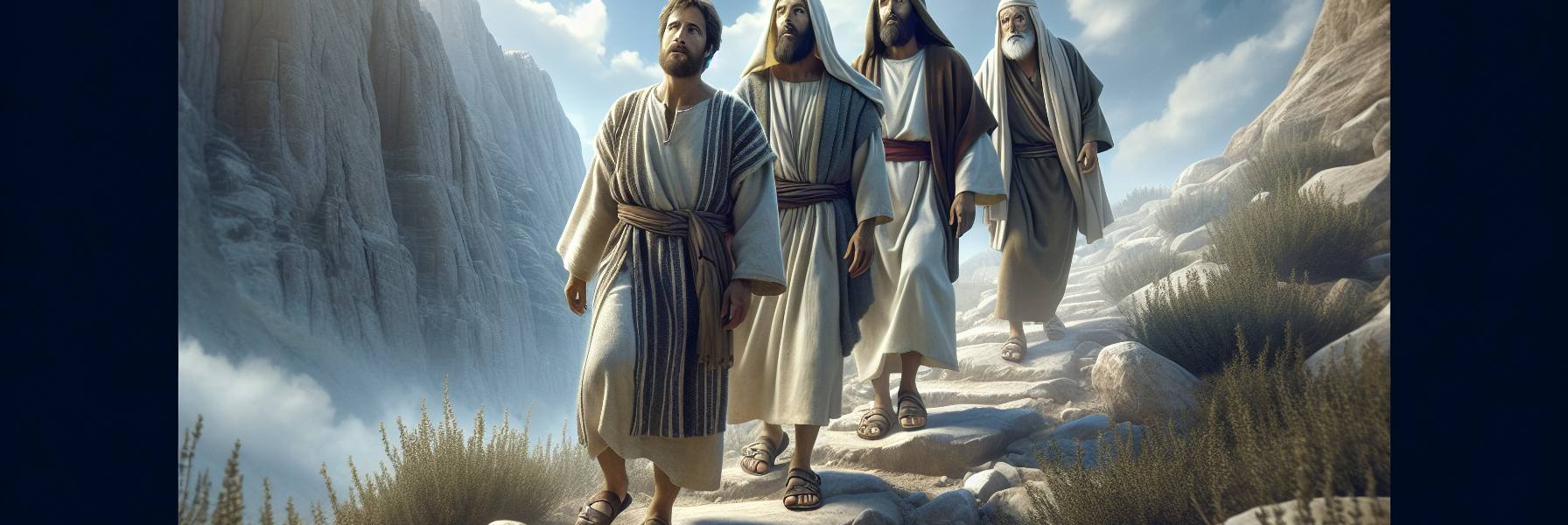
It began with the climb. Jesus led them—James, John, and him—up a high mountain. Not a gentle hill of wildflowers, but a steep, rocky thing that stole your breath and made your calves burn. They didn’t ask where they were going. They’d stopped asking months ago. The silence between them was companionable, filled only with the scuff of sandals on stone and the sigh of the wind through dry grasses. The lower slopes gave way to a sharper, cleaner air. Peter remembered the smell of thyme crushed underfoot.
Then, on the summit, as the world fell away below them in a haze of blue and brown, it happened. Not with a sound, but with a quality of light. Jesus was praying, his face turned toward the vast sky, and as he prayed, his appearance began to *change*. That’s the only word Peter could ever find. It wasn’t a glow around him; it was as if the very fabric of his ordinary robe, his sun-weathered skin, was being unraveled and rewoven with something purer than sunlight. His clothes became a white so brilliant, so fiercely clean, that no fuller on earth, no matter how skilled, could have bleached them. It was a white that hurt to look at, yet you couldn’t look away.
And then, they were there. Moses and Elijah. Peter didn’t know how he knew—he’d never seen a portrait of either—but the knowledge was absolute, thrumming in the charged air. They were talking with Jesus. Their forms were solid, real, yet seemed made of the same substance as the shimmering light. He caught fragments of speech, not in words his ear could hear, but in his spirit: “Exodus… Jerusalem… fulfillment.” They spoke of his departure, which he was about to bring to fulfillment at Jerusalem. The terror and the glory of it pressed down on Peter’s chest.
His mouth moved before his mind could catch up. It was always that way with him. “Rabbi,” he blurted out, his voice strangely loud in the supernatural stillness. “It is good for us to be here. Let us put up three shelters—one for you, one for Moses, and one for Elijah.” The words sounded foolish even as he said them. What was he thinking? Tents? For this? He was groping for something to do, some way to nail the moment down, to make it stay. He didn’t want it to end, this terrible, beautiful confirmation of everything he hoped was true.
He was still speaking when the cloud appeared. It wasn’t a weather cloud; it descended with purpose, enveloping them in a cool, thick mist that dimmed the blinding light. A deep, primal fear, older than thought, seized all three of them. This was the Shekinah, the dwelling presence of the Holy One. And then the Voice. Not a sound from a throat, but a vibration in the bones, in the stones under their feet, in the marrow of the sky itself: “This is my Son, whom I love. Listen to him!”
Then, as suddenly as it began, it was over. The cloud evaporated. The light was gone. Moses and Elijah were nowhere. It was just Jesus, alone, looking as he always did, perhaps a little tired around the eyes. He walked over and touched Peter’s shoulder, then James and John, who were face-down on the ground, trembling. “Get up,” he said, his voice wonderfully, ordinarily human. “Don’t be afraid.” And as they lifted their heads, blinking, they saw no one but Jesus.
The walk down was quieter than the walk up. Jesus instructed them not to tell anyone what they had seen until after the Son of Man had risen from the dead. They obeyed, but they argued among themselves in whispers about what “rising from the dead” could possibly mean. The glory of the mountain made the idea of death seem impossible, yet the shadow of the cross had been in the conversation with Moses and Elijah.
When they reached the base, they found the other nine disciples surrounded by a large, agitated crowd and some arguing teachers of the law. A man broke from the crowd, his face etched with desperation. “Teacher,” he cried out to Jesus, “I brought my son to you. He is possessed by a spirit that robs him of speech. Whenever it seizes him, it throws him to the ground. He foams at the mouth, gnashes his teeth and becomes rigid.” The man’s voice broke. “I asked your disciples to drive it out, but they could not.”
Jesus looked at the crowd, then at his disciples. A profound disappointment, deeper than frustration, passed over his face. “You unbelieving generation,” he said, the words heavy with sorrow. “How long shall I stay with you? How long shall I put up with you? Bring the boy to me.”
They brought him. And as the boy approached, the spirit saw Jesus and immediately threw the child into a violent convulsion. He fell to the ground, rolling around, foaming at the mouth. It was a horrifying, public spectacle. The father watched, his hands clenched. “How long has he been like this?” Jesus asked.
“From childhood,” the man said, despair thick in his throat. “It has often thrown him into fire or water to kill him. But if you can do anything, take pity on us and help us.”
“‘If you can’?” Jesus repeated, his gaze locking onto the man’s. “Everything is possible for one who believes.”
The father’s cry was immediate, torn from the very core of his being. It was the prayer of every broken person who has ever reached for hope. “I do believe; help me overcome my unbelief!”
Seeing the crowd was running to the scene, Jesus rebuked the impure spirit. “You deaf and mute spirit,” he commanded, “I command you, come out of him and never enter him again.” The spirit shrieked, convulsed the boy violently one last time, and came out. The boy lay so still that many in the crowd whispered, “He is dead.” But Jesus took him by the hand, lifted him to his feet, and the boy stood, whole and quiet, the terrible tension gone from his limbs, a dazed peace in his eyes.
Later, in the privacy of a house, the nine asked Jesus privately, “Why couldn’t we drive it out?” His answer was simple, a lesson that would take a lifetime to learn. “This kind can come out only by prayer.” Not by technique, not by borrowed authority, but by the raw, dependent connection to the Father. The mountain-top glory and the valley’s desperate battle were part of the same story.
The rest of the journey to Capernaum was filled with Jesus teaching them, his words now carrying the afterglow of the mountain and the authority of the valley. He spoke of betrayal, of death, of rising again. They didn’t understand, but they were afraid to ask. Instead, they argued on the road about which of them was the greatest. The pettiness of it, after all they had witnessed, was a different kind of darkness.
Sitting down in the house, Jesus called the Twelve. “Anyone who wants to be first must be the very last, and the servant of all.” He brought a small child, one of those always underfoot in such households, and stood the little one among them. Taking the child in his arms, he said, “Whoever welcomes one of these little children in my name welcomes me; and whoever welcomes me does not welcome me but the one who sent me.”
John, hesitant, spoke up. “Teacher, we saw someone driving out demons in your name and we told him to stop, because he was not one of us.”
Jesus’s response was gentle but firm. “Don’t stop him. For no one who does a miracle in my name can in the next moment say anything bad about me. Whoever is not against us is for us.”
The lessons tumbled out, one after another, like stones marking a path: about causing others to stumble, about cutting away whatever leads you from the kingdom, about being salted with fire, and preserving the peace that is your salt. It was a lot. Too much, perhaps.
Peter would remember it all in pieces—the blinding light, the feel of the boy’s rigid limbs in his memory, the weight of the child Jesus held, the taste of dust from the road. It didn’t fit together neatly. The Messiah who shone with the uncreated light was the same man who spoke of service, of death, of picking up a child. The faith that moved mountains was the same as the desperate, honest cry: “Help my unbelief.” It was a mystery, and Peter, the fisherman, learned to live inside it, trusting not the clarity of explanation, but the person who had called him from his nets, and who, on a mountain top, had been revealed, for one staggering moment, as the very heart of God.