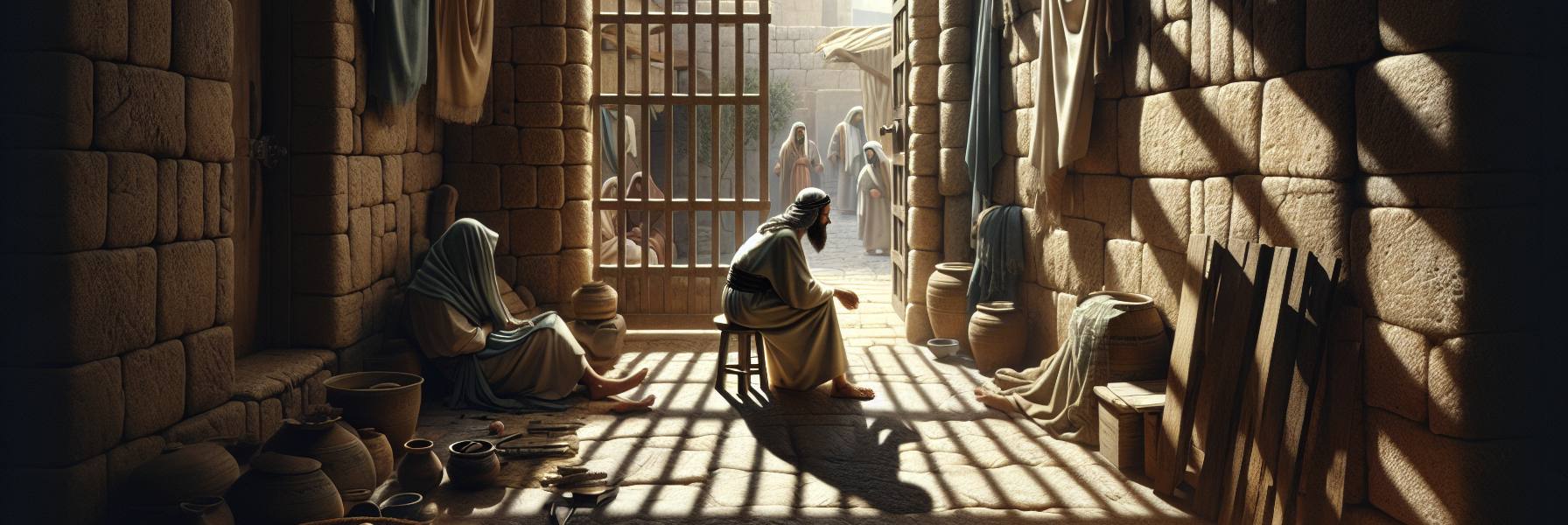

The heat had settled into the stones of Bethlehem, a heavy, woolen blanket by late afternoon. Levite. The title meant little here in Judah, away from the hill country of Ephraim that was his home. He shifted on the small stool in the doorway of his father-in-law’s house, watching the long shadows stretch across the courtyard. His concubine was inside, her silence a louder presence than any quarrel. The word between them was a cold thing. She had left him, fled back to this, her father’s house. Pride had kept him away for four months, but a hollow sort of yearning, mixed perhaps with a sense of possession, had drawn him south to speak tenderly to her, to bring her back.
Her father had been effusive in his welcome, a balm to the awkwardness. For three days they ate and drank, the old man’s joy at reconciliation seeming to fill the clay vessels with more wine, the platters with more meat. On the fourth morning, the Levite rose early, intent on the journey home. But the father clasped his wrist. “Strengthen your heart with a morsel of bread,” he urged, and the sun climbed as they ate. It became a pattern. A fifth day dawned, and again the Levite made to leave, and again the father detained him. “Please, spare the day.” They ate and drank, the afternoon dissolving into a languid, wine-softened evening.
On the fifth afternoon, the Levite stood, firm. Sunset was staining the west when he finally set out with his concubine and a lone, laden servant, the two donkeys’ hooves clopping a slow rhythm on the stony path. The road north was empty. A sense of lateness pressed upon him. By the time the walls of Jebus—a city of foreigners, Jebusites—loomed dark against the twilight, the last of the light was leaching from the sky.
The servant cleared his throat. “Master, let us turn aside into this city of the Jebusites and spend the night.”
The Levite shook his head, a sharp motion. “We will not turn aside into a foreign city, where there are no people of Israel. We will press on to Gibeah, or perhaps to Ramah.” It was a decision born of tribal pride, and perhaps fear. He would rather be among Benjaminites, his own kin, however late the hour.
They pushed the tired animals on. The dark was complete now, a velvety blackness pierced only by their small lamp’s guttering flame. It was deep night when they entered Gibeah of Benjamin. They sat in the open square of the city, waiting by the public well, but no one took them in. The cold of the night stone seeped into their bones. It was a profound, unsettling neglect; the law of hospitality was a sacred thread in the fabric of their world, and here it had snapped.
Finally, an old man came in from his work in the fields, his steps slow with weariness. He, too, was from the hill country of Ephraim, though he lived here now as a sojourner. His eyes, rheumy in the lamplight, took in the forlorn little group. “Where are you going?” he asked, his voice scratchy with age. “And where do you come from?”
The Levite poured out their tale: the journey from Bethlehem, the decision to bypass Jebus, the hope for shelter here among Benjaminites. “We have fodder and straw for our donkeys, and bread and wine for ourselves,” he finished, a note of desperation thinning his voice. “We lack only a place to lodge.”
The old man’s face softened. “Peace to you,” he said. “I will care for all your needs. Only do not spend the night in the square.” He led them to his modest house, untying the donkeys himself, bringing water to wash their dusty feet. They were just beginning to relax, to feel the warmth of a shared meal, when the sound began.
It started as a murmur, then grew into a clamor—the noise of many men surrounding the house. A pounding fist rattled the door. The old man went to the shutter, peering out into the hostile dark.
“Bring out the man who came to your house,” a voice, thick and slurred, demanded. “That we may know him.”
The old man stumbled back, his face ashen. He went out to them, pulling the door shut behind him. “No, my brothers, do not act so wickedly,” he pleaded. “Seeing this man has come into my house, do not commit this outrage. Here is my virgin daughter, and his concubine. Let me bring them out to you. Humble them, do what seems good to you; but against this man do not do this vile thing.”
The silence from inside the house was absolute. The Levite sat frozen, hearing the offer. His own heart hammered against his ribs. The noise outside swelled, ugly and insistent. Then, with a movement that felt like someone else was moving his limbs, he stood. He seized his concubine by the arm, his grip tight. He opened the door, thrust her out into the press of men, into the torch-lit frenzy of their faces, and shut the door again. The thud of the wooden bar falling into place was the loudest sound he had ever heard.
The night wore on in that shut-up house. There were sounds from the square, terrible sounds, but they seemed to come from a great distance. The old man wept silently in a corner. The servant stared at the floor. The Levite did not move from his seat by the dead fire. When the first grey light touched the shutter slats, he rose, his joints stiff. He opened the door. The cool morning air rushed in.
She was there, crumpled on the threshold of the house, her hands flung out, her fingers curled against the stone. Her clothes were torn. He looked down at her and said, “Get up. We must be going.” There was no answer. A strange, practical thought entered his mind: they had far to travel. He bent, and his hands found no life in her. He lifted her, her form limp and heavy, and placed her across one of the donkeys. He did not look at her face.
The journey home was a blank space in his memory, a white-hot stretch of road under a pitiless sun. When he reached his house in Ephraim, he carried her inside. Then, with a knife used for sacrificing, he took her. He divided her, limb by limb, into twelve pieces. He sent them throughout all the territory of Israel by the hands of messengers. Each piece, a raw and bloody summons.
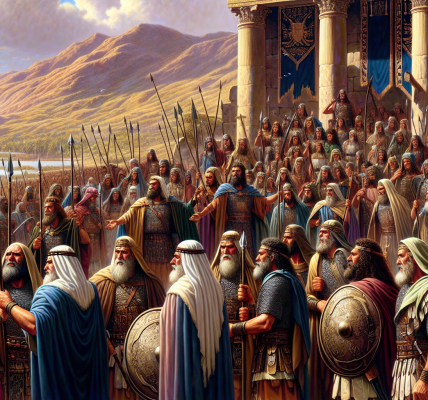
Where the pieces arrived, a great cry went up. People gathered, their voices a single, horrified question: “Has such a thing ever happened since the day the Israelites came up from Egypt? Consider it, take counsel, and speak.”
And Israel, from Dan to Beersheba, stood as one. They knew, looking upon the awful evidence, that a line had been crossed in Gibeah that no law could erase, a story written not on scrolls, but on flesh. And the silence that followed the national cry was the silence before the storm.