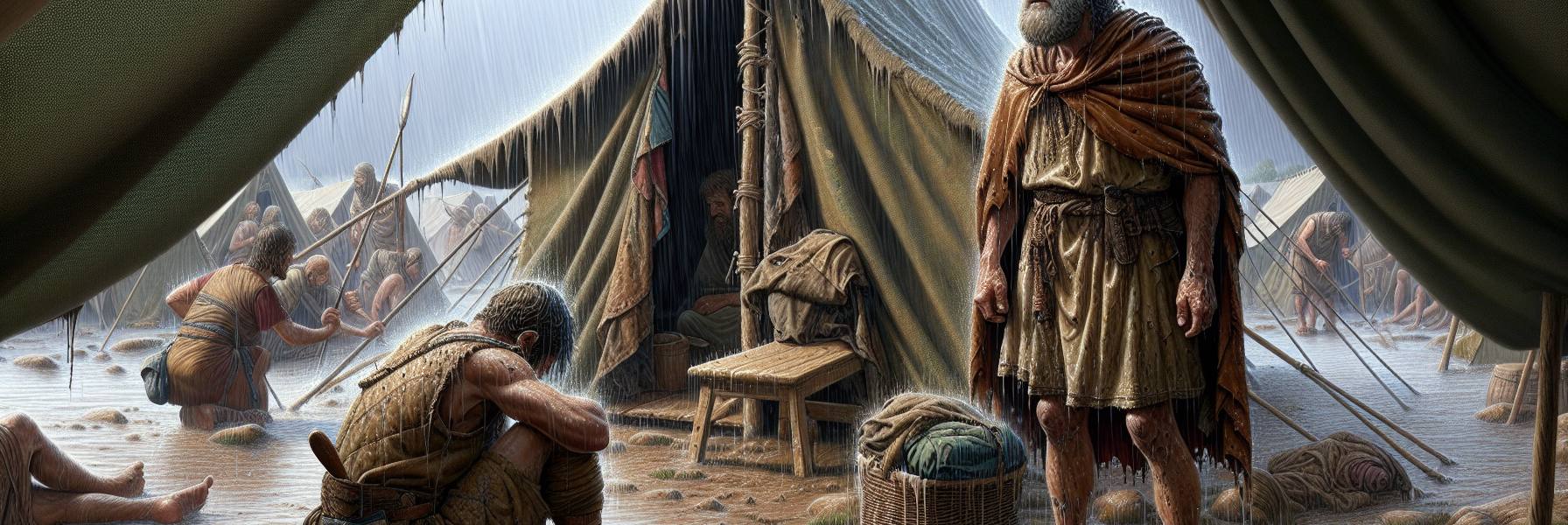

The rain had not stopped for three days. It was a cold, persistent rain, the kind that seeped into leather and wool, that turned the ground of the camp at Merom into a churning bog of mud and trampled grass. Joshua ben Nun stood under the sagging canopy of his tent, watching the water sheet off the hide. His knees ached, a deep, familiar complaint. He was not a young man. The memory of crossing the Jordan, of the stones piled at Gilgal, felt both immediate and a lifetime away.
A scout, mud-spattered and breathing hard, pushed through the flap. “They are gathered. All of them.”
Joshua nodded, his face like weathered stone. The reports had been trickling in for weeks. Jabin, king of Hazor, had not made the mistake of the southern kings. He had not come piecemeal. He had sent word, a call to arms across the whole of the north—to Madon, Shimron, Achshaph, and to the kings in the northern mountains and the plains east of the Sea of Kinnereth. He had even called upon the ancient peoples of the hills, the Hivites below Hermon. And the Canaanites, from east and west, had answered. A confederacy, not of rebellion, but of sheer, calculated obliteration. Their numbers, the scouts whispered, were like the sand on the seashore. And their chariots, iron-scythed and terrible, were beyond counting.
“Where?” Joshua’s voice was low, almost lost in the drumming rain.
“The waters of Merom. They camp there. The chariots are mired in the soft ground by the lake. It is… a vast sea of men and machines.”
A grim smile touched Joshua’s lips, so slight it was more a tightening of the skin around his eyes. The Lord had said, *Do not be afraid of them, for at this time tomorrow I will give all of them, slain, to Israel.* The promise was a fire in his belly, but the method was his to discern. Iron chariots on open ground were a death sentence. But here, in the sodden hills, by the waters made swollen by this very rain…
He called the commanders. Their faces were tense, shadows under their eyes. He laid out the plan not as a divine oracle, but as a gritty, tactical necessity. A forced night march. Through this cursed rain. Over the slick, hidden paths of the hills. To come upon them at dawn, from the heights, before the chariots could be extricated and formed for battle.
“We will not fight the chariots,” Joshua said, his words cutting through the worried silence. “We will destroy the men who drive them. Strike the horse, and the chariot is a burden. Hamstring every animal. Burn every cursed vehicle.”
The march was a trial of darkness and misery. No torches. Only the squelch of feet, the muffled curses as men slipped on roots, the constant, cold kiss of the rain. The weight of wool cloaks, soaked through, doubled. Joshua moved among them, an old wolf leading the pack, his silence more compelling than any speech. They trusted him. They trusted the God who went before him.
Dawn came not with light, but with a pale, grey lifting of the darkness. The Canaanite camp sprawled below them beside the metallic glint of the lake, a confused anthill of men stirring to a wet morning. The chariots stood in disordered ranks, their wheels sunk to the axles in the mud. There was no warning trumpet. Just a sound that began as a low rumble and grew into a roaring wave—the sound of thousands of voices crying out to the Lord, and the terrible, descending rush of Israel from the hillsides.
It was not a battle; it was a divinely-wrought avalanche. The confederacy shattered upon first impact. Men ran, not to form lines, but to flee. The charioteers, the pride of the north, were cut down as they struggled to untether their beasts. Joshua’s men, their exhaustion burned away in the fury of the moment, moved with a terrible efficiency. The sharp, sickening cries of horses mingled with the shouts of war. Smoke began to rise, thick and black, as the prized iron chariots were put to the torch, the acrid smell of burning wood, paint, and hide clotting the wet air.
Joshua himself led the pursuit. He felt the years fall away, the fire of the Lord in his muscles. They chased them west to Greater Sidon, east to the valley of Mizpah. No city offered sanctuary. The terror of the Lord had gone before them, and gates were shut against their own fleeing allies. Every man, as the Lord had commanded Joshua, was put to the edge of the sword until none remained breathing.
Then, they turned to Hazor.
It stood atop its mound, the greatest of all these kingdoms, a city that had seen empires rise and fall. Jabin’s capital. Its walls were formidable, but its spirit was broken. Its army was already ashes by the waters of Merom. The siege was short, a formality of relentless pressure. When the walls were breached, Joshua gave a specific order. Hazor was to be made an example. Not for plunder, not for occupation. It was to be a testament.
They took the city. They put every soul to the sword. Then they brought fire. They burned Hazor to the ground. Joshua himself stood and watched as the great citadel of the northern confederacy was consumed, the flames leaping high into the twilight, a pillar of fire for all the land to see. It was a harsh decree, a fulcrum of holiness and judgment that he did not fully fathom, but he obeyed. This was the command of Moses, and of the Lord who had given the land.
The work was methodical, thorough, and wearying. City after city fell. Some kings they chased down; others were brought from their hiding places. Joshua’s men grew hard and lean, their movements precise. They hamstrued horses, they burned chariots, they overthrew walls and left smoldering ruins. But they did not take every city. The great, fortified cities on their mounds, like those of the Philistines, stood untouched. The hill country was subdued, but the coast remained, a reminder that the work was both complete and ongoing.
Years later, an old man sat in the shade of his tent at Timnath-serah, in the land of his inheritance. The ache in his knees was constant now. The sound of battle was a memory, replaced by the lowing of cattle and the chatter of his grandchildren. He thought of the sand-like armies, of the rain at Merom, of the pillar of smoke that was Hazor. The land, finally, had found rest from war. It had been a terrible, necessary gift. A gift purchased not by the edge of the sword alone, but by the faithfulness of the One who had promised it. He had done it. The Lord had given them the land, every bit of it. And as the sun set in a peaceful, quiet sky, Joshua found that the memory of the promise was sweeter than the memory of the victory.