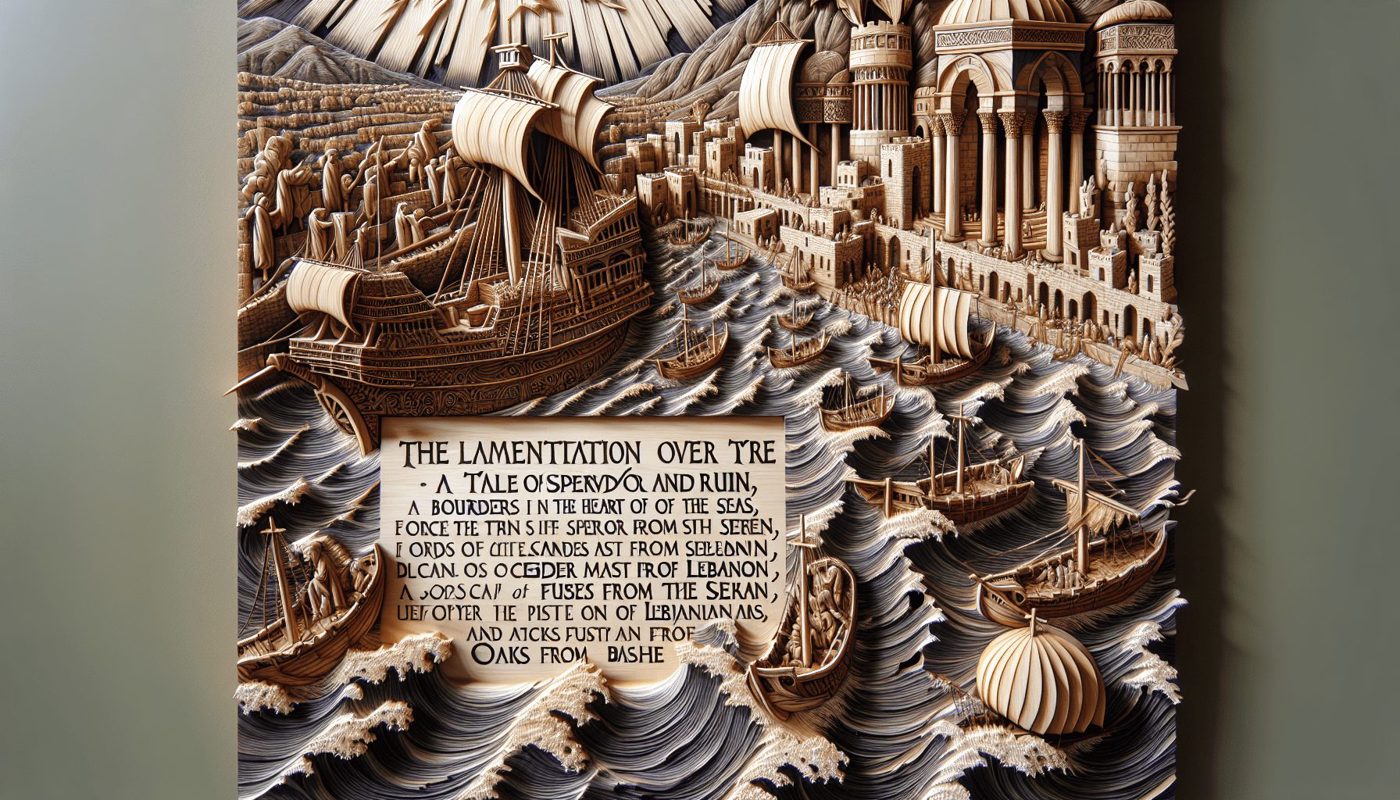
The word of the Lord came to Ezekiel, and he was told to take up a lamentation over Tyre. The city that called itself perfect in beauty, that sat at the entry of the sea and traded with many isles, was about to hear its own funeral song. The Lord did not send a war oracle or a promise of restoration. He sent a lament, spoken before the ruin had fully come, as if the city were already dead.
Ezekiel described Tyre as a ship. Its planks came from the fir trees of Senir, its mast from a cedar of Lebanon. The oars were cut from the oaks of Bashan, and the benches were inlaid with ivory from the isles of Kittim. The sail was fine embroidered linen from Egypt, and the awning was blue and purple from the isles of Elishah. The city was built like a vessel meant to ride the seas in splendor, and every detail was chosen for beauty.
The rowers came from Sidon and Arvad. The pilots were Tyre's own wise men. The old men of Gebal were the caulkers, sealing the seams. Every ship of the sea brought its mariners to deal in Tyre's merchandise. The city was not alone in its glory; it was staffed by the skilled men of many coasts, all contributing to the perfection Tyre claimed for itself.
Persia, Lud, and Put supplied the army. They hung their shields and helmets on Tyre's walls, adding to its comeliness. The men of Arvad stood on the walls round about, and the valorous men manned the towers. Tyre's beauty was not only a matter of trade goods; it was a military display, a show of strength that the city thought would never end.
The list of merchants reads like a catalog of the known world. Tarshish traded silver, iron, tin, and lead. Javan, Tubal, and Meshech traded slaves and vessels of bronze. Togarmah brought horses and mules. Dedan brought ivory and ebony. Syria traded emeralds, purple, embroidered work, fine linen, coral, and rubies. Judah and Israel brought wheat, honey, oil, and balm. Damascus brought wine and white wool. Sheba and Raamah brought spices, precious stones, and gold. Every nation that had anything of value sent it to Tyre.
The ships of Tarshish were the caravans that carried this wealth. Tyre was replenished and made very glorious in the heart of the seas. But the rowers brought the ship into great waters, and then the east wind broke it. The Lord did not send a foreign army in this vision. He sent a wind, and the perfect ship shattered.
In the day of ruin, everything fell into the heart of the seas. The riches, the wares, the merchandise, the mariners, the pilots, the caulkers, the dealers, the men of war, the whole company—all of it sank. The city that had been built like a ship went down like one, and the waters closed over it.
The pilots cried out, and the suburbs shook. The mariners came down from their ships and stood on the land. They cried bitterly, cast dust on their heads, and wallowed in ashes. They made themselves bald and put on sackcloth. They wept with bitter mourning and took up a lamentation of their own: Who is like Tyre, brought to silence in the midst of the sea?
The merchants among the peoples hissed at Tyre. The city became a terror. The kings of the isles were horribly afraid, and their faces were troubled. Tyre had enriched them all, and now it was gone. The lament that began as a command from the Lord ended as a universal shock. The city that was perfect in beauty had no being left.
Comments
Comments 0
Read the discussion and add your voice.
Members only
Sign in to join the conversation
We keep comments tied to real accounts so the discussion stays clean and trustworthy.
No comments yet. Be the first to add one.