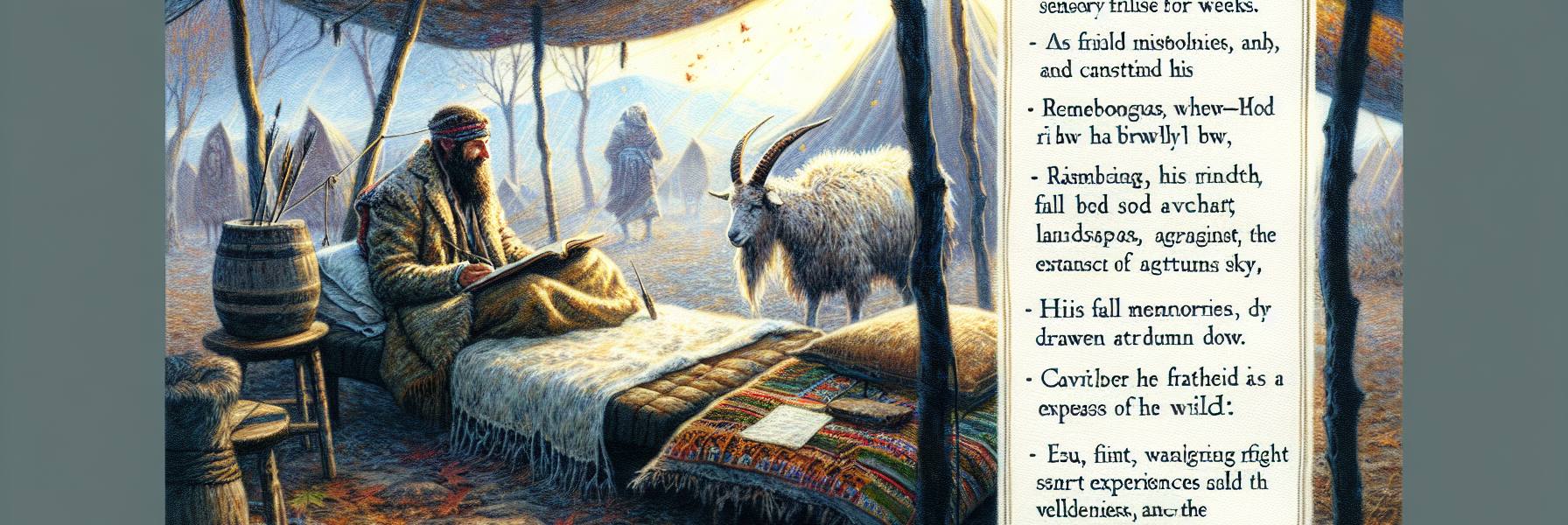

The tent smelled of old wool, of dust, of the slow, persistent scent of sickness. Isaac lay on his bed, the fine weave of the goat-hair fabric beneath him grown familiar through weeks of stillness. His world had narrowed to sound and touch and memory. The vibrant sweep of the Negev, the feel of a well-drawn bow, the memory of his father’s face against a sky rent by faith—these were receding now, softened at the edges like stones in a fading stream. All that remained sharp was the internal landscape: a promise, a blessing, and a deep, unspoken craving for a taste of the wild.
“Esau,” he said, and his voice was a dry rustle in the dimness. “My son.”
“I am here, Father.”
Isaac could hear the shift of his son’s weight, could sense the outdoors still clinging to him—the faint, clean scent of cold air and dried sweat. “Take your gear, your quiver and bow. Go out to the open country and hunt some wild game for me. Prepare me the kind of tasty food I love. Bring it to me to eat, so that I may give you my blessing before I die.”
A swift movement, the clatter of tools gathered. Then silence, and Isaac knew he was alone again. The blessing. It was not a mere wish. It was a conveyance, the last great transaction of his life, the passing on of the covenant forged in fire with his father Abraham. It belonged to the firstborn. It belonged to Esau. His rough, capable son, a man of the field. Isaac settled into his pillows, the decision a comfort. He would eat, and then he would speak the words that would set the future in stone.
Outside, Rebekah had been listening. The goat-hair partition was no barrier to a woman who had spent a lifetime deciphering the moods of her household. She stood perfectly still, her hands buried in a bowl of meal she was no longer kneading. A cold clarity washed over her. Years ago, when the twins struggled within her, she had sought an oracle. *Two nations are in your womb… the older will serve the younger.* The words had never left her. They sat in her heart like a polished stone, heavy and undeniable. Isaac, in his darkness, was choosing to forget. She would not.
She found Jacob at the back of the encampment, tending to the penned lambs. “Your father,” she said, her voice low and urgent, “has sent your brother for venison. He means to bless him before the Lord. Now, my son, listen carefully. Do exactly as I tell you.”
Jacob’s face, so like her own in its delicate structure, paled. “But Esau is a hairy man, and I am smooth-skinned. What if my father touches me? He will think I am trying to mock him, and I will bring a curse on myself, not a blessing.”
His fear was practical, born of a younger son’s caution. Rebekah’s was of a higher, fiercer order. “Let the curse fall on me, if it comes to that,” she said, her words biting the air. “Just do as I say.”
She moved with a terrifying efficiency. Selecting two fine young goats from the flock, she slaughtered and skinned them, her hands sure and quick. The meat she seasoned and cooked, the way Isaac loved it, rich with herbs and memory. Then she took Esau’s best clothes, stored in her own tent, and the smell of her eldest son—the scent of open fields and myrrh—rose from the fabric. She draped them on Jacob’s slender frame, the garments hanging loose on his different build. Finally, she took the goatskins and bound them over his hands and the smooth nape of his neck. The feel was grotesque, a crude imitation.
“Now,” she instructed, placing the stew and fresh bread into his trembling hands. “Go to your father.”
Jacob drew a shaky breath. The deception was a physical weight. He stepped into the gloom of his father’s tent, the savory smell of the stew cutting through the stale air. “My father,” he said.
Isaac stirred. “Yes, my son. Who is it?”
The lie, once begun, had to be clothed in confidence. “I am Esau, your firstborn,” Jacob said, forcing the words out. “I have done as you told me. Please sit up and eat some of my game, so that you may give me your blessing.”
Isaac’s milky eyes seemed to search the space before him. “How did you find it so quickly, my son?”
“The Lord your God gave me success.” The holy name on his lying tongue felt like a burn.
A long pause. Isaac’s head tilted, listening to more than the words. “Come near so I can touch you, my son. Are you really my son Esau or not?”
Jacob approached, extending his arms, the rough goatskin brushing against his father’s searching fingers. Isaac’s hands moved slowly, patting the fleece-covered arms. The voice, it was Jacob’s voice. But the touch… the touch was wrong, and yet right. It was like Esau. The clothes smelled of Esau.
“The voice is the voice of Jacob,” the old man murmured, almost to himself, “but the hands are the hands of Esau.” He was at the cliff’s edge of doubt. But the sensory evidence—the potent smell of the fields on the robes, the hairy pelt of the hunter—pushed him over. “Are you really my son Esau?”
“I am.”
“Then bring me some of your game to eat, my son, so that I may give you my blessing.”
Jacob served him, and brought him wine. Isaac ate and drank. The meal was a sacrament of deceit. When he was finished, he said, “Come here, my son, and kiss me.”
Jacob bent and kissed him. Isaac breathed in deeply the scent of the open country on the stolen clothes. And then, his doubt finally stilled, he began to speak. The words were not just words. They were a weather system forming in the tent, a shift in the spiritual atmosphere. They spoke of dew and abundance, of grain and new wine. They spoke of nations bowing, of brother serving brother. They were the blessing, irrevocable, poured like costly oil over the head of the wrong son.
Jacob had scarcely left the tent, his heart a frantic drum against his ribs, when Esau returned. The real venison was prepared with the same care, brought to the old man with the easy stride of a rightful heir. “Let my father arise and eat of his son’s game,” he boomed, “that you may give me your blessing.”
The silence that followed was terrible. Isaac began to tremble, a fine, uncontrollable shaking that seemed to start in his soul. “Who… who are you?”
“I am your son,” Esau said, confusion edging into his voice. “Your firstborn, Esau.”
Then Isaac knew. The trembling became a great shudder. “Your brother came deceitfully and took your blessing.” The admission was an agony.
Esau’s cry was raw, a sound of profound and animal loss. “Bless me—me too, my father!”
“He has taken your blessing, my son.”
“Haven’t you reserved any blessing for me?” The big man was begging, his world crumbling.
Isaac, emptied, could only state the bleak truth he had enacted. “I have made him lord over you. With grain and new wine I have sustained him. What then can I possibly do for you, my son?”
The blessing he finally spoke over Esau was a shadow of the first. It spoke of a dwelling away from fertility, of living by the sword, of serving a brother until a distant, uncertain day of breaking a yoke. It was a blessing of the second order, a life defined by absence.
Esau left his father’s presence seething, not just at Jacob, but at the universe that had allowed this theft. The bitterness took immediate, murderous shape. “The days of mourning for my father are near,” he said to himself, the words a grim vow. “Then I will kill my brother Jacob.”
In her tent, Rebekah heard of this too. The prophecy was fulfilled, but its fulfillment had the taste of ashes and blood. The stone of the oracle had dropped, shattering the peace of her house. She had secured the promise, but the cost was now breathing down their necks, carrying a knife. The silence that fell over the camp that evening was not peaceful. It was the silence of a fracture, deep and irreparable, waiting for the long, weary years of exile and fear to begin. The tent still smelled of old wool, and dust, and cooked meat. And now, of betrayal.