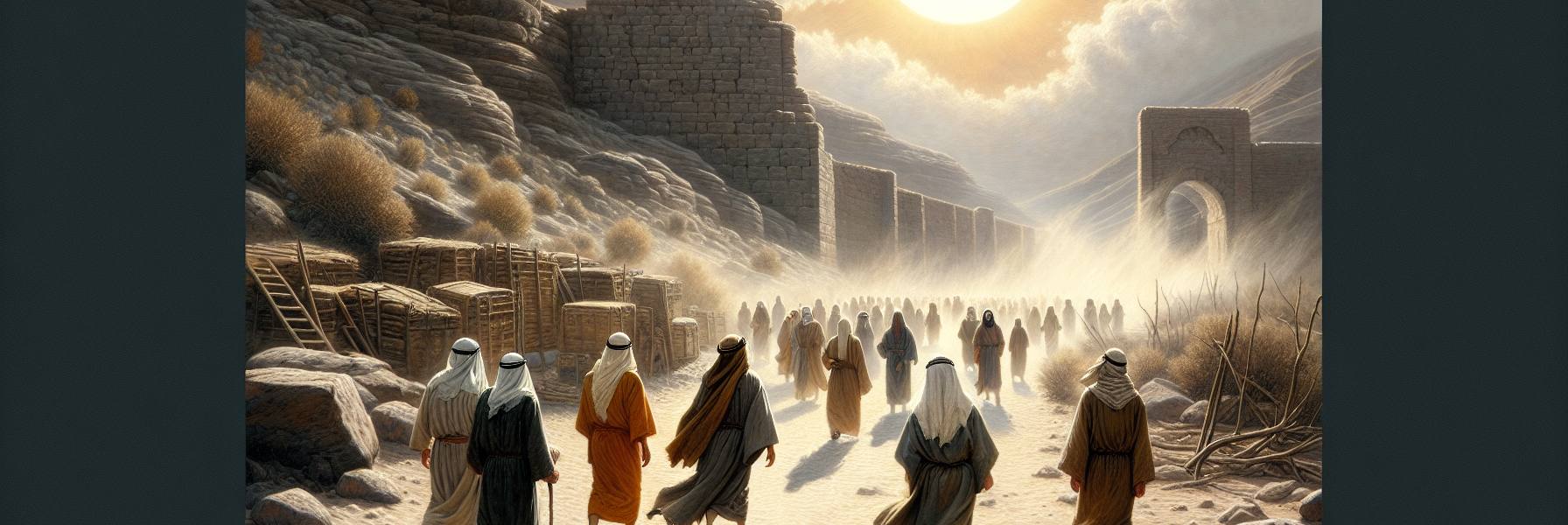

The sun, a pale white coin in a bleached sky, burned over the dusty road to Gennesaret. It was the kind of heat that made the air over the stones shimmer and stole the breath from your lungs. Jesus walked ahead, his sandals kicking up little puffs of pale dust that settled on the hem of his robe. The disciples followed, a loose knot of tired men, the debate from Jerusalem still hanging around them like the haze.
They’d come north to get away, or that’s what Peter had muttered to Andrew. Jerusalem had been a knot of scrutiny, of cold eyes watching from under the brims of prayer shawls. A delegation of Pharisees and scribes had found them, not to listen, but to audit. Peter could still see their faces, pinched with a disapproval that felt colder than shadow.
“Why do your disciples break the tradition of the elders?” the lead Pharisee had said, his voice a careful instrument. “They do not wash their hands before they eat.”
It hadn’t been about hygiene. It was about a hundred little fences built around the Law, rules upon rules to keep a person ceremonially clean. The way the man said it—*tradition of the elders*—made it sound ancient and unassailable. Jesus had been quiet for a moment, looking at them not with anger, but with a weary sadness, as if he saw right through their polished piety to the hollow center.
“And why do you break the command of God for the sake of your tradition?” he’d answered, his voice cutting through the formal air. He’d told them about Corban, the religious vow people used to avoid helping their parents. “You nullify the word of God,” he said, “for the sake of your tradition.” Then he’d turned, not just to the Pharisees, but to the crowd that had gathered, people with hopeful, hungry faces smudged with the grime of living.
“Listen and understand,” he’d called out, his voice carrying. “What goes into someone’s mouth does not defile them, but what comes out of their mouth, that is what defiles them.”
Peter remembered the shock that ran through the crowd, a physical ripple. It was like turning the world upside down. For so long, purity was about what you touched, what you ate, the meticulous rituals. And here he was, pointing a finger at the heart.
Later, when they were away from the crowds, Peter, ever the one to charge in where angels might hesitate, had fumbled, “Explain the parable to us.”
Jesus had sighed, a sound of genuine frustration. “Are you still so dull?” But his tone wasn’t cruel; it was the tone of a teacher with a student who keeps missing the point. “Don’t you see that whatever enters the mouth goes into the stomach and then out of the body?” He spoke of food, of digestion, things simple and physical. “But the things that come out of the mouth,” he said, his voice dropping, intent, “come from the heart, and these make a man ‘unclean.’ For out of the heart come evil thoughts—murder, adultery, sexual immorality, theft, false testimony, slander. These are what defile a person; but eating with unwashed hands does not.”
The words had sat with them, heavy and revolutionary, as they left Jerusalem behind. They were still chewing on it as they trudged into the region of Tyre and Sidon. The air changed here; it smelled of salt and pine, a foreign smell. They were in Gentile land.
In a small, whitewashed house at the edge of a village, Jesus sought solitude. It didn’t last. News, it seemed, had a life of its own, scurrying ahead of them on dusty roads and through market squares.
She found him. A Canaanite woman, her face lined with a worry so deep it looked carved. Her clothes were different, her accent thick and guttural to their ears. She pushed through the disciples who tried, with awkward gentleness, to block her way. “Lord, Son of David!” she cried, her voice raw. “Have mercy on me! My daughter is suffering terribly from demon-possession.”
The disciples were irritated. The heat, the journey, the theological upheaval, and now this—a Gentile woman causing a scene. “Send her away,” they urged Jesus. “She keeps crying out after us.”
Jesus was silent for a long moment, looking at her. When he spoke, his words sounded strange, harsh even. “I was sent only to the lost sheep of Israel.”
But the woman didn’t flinch. She came closer, right to his feet, and knelt in the dust. “Lord, help me,” she said, the words simple and desperate.
He looked down at her, and his next words seemed even harder. “It is not right to take the children’s bread and toss it to the dogs.”
Peter winced. It was the kind of thing a strict rabbi might say, putting the Gentiles in their place. But the woman didn’t get up. She didn’t protest the label. Instead, a spark lit in her eyes, a brilliance of sheer, stubborn faith. “Yes, Lord,” she said, her voice suddenly clear and firm. “But even the dogs eat the crumbs that fall from their masters’ table.”
Then Jesus did something Peter would remember for the rest of his life. He smiled, a real, wide smile that crinkled the corners of his eyes. He reached out, not to shoo her away, but as if to welcome her. “Woman,” he said, his voice now warm as sun-warmed stone, “you have great faith! Let it be done for you as you wish.”
And it was. They learned later her daughter was healed from that very hour. The woman left, her step light, her face transformed. The disciples stood there, humbled. The teacher who spoke of the heart’s defilement had just shown them its opposite: a faith so clean, so sharp, it came from a heart they had been taught to overlook.
They traveled on, back toward the Sea of Galilee, climbing to a high, sparse plateau overlooking the water. The crowds found them again—great multitudes of people, the lame, the blind, the mute, the maimed. They laid them at his feet, and he healed them all. The sound that rose wasn’t cheers, but something deeper: a collective sigh of relief, a rustle of wonder.
They’d been there three days. The food was gone. People were weak, far from home. Jesus called his disciples over. His compassion was a tangible thing. “I have compassion for these people; they have already been with me three days and have nothing to eat. I do not want to send them away hungry, or they may collapse on the way.”
The disciples looked at the vast, hungry crowd, then at each other. The old anxiety surfaced. “Where could we get enough bread in this remote place to feed such a crowd?”
“How many loaves do you have?” Jesus asked.
A quick check. “Seven,” someone said. “And a few small fish.”
Jesus told the crowd to sit down on the dry grass. He took the seven loaves and the fish, gave thanks, broke them, and gave the pieces to the disciples, who began to distribute them. Peter’s hands were full, then empty, then full again. It made no sense. The bread was coarse and barley, but it was warm, and it kept coming. The fish, dried and salted, broke into fragments that multiplied between his fingers. He stopped thinking and just moved, handing food to outstretched hands, seeing the shock on faces turn to gratitude, then to a quiet, seated satisfaction.
When everyone had eaten, they gathered the leftover pieces. Seven basketfuls. Not twelve, like before. Seven. A number of completeness, in a Gentile region, after a lesson on the true source of defilement and a demonstration of faith from a foreign heart.
Jesus sent the crowds away, finally. They left slowly, talking in low, amazed tones, their bodies nourished, their minds full of things they couldn’t quite explain. Jesus stood watching them go, a solitary figure against the vast sky. Then he turned, and with the disciples, got into a boat. The water of the sea was turning violet in the late afternoon light. As they pushed off from the shore, no one spoke. The only sounds were the creak of the wood, the dip of the oars, and the gentle lap of water against the hull. The words from Jerusalem, the woman’s brilliant reply, the endless bread—it all swirled together, not as a doctrine, but as a new and unsettling rhythm in the world, beating in time with the oar-strokes taking them toward an unknown shore.