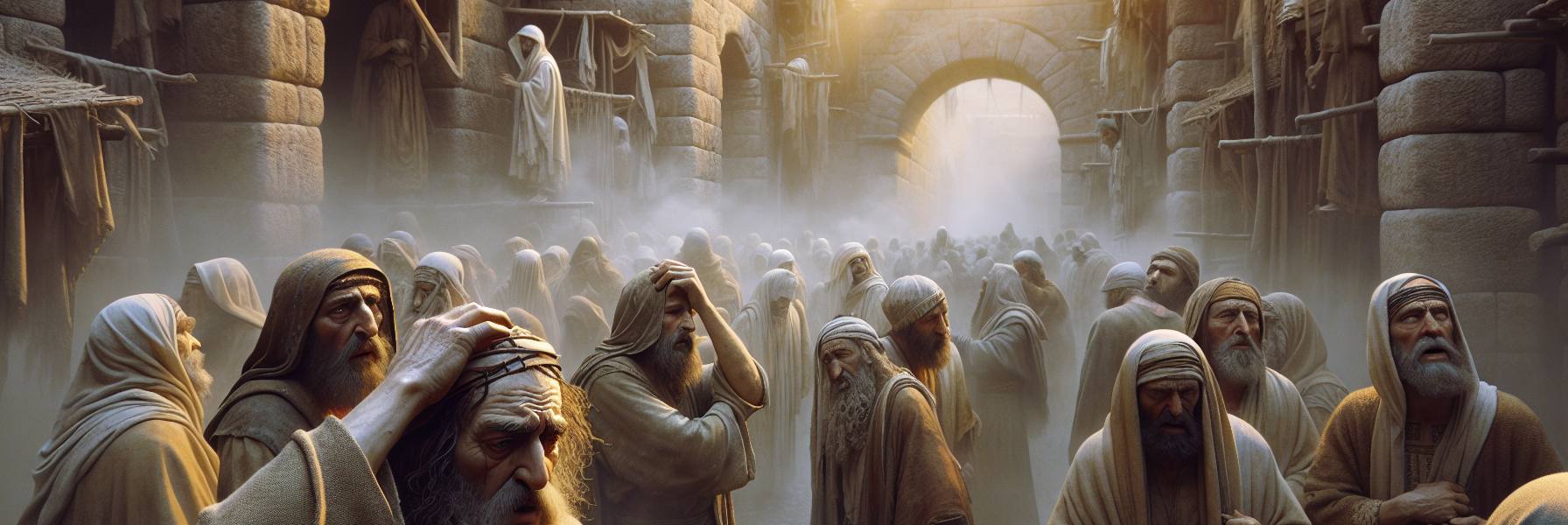

The heat in Jerusalem that summer was a physical presence. It didn’t just hang in the air; it pressed down on the stone, seeped into the shaded alleyways, and made the very dust of the streets feel like grit in a kiln. We moved through it slowly, like men wading through deep water. My uncle, Jedaiah, was among them, a leader of the elders, his brow perpetually damp beneath his linen headcloth. There was a new tension in his face, a pinched look around the eyes that had nothing to do with the sun.
“We will go to the prophet,” he had said that morning, his voice low. “To Ezekiel, in his house by the canal.”
The others had nodded, a silent, grim consensus. It wasn’t enthusiasm that drove them, but a kind of desperate formality. Things were unraveling. Nebuchadnezzar’s shadow grew longer with each passing season, and the whispers from back-alley prophets—promises of deliverance, of a swift breaking of the Babylonian yoke—rang hollow even as they were spoken. Ezekiel was different. He said nothing anyone wanted to hear. His words were hard, strange, and full of dreadful theatre. But he was, undeniably, a man who stood before the Holy One. So we went, a solemn little procession through the oppressive noon, to the exiled quarter.
Ezekiel’s dwelling was modest, the main room cool and dim after the glare outside. He sat on a simple mat, his back straight, his gaze unsettling in its directness. He did not rise to greet the elders as they filed in, though he acknowledged them with a slight incline of his head. The respect his station demanded was given, but no more. The room smelled of dried clay and parchment.
My uncle and the others arranged themselves carefully, sitting with the practiced dignity of men accustomed to being heard. They began to speak of the situation—vague, worried words about the city, about the king in Babylon, about seeking a word from the Lord. Their language was pious, polished from years of use in the temple courts.
Ezekiel listened. He did not move. But as the last polite phrase faded into the still air, a change came over the room. It wasn’t something you could see, but you felt it, like a sudden drop in pressure before a storm. The prophet’s eyes, which had been merely attentive, now seemed to see *through* the fine wool of their robes, past the skin and bone, into the hidden chambers of their hearts.
When he spoke, his voice was quiet, yet it filled the space completely, leaving no corner for pretense to hide.
“Thus says the Lord God,” he began, and the ancient formula fell like a judge’s gavel. “Any man of the house of Israel who sets up his idols in his heart and puts the stumbling block of his iniquity before his face, and yet comes to the prophet—I, the Lord, will answer him myself in accordance with the multitude of his idols.”
I saw my uncle flinch, almost imperceptibly. The other men grew very still. *Idols in the heart.* The phrase was terrifying in its intimacy. This was not a denunciation of the crude teraphim hidden in a back room; this was an accusation of a deeper, more insidious architecture. Loyalties divided. Trust placed in alliances with Egypt, in secret diplomatic gambits, in the remembered glory of a kingdom that was now a ghost. A heart cluttered with little altars to security, to strategy, to pride.
“Therefore speak to them,” Ezekiel continued, his words measured and heavy, “and say to them, ‘Thus says the Lord God: Every one of the house of Israel who takes his idols into his heart… and then comes to the prophet, I the Lord will answer him as he comes, because of the multitude of his idols, that I may lay hold of the hearts of the house of Israel, who are all estranged from me through their idols.’”
The answer, then, would not be the oracle of hope they sought. It would be a mirror, a confrontation. The Lord would answer the idol, not the man, revealing the fatal crack in the foundation. The purpose was surgical, terrible: to seize the corrupted heart itself.
Then Ezekiel’s tone shifted, from the particular to the cosmic. He spoke of a land that sins, breaking faith. He spoke of four acts of judgment: sword, famine, wild beasts, plague. His words painted a stark, unyielding picture.
“Even if these three men, Noah, Daniel, and Job, were in it,” he said, naming paragons of righteousness from the deep past, men who stood alone for integrity, “they would deliver but their own lives by their righteousness.”
The air left the room. The idea was crushing. The accumulated merit of the righteous would not be transferable, not a currency to spare a faithless generation. Salvation had become terrifyingly personal, non-negotiable. Each soul would stand in the naked light of its own choices. The catastrophe would not discriminate; it would sweep through, and only those who had, in that moment, cleaved to the Lord would be pulled from the flood. They would be a remnant, a stark testimony not to their own virtue, but to the severity of the breach.
He said it again, for each judgment. Sword. Famine. Beasts. Plague. Each time, the refrain: *they would save only themselves.* It was a doctrine of dreadful clarity, stripping away any last collective illusion.
When he finished, there was a long silence. The elders did not ask their questions. They had been answered before they had even fully formed them. The word they received was not about Babylon or geopolitics. It was about the landscape of their own loyalties. The stumbling block was not out there in the world; it was placed before their own faces, by their own hands.
We left his house as quietly as we had come. The blinding sun felt accusatory. My uncle walked slower now, his shoulders bowed not by heat, but by a weight far greater. He did not speak. None of them did. There were no plans to discuss, no strategies to devise. Ezekiel had given them no policy. He had handed them a plumb line, and shown them how crooked the wall stood.
And I understood, walking back through the dusty, familiar streets that seemed suddenly alien, that the true exile had already happened. It wasn’t about living by the canals of Babylon. It was about the heart dwelling among idols, far from the presence it claimed to seek. The siege to come would merely make the inward rupture visible, stone by fallen stone. The promise, what little there was, was a ghastly one: that the fire of judgment might, in the end, burn away everything but the truth. And that truth, for now, was a lonely, silent walk home under a relentless sun.