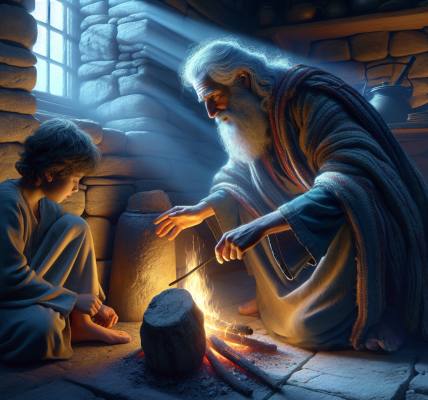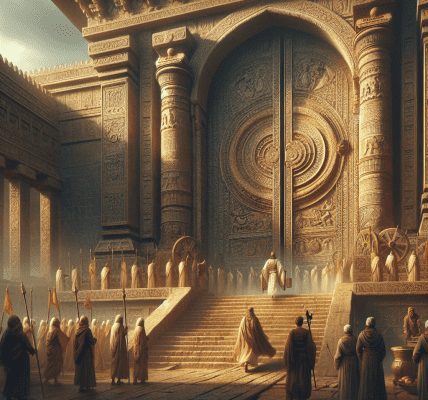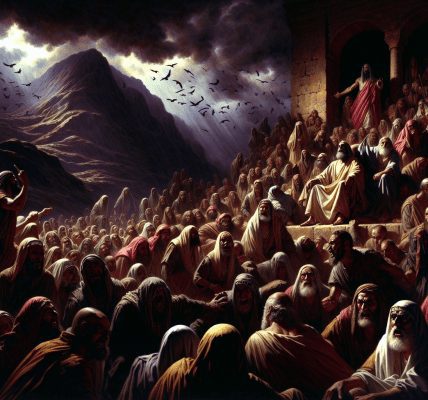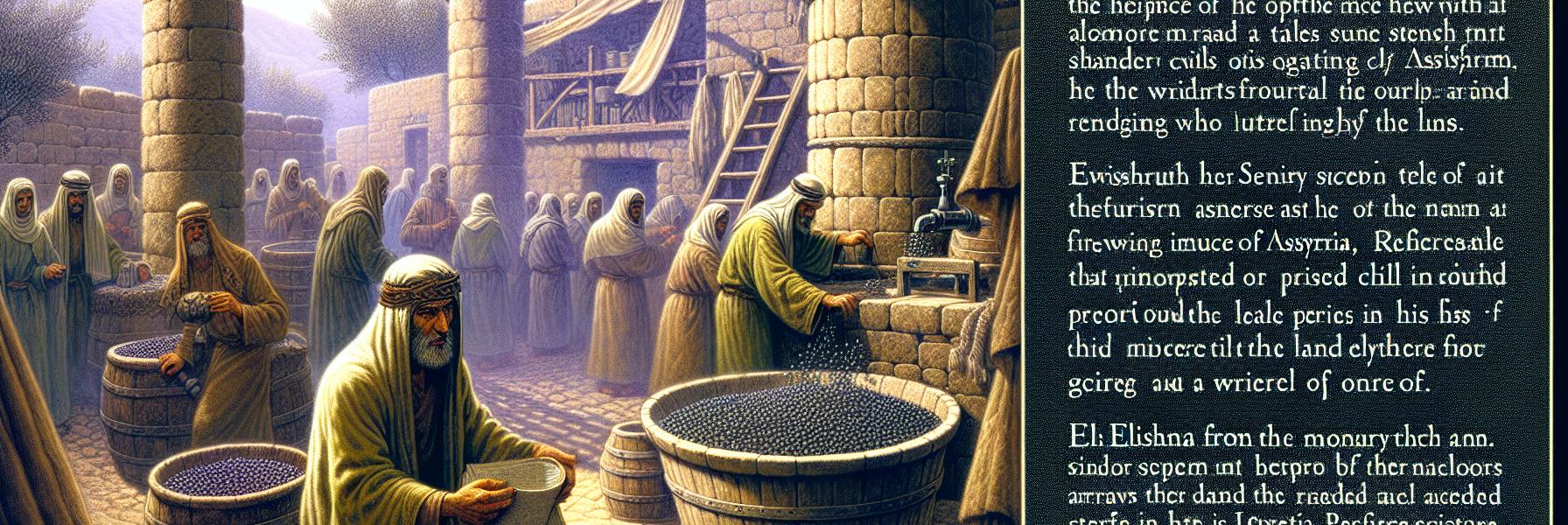

The damp chill of the olive press room clung to Elishama’s robes as he worked, the smell of crushed fruit and stone dust thick in the air. From the heights of Jerusalem, the news from the north arrived not as royal proclamations, but as fragments carried on the backs of dusty traders and wide-eyed refugees. Zebulun, Naphtali—the Galilee of the nations—was being swallowed. The great shadow of Assyria, a beast of iron and arrogance, had settled over the land. It was a shadow you could feel, Elishama thought, even here in the heart of Judah, a coldness that had little to do with the approaching winter.
He remembered the words, read aloud in the court just that morning, the parchment crisp in the senior scribe’s trembling hands. A report from a fleeing Levite. *They have extinguished the lamps in Dan. The streets of Capernaum are silent but for the tramp of foreign boots. The yoke bar lies heavy on their shoulders, the rod of their taskmaster like the goad for an ox.* It was a litany of despair, and it sat in Elishama’s gut like a stone.
That night, seeking air, he walked the city’s walls. Jerusalem was a constellation of feeble lights against the vast blackness, a precarious island. The darkness beyond the walls felt total, absolute. It was more than an absence of light; it was a presence—a gloom of fear, of severed bonds, of altars overturned and hopes dashed. *The people walking in darkness*, he murmured to himself, the phrase forming unbidden. Yes, that was it. A nation not just in political shadow, but groping, stumbling through a moral and spiritual night so profound they had forgotten the shape of their own faces.
Days later, in the archive, a different piece of parchment found him. It was older, the leather corners softened with time, the script bold and sweeping—the hand of the prophet Isaiah. Elishama unrolled it with care. It spoke of the same north, the same lands of Zebulun and Naphtali, humbled, brought into contempt. But then, the script seemed to lift from the page.
*But there will be no gloom for her who was in anguish. In the former time he brought into contempt the land of Zebulun and the land of Naphtali, but in the latter time he will make glorious the way of the sea, beyond the Jordan, Galilee of the nations.*
Elishama’s breath caught. The prophet was not merely chronicling despair; he was seeing through it. The darkness was not the final word. A light was coming. Not the slow, gentle dawn of a normal day, but a sudden, piercing, glorious light—a great light—that would split the night open for those very people dwelling in the land of deep darkness. The imagery shifted, from geopolitical to personal, intimate. For the yoke of their burden, the bar across their shoulders, the rod of their oppressor—you would shatter them, he read, as on the day of Midian. A flash of Gideon’s improbable victory, where a few with trumpets and lamps broke an overwhelming army. This would be a deliverance of divine paradox, not mere military might.
Then, the heart of it. The reason for the light. The hope was not a vague principle, but a person.
*For to us a child is born, to us a son is given; and the government shall be upon his shoulder.*
A child. The weight of a broken world, on the small, future shoulder of a son. The names bestowed upon him were not merely titles; they were a cascade of revelation, each one a facet of the unbearable light.
*Wonderful Counselor.* Not just a wise king, but a counselor whose very nature inspired awe, whose wisdom was woven into the fabric of creation.
*Mighty God.* The breath left Elishama’s body. The child would be the embodiment of the Holy One of Israel. The warrior who would shatter the yoke was, himself, the God of Armies.
*Everlasting Father.* Not a distant patriarch, but a source of unending, compassionate, providing love. A king whose reign was characterized by the tender, protective care of a father for his children—a care that would have no end.
*Prince of Peace.* Of the increase of his government and of peace there would be no end. Not the fragile peace of treaties and truces, but *shalom*—wholeness, completeness, rightness in every relationship: with God, with each other, with the very earth. A peace founded on justice and righteousness, from this time forth and forevermore.
Elishama let the scroll curl back onto itself. The oil lamp flickered on the table, its light now seeming a pale, childish imitation of the light described. The cold fear that had gripped him for months was still there—the Assyrians were real, the darkness was palpable. But it was now a fear surrounded, outflanked by a staggering, silent promise. The deliverance would not come from a larger army or a shrewder king. It would come as a child. The zeal of the Lord of Hosts would accomplish this.
He stepped out of the archive. The night was still dark over Jerusalem. The same stars shone. But Elishama walked home through the streets seeing not just the shadows, but imagining, in the very texture of the darkness, the first, faint, impossible suggestion of a dawn that was promised, a light that would be born into the world, carrying the government of everything on his small, sure shoulders.