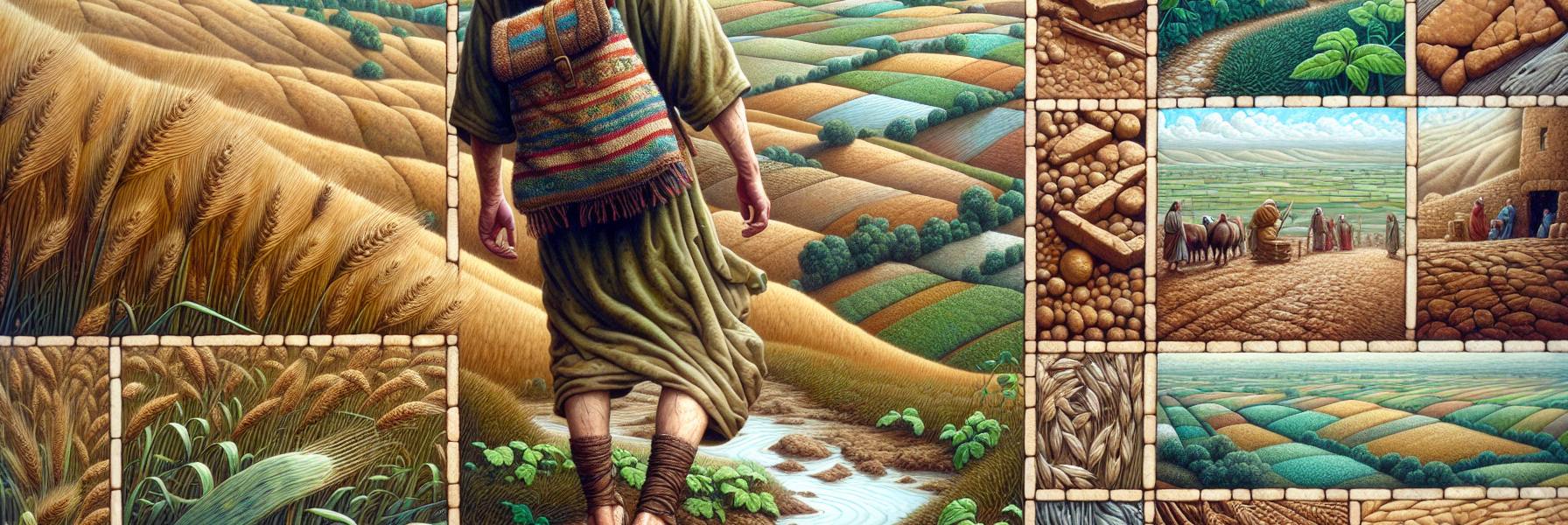

The rain had finally ceased, but the clay path leading up to the ridge was a river of ochre mud. Micah placed his sandaled feet with care, the familiar weight of the woolen satchel across his shoulder. From this height, he could see the patchwork of fields below, some already green with new barley, others lying fallow and choked with thistles. It was a view that usually settled him, but today his stomach was tight with a dull, familiar ache.
The trouble was in the village square. It always was. Old Caleb, son of Jephunneh, had been at it again. A dispute over a boundary stone, shifted in the night. A missing ewe. Harsh words that lingered like woodsmoke. Micah was no elder, not yet, but people spoke to him. They saw him at the synagogue, listening, his face quiet. They knew he sought the old ways, the straight paths.
As he walked, a verse he’d copied just that morning echoed in his mind: *“The wicked flee though no one pursues, but the righteous are as bold as a lion.”* Caleb was no lion. He was a weasel, all darting eyes and bluster. He’d shout his innocence to the sky, his face flushed, pointing bony fingers, while the one he’d cheated stood silent, shoulders slumped. The boldness was all on the wrong side. It twisted things.
Micah’s destination was a smallholding on the lee side of the ridge, where the soil was poorer but the silence deeper. Ezra lived there, a man who had once sold fine linen in Joppa but now tended a few goats and a grove of olive trees gone mostly wild. He was a man of ruined reputation, by some accounts. A failed merchant. Yet when Micah sat with him, the tightness in his gut would loosen.
He found Ezra mending a stone wall, his hands, gnarled as old olive roots, fitting rock to rock with a patience that seemed to seep into the very air. He didn’t look up as Micah approached.
“The rain washed out part of the lower field,” Micah said, stating the obvious as a greeting.
“It does that,” Ezra replied, his voice a dry rustle. “Washes away what isn’t rooted. And reveals what’s been hidden.”
They worked in silence for a time, the only sounds the click of stone and the distant cry of a hawk. Finally, Micah spoke of Caleb, of the shifted boundary, of the accusations that flew like stones.
Ezra sat back on his heels, wiping his forehead with a dusty forearm. “A ruler who lacks understanding is a great oppressor,” he said, not looking at Micah. “But one who hates unjust gain will prolong his days.” He nodded toward the valley. “Caleb sees a field and thinks only of what he can take from it this season. He does not see the years. He does not see that a faithful man will be richly blessed, but one eager to get rich will not go unpunished.”
“But he *prospers*,” Micah said, the frustration boiling over. “His storehouse is full. He gives loud offerings at the feast. People… they listen to him.”
Ezra’s eyes, the colour of flint, met his. “Whoever trusts in his own mind is a fool. You think the ledger of heaven is written on parchment? It is written in the marrow. A man stiff-necked in his crimes, even if he makes a hundred prayers, is an abomination. The prayer of Caleb is the rattling of a dry gourd. But whoever confesses and forsakes his sins… that man finds mercy.” He picked up another stone, turning it over in his hand. “You see his full storehouse. I see a man who, when he becomes great, becomes many things, but rarely honest. And when the wicked rise, people hide themselves. Have you not felt the village hiding?”
Micah had. It was in the averted gazes, the quick changes of subject. It was in Leah, the widow whose son Caleb had pressed into unfair service to settle a dubious debt. She walked like a shadow now.
Later, as Micah trudged back down toward the village in the fading light, he passed Leah’s small plot. She was outside, trying to lift a heavy water jar. He moved to help her. She flinched, at first, then nodded her thanks, her eyes on the ground. As he poured water into her cistern, he heard a commotion from the direction of the square – Caleb’s voice, raised in anger, and the lower, troubled murmur of the village elder.
That night, the tension broke. Caleb’s own son, a quiet boy of fifteen, stood before the elders in the flickering torchlight. His voice shook, but it was clear. He had seen his father move the stone. He had been ordered to say nothing. The boy’s conscience, a tender, trampled thing, had finally grown bold as a lion. *“He who conceals his transgressions will not prosper…”*
The fallout was swift and ugly. Caleb’s bluster turned to a screeching, wild-eyed denial, then to a torrent of blame aimed at his son, his neighbours, even the weather. The more he ranted, the more the villagers, who had been hiding, seemed to solidify in the torchlight. Their silence became a wall. The elder, a weary man named Josiah, finally raised a hand. The judgement was restitution, double for what was taken, and a period of exclusion from the community until repentance was shown. True repentance, Josiah stressed, not the shouting of empty words.
Caleb left the square a shattered man, his false boldness evaporated. He looked, suddenly, like a man perpetually pursued.
The next morning, Micah climbed the ridge again. The air was clean, washed. He found Ezra pruning an olive tree.
“It happened,” Micah said simply.
Ezra nodded, making a careful cut. “A rebuke goes deeper into a man of understanding than a hundred blows into a fool. Caleb was a fool. But the boy… the boy showed understanding. To turn away from your own father’s error to hear instruction—that is to guard your soul.”
“Will Caleb find mercy?” Micah asked, watching a cloud pass over the sun.
Ezra paused, his knife still. “Whoever hardens his heart will fall into calamity. Mercy is for the one who comes with a broken spirit. It is not for us to say if the breaking has begun, or if the heart has simply cracked into sharper pieces.” He looked toward the village. “Better is a poor man who walks in his integrity than a rich man who is crooked in his ways. The village is poorer in coin today, perhaps, for Caleb’s restitution will be a strain on him. But it is richer in peace. The people can stop hiding.”
Micah took a deep breath, the tightness in his stomach gone, replaced by a sober clarity. The proverbs were not just words to be copied. They were the grain of the world, the hidden pattern beneath the mud and the bluster and the shifting stones. They played out in the square, in the field, in the silent fortitude of a widow and the trembling courage of a son. The righteous *were* bold as a lion, not with the roar of Caleb, but with the quiet, bone-deep certainty of a boy telling the truth, or a man mending a wall, stone by patient stone, on the quiet side of the hill.