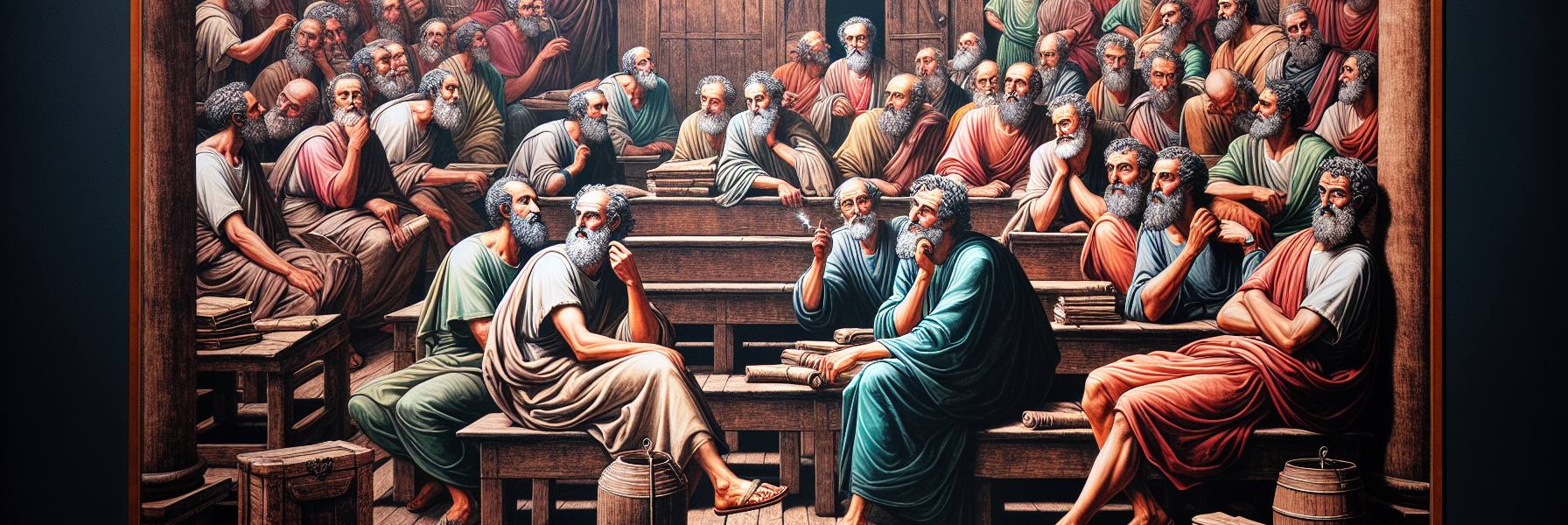

The air in the lecture hall was thick, not just with the heat of too many bodies packed onto rough wooden benches, but with the scent of lamp oil, old scrolls, and ambition. Philemon, a Greek merchant of some means, sat near the back, his fine linen tunic feeling suddenly conspicuous. He had come to Ephesus for the dyed silks of the harbors, but a curiosity, a persistent nagging he couldn’t name, had drawn him here, to this gathering around a man named Hymenaeus.
Hymenaeus was a compelling speaker. His words were polished stones, smooth and pleasing. He spoke of faith, yes, but he wove it skillfully with promises of a better life now. “Godliness,” he declared, his voice rising to the rafters, “is not a path of denial, but of acquisition! The Lord desires His children to prosper. The evidence of true belief is blessing, material blessing. To be poor is to lack faith.” Philemon felt a strange pull. It sounded reasonable, even pious. It married the spiritual longing he felt with the practical drive that had built his trading business. He saw men around him nodding, their eyes alight with a new, religious calculation.
Later, restless, Philemon wandered the agora. The message of Hymenaeus buzzed in his mind, clashing with snippets he’d heard from the quieter, older followers of the Way. Near the leatherworkers’ stalls, he saw a small group clustered around another man. This one was younger, slender, with a kind of weary sincerity in his posture. This was Timothy, the one Paul had left in charge. His voice didn’t carry like Hymenaeus’s; you had to lean in to hear.
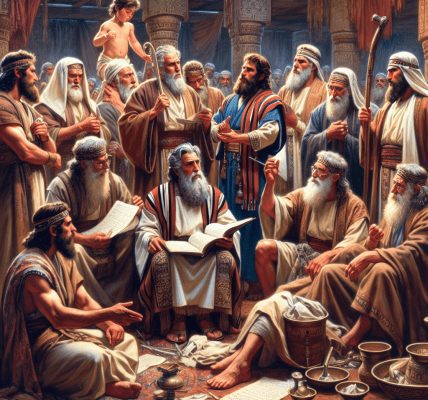
“…and if anyone teaches otherwise,” Timothy was saying, his words measured but firm, “and does not agree to the sound instruction of our Lord Jesus Christ and to godly teaching, they are conceited and understand nothing. They have an unhealthy interest in controversies and quarrels about words that result in envy, strife, malicious talk, evil suspicions and constant friction…”
Philemon stopped, pretending to examine a belt. The description fit the electric, divisive atmosphere in Hymenaeus’s hall perfectly. Timothy went on, speaking of contentment. “But godliness with contentment is great gain. For we brought nothing into the world, and we can take nothing out of it. But if we have food and clothing, we will be content with that.”
Contentment. The word felt foreign, like a dry crust of bread offered after a promise of honeyed cakes. Philemon looked at his own hands, soft compared to the tanner’s beside him. He thought of his warehouse, his debts owed and owing, the constant churn of *more*. He had food and clothing in abundance, yet a quiet anxiety was his constant companion.
Days passed. Philemon found himself drawn more to the periphery of Timothy’s gatherings than to the grand lectures. He heard the older man speak of the rich, not with Hymenaeus’s flattery, but with a grave warning. “Those who want to get rich,” Timothy said one evening, his face lit by a single oil lamp, “fall into temptation and a trap and into many foolish and harmful desires that plunge people into ruin and destruction. For the love of money is a root of all kinds of evil. Some people, eager for money, have wandered from the faith and pierced themselves with many griefs.”
The words landed like a physical weight. Philemon thought of a competitor back in Corinth, a man who had fabricated a debt to seize a shipment, whose family now lived in shrill misery. He thought of his own late nights scheming over ledgers, the cold distance that had grown between him and his wife, whom he now saw as part of the household’s economy rather than its heart. The *love* of money. It wasn’t the coins themselves, but the sickly devotion they commanded.
One afternoon, he managed a word with Timothy alone, near the city’s small eastern gate. He spoke of his confusion, of the two competing visions of faith. Timothy listened, his eyes patient. “Philemon,” he said, “command those who are rich in this present world not to be arrogant nor to put their hope in wealth, which is so uncertain, but to put their hope in God, who richly provides us with everything for our enjoyment.” He placed a hand on the sun-warmed stone of the gate. “He provides for enjoyment, yes. Not for hoarding. Not for worship. The command is to do good, to be rich in good deeds, and to be generous and willing to share. In this way, they lay up treasure for themselves as a firm foundation for the coming age, so that they may take hold of the life that is truly life.”
*The life that is truly life.* The phrase echoed in Philemon long after he returned to his rented rooms. He looked at the piles of inventory lists, the contracts sealed with wax. They weren’t evil. But they were ephemeral. The life Hymenaeus offered was just a sanctified version of the same old race. What Timothy described—this foundational, generous life—felt different. It felt like building on stone instead of sand.
He didn’t sell everything that day. He wasn’t transformed in an instant. But a slow recalibration began. He paid a debt he could have legally disputed. He looked his chief porter in the eye and asked about his son’s fever. The anxiety didn’t vanish, but it began to share space with something else—a fleeting, unfamiliar sense of peace.
On the day his ship was due to sail back to Corinth, Philemon stood on the dock. He carried a letter, a copy of the words Timothy had shared from his mentor Paul, words he’d asked to be written down. He rolled the small scroll in his hand, feeling the papyrus’s texture. The words about fighting the good fight, taking hold of the eternal life he was called to, felt less like an abstract command now and more like a set of directions for a journey he’d already, clumsily, begun. The harbor water slapped against the pilings, thick with the flotsam of trade: a broken crate, a bit of frayed rope. He looked at it, then at the clean line of the horizon where the sea met the sky. He turned and boarded, the promise of a different kind of wealth tucked securely in his belt.