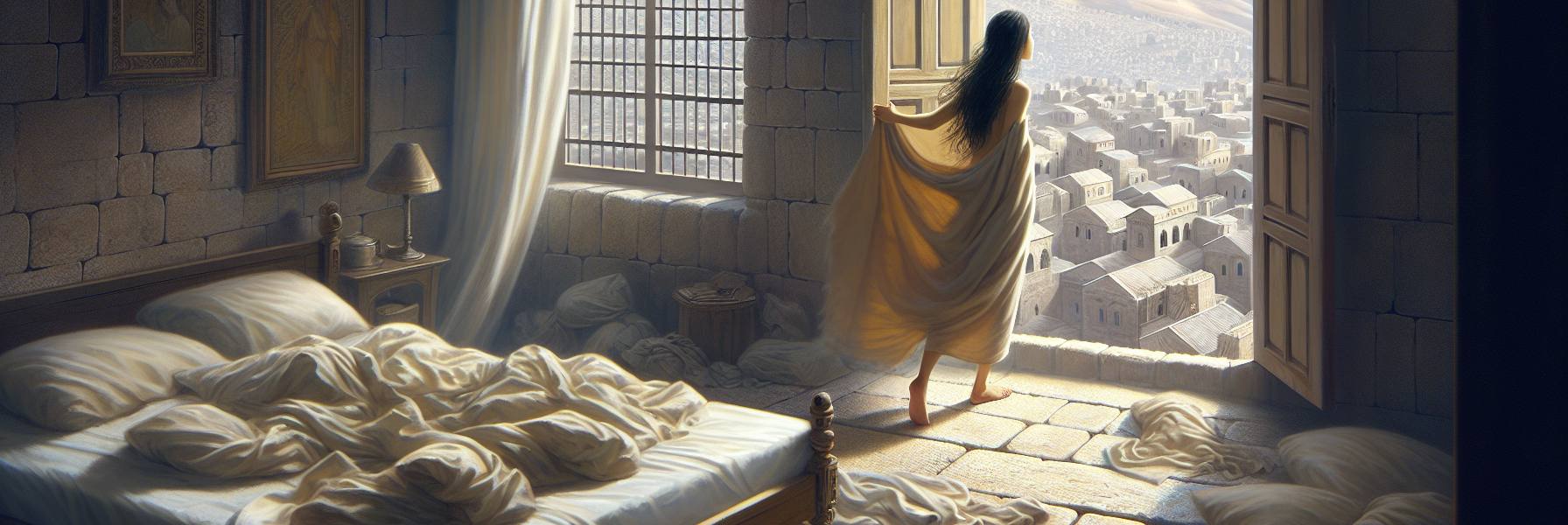

The sun had not yet climbed above the hills of Jerusalem, but the pale, grey light of dawn was enough to see the disarray of my chamber. The bed linens were twisted, a testament to a night spent in restless turning. His absence was a physical ache, a hollow space beside me that the morning chill rushed to fill. Where had he gone? My beloved, who had been with me just hours before, had vanished into the night.
I rose, my bare feet cold on the stone floor, and wrapped a shawl around my shoulders. I moved to the window, pushing the lattice open to the cool air. The city was still mostly asleep, but below, in the courtyard, I saw my companions, the daughters of Jerusalem, already stirring. Their faces, when they looked up at me, were full of a gentle, knowing pity.
“Where has your beloved gone,” one called up, her voice soft but carrying in the quiet, “O most beautiful among women? Where has your beloved turned, that we may seek him with you?”
The question, though kindly meant, was a sharp sting. It gave voice to the panic fluttering in my own chest. Where had he turned? I closed my eyes, trying to still my breathing, to think. And then it came to me, not as a memory, but as a certainty, a knowledge woven into the very fabric of my soul.
“My beloved has gone down to his garden,” I said, my voice gaining strength as I spoke the truth aloud. “To the beds of spices, to graze his flock in the gardens and to gather lilies.”
The words painted the picture in my mind so clearly I could almost smell the damp earth and the crushed mint underfoot. His garden was not a place of mere leisure; it was his sanctuary, his workshop, the place where he went to tend and to cultivate, to be alone with the fruits of his labor. Of course he was there. The anxiety began to melt away, replaced by a warm, steadying confidence.
“I am my beloved’s and my beloved is mine,” I whispered to the dawn, the foundational truth of our lives. “He grazes among the lilies.”
The daughters nodded, their expressions shifting from pity to quiet support. Emboldened, I decided to go to him. I dressed quickly, not in finery, but in simple, sturdy clothes suitable for a walk outside the city walls. The path to his garden was familiar, a ribbon of dust winding between ancient olive trees. As I walked, the sun finally crested the hills, flooding the world with a golden light that set the dewdrops on the spiderwebs ablaze.
I saw him before he saw me. He was standing near a row of flourishing henna bushes, their clusters of white flowers like tiny stars. His back was to me, his attention wholly absorbed by the vines he was inspecting. The early light caught the strength in his shoulders and the quiet focus of his posture.
And then, as if he felt the weight of my gaze, he turned.
The world seemed to hold its breath. His eyes found mine, and a slow, wondrous smile spread across his face, erasing all the miles of the night we had spent apart. He began to walk toward me, and his voice, when he spoke, was low and filled with a reverence that never failed to undo me.
“You are beautiful as Tirzah, my love,” he said, his gaze sweeping over me, “lovely as Jerusalem, awesome as an army with banners.”
Tirzah, the beautiful old capital, nestled in the hills. Jerusalem, the holy city, the joy of the whole earth. And an army with banners—a force of breathtaking power and ordered majesty. The comparisons were staggering, yet in his eyes, I saw that he meant every word. He saw not just me, but the strength and the history and the sacred promise I represented to him.
“Turn your eyes from me,” I murmured, half in genuine overwhelmed feeling, half in the old, playful dance of our love, “for they overwhelm me.”
But he only drew closer, his smile deepening. He began to speak again, his words a poet’s litany, a shepherd’s careful inventory of his most precious flock.
“Your hair is like a flock of goats leaping down the slopes of Gilead.” I could see it in my mind—the dark, glossy cascade of animals moving with a single, fluid grace down a sun-warmed hillside.
“Your teeth are like a flock of shorn ewes that have come up from the washing, all of which bear twins, and not one among them has lost its young.” The image was one of perfect health, of completeness and fruitful blessing, each tooth clean and matched.
“Your cheeks are like halves of a pomegranate behind your veil.” The rich, rosy blush, the hidden, seeded fruit promising sweetness and life.
He did not stop. He spoke of sixty queens and eighty concubines, and maidens without number. But I, he said, was unique. I was his dove, his perfect one. I was the only one of my mother, the pure favorite of the one who bore me. The maidens saw me and called me blessed; the queens and concubines praised me.
“Who is this,” he finished, his voice dropping to a whisper meant for me alone, “who looks down like the dawn, beautiful as the moon, bright as the sun, awesome as an army with banners?”
It was the same phrase, but now it was a question of awe and possession. Who is this? She is mine.
I had gone down to the nut grove, he told me later as we walked together through the rows of vines, to see the blossoms of the valley, to see whether the vines had budded, whether the pomegranates were in bloom. And before I knew it, he said, my desire set me among the chariots of my noble people.
The morning wore on, the sun climbing higher, warming the spices in the garden. The air was thick with the scent of nard and saffron, calamus and cinnamon, with all trees of frankincense. We sat together on a simple stone bench, my hand in his, the silence between us as rich and communicative as any words. The search was over. The night’s loneliness was a forgotten ghost. Here, in the garden he tended, in the gaze that held me as his most rare and treasured possession, I was home. I was his, and he was mine, and he grazed here, his soul at rest, among the lilies.