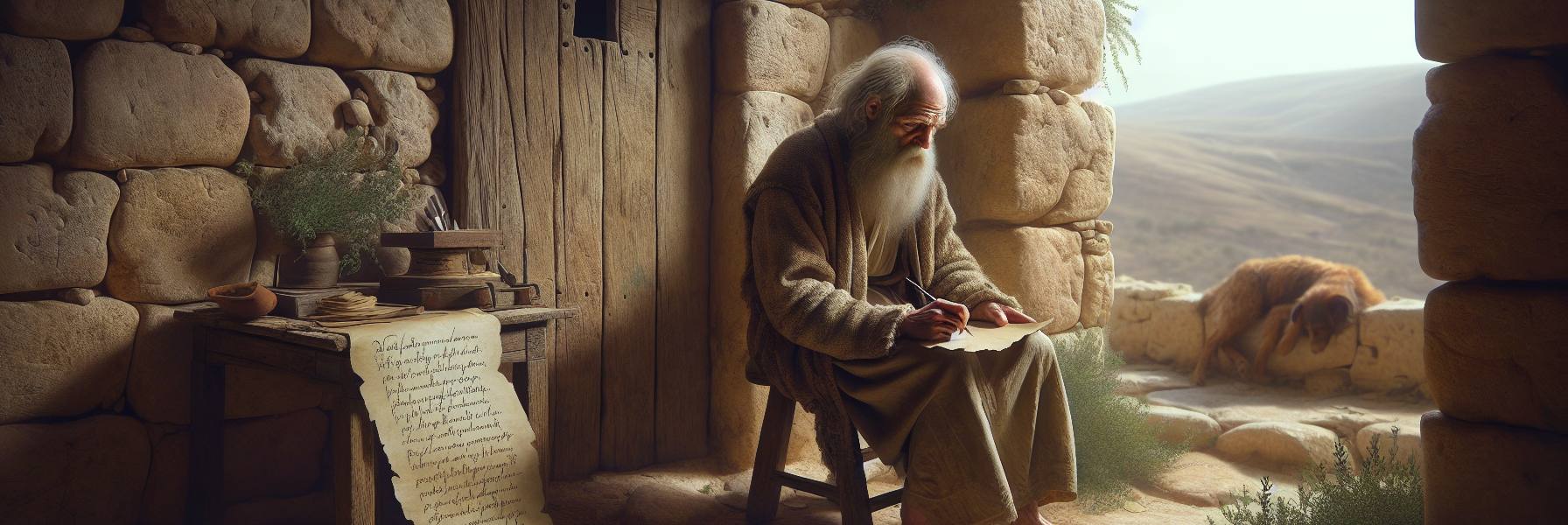

The wind came down from the hills with the smell of dry earth and wild thyme. It was an old wind, one Elian had known all his life, and it whispered through the cracks in the stone walls of his small home. He sat on a rough-hewn stool by the doorway, his hands, gnarled and spotted like the bark of an olive tree, resting on his knees. The parchment on the low table before him was blank, but the words were not. They were a storm inside him, a tempest of memory and grace that had been building for days.
It had started with the fever. It had taken his youngest grandson, a boy with eyes like still pools and a laugh that could startle the birds from the fig tree. For three days, Elian had sat by the boy’s pallet, wiping his brow, praying old prayers that felt as dry as dust in his mouth. When the small chest had finally stilled, a silence fell over the house that was heavier than any stone. In the following weeks, a different sickness had taken root in Elian—a cold, hard bitterness that coiled around his heart. He felt abandoned on a barren shore, the promises of his God feeling like stories told to children.
This morning, however, something had shifted. He had gone to the well, his bones aching with more than just age. As he drew the water, his gaze had fallen upon a cluster of scarlet poppies growing defiantly from a fissure in the stone coping. Their petals were thin as lambskin, trembling in the breeze, a riot of colour against the grey rock. They asked for no permission to live; they simply did, drinking from some hidden moisture, turning their faces to a sun that felt distant to him.
And the words began to stir.
He did not write them yet. He let them form in the quiet of his soul, the way a healer mixes a poultice, feeling for the right balance of herbs.
*Bless the Lord, O my soul,* the thought began, a gentle command to his own weary spirit. *And all that is within me, bless his holy name.*
It was not a shout of victory. It was a whisper, a plea from a man ordering the shattered pieces of himself to remember a song they had forgotten. *All that is within me…* the grief, the anger, the emptiness, the flicker of faith that refused to be fully extinguished. All of it was to be marshalled for this one task: to bless.
He thought of the boy. The pain was a physical weight. But another memory surfaced, unbidden—the time the boy had stolen a honey cake and, caught with crumbs on his chin, had looked up at Elian not with fear, but with a mischievous grin that dissolved all scolding into helpless laughter. The transgression was forgotten, the relationship restored in an instant of shared joy.
*Who forgives all your iniquity,* the words continued to take shape in his mind, *who heals all your diseases.*
He looked at his own hands. The joint ache that plagued him each morning was still there. His grandson was still gone. This was not a healing he could understand. But he remembered the fever breaking for a moment, the boy’s eyes clearing, and a small hand finding his. “Grandfather,” he had whispered, a moment of pure, unburdened peace before the struggle returned. Was that not a kind of healing? A healing of the spirit, a moment of grace snatched from the jaws of despair? The healing of diseases, he saw now, was not always a staying of death, but could be the granting of peace in the midst of it.
His eyes drifted to the hills where he had shepherded as a youth. He remembered the terror of being chased by a bear, the sheer, gut-wrenching fear. And he remembered the narrow escape, the feeling of being pulled from a pit he could not climb out of alone.
*Who redeems your life from the pit,* the narrative within him unfolded, *who crowns you with steadfast love and mercy.*
A crown. Not of gold, but of love. Not of power, but of mercy. He thought of his wife, long asleep with her fathers, and how her kindness had been a daily coronation, a dignity bestowed upon him simply because he was hers. This was the nature of his God. Not a distant king demanding tribute, but one who crowned his fallible, forgetful people with compassion.
The wind shifted, carrying the scent of baking bread from a nearby house. It spoke of satisfaction. He thought of the simple meal he would eat later—bread, oil, a few olives. It was enough. More than enough.
*Who satisfies you with good so that your youth is renewed like the eagle’s.*
He was old. His back was bent, his sight was dimming. Yet, in moments like this, when a truth broke upon him with the clarity of the dawn sun striking the high peaks, he felt a surge of something that was not physical strength, but a youthful vigour of the spirit. It was a renewal from within, a second wind for the soul.
He picked up his stylus. The blank parchment was no longer a challenge, but an invitation. He began to write, the words flowing now, not as a theological treatise, but as the testimony of a man who had walked through the shadow and found, to his astonishment, that he was not alone.
He wrote of the ways of the Lord, how they were not arbitrary laws carved on stone, but a character revealed—merciful and gracious, slow to anger, abounding in steadfast love. He remembered the years of wandering in his own heart, the grumbling and the doubt. And he remembered the faithfulness that had never failed, even when his own had.
*He will not always chide, nor will he keep his anger forever.*
The forgiveness he had felt for his grandson’s small theft was but a pale reflection of the divine forgiveness that had pursued him all his days. The distance he had felt from God was his own doing, his own turning away. The Lord, he saw, was always in the process of removing our transgressions from us, not as a merchant carefully weighs a payment, but as a father sweeps up the shards of a broken jar, ensuring no one gets cut on the pieces ever again.
He looked out at the poppies again, then beyond, to the vast expanse of the sky, the endless stretch of the desert. The scope of the psalm widened in his mind, beyond his personal grief, to encompass all of creation.
*For he knows our frame; he remembers that we are dust.*
The humility of that truth washed over him. He was dust, like the dust from which the poppies grew. Fragile, temporary. And yet, the Maker of the mountains and the seas knew that frame intimately. His love was not contingent on strength, but was bestowed in full knowledge of weakness.
*As for man, his days are like grass; he flourishes like a flower of the field; for the wind passes over it, and it is gone, and its place knows it no more.*
His grandson was the grass. He, Elian, was the grass. But the steadfast love of the Lord, he wrote, his hand steady now, is from everlasting to everlasting. The flower fades, but the love that made it bloom does not. The wind scatters the grass, but the field upon which it grew remains.
He finished, setting the stylus down. The parchment was filled with the uneven, heartfelt script of an old man. It was not perfect. There were smudges, a few words crossed out and rewritten. It was human.
The wind still blew, but the bitterness was gone from it. It was just the wind, part of the world the Lord had made. Elian’s grief was not gone, but it was now held within something larger, something eternal. It was encompassed by a love that ruled over all, from the highest heavens to the deepest, most personal pits of human sorrow. And for now, for this moment held in the palm of a merciful hand, that was enough.