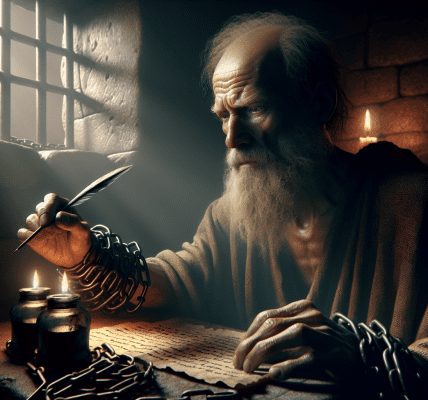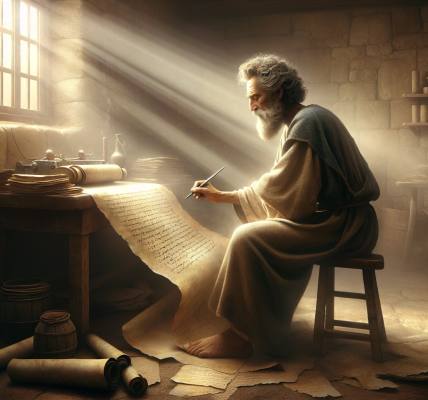

The lamplight flickered, casting long, dancing shadows across the rough-hewn stone of the wall. Ezra’s hand, gnarled and veined like an old olive branch, trembled slightly as he dipped the reed pen into the small clay inkwell. The scent of oil and parchment was a familiar comfort, a scent that spoke of a lifetime of such evenings. He was old now, so very old. The strength that had once coursed through his limbs had retreated, leaving a dull, persistent ache in its wake. The world outside his small chamber in Jerusalem was changing, the voices of a new generation rising in pitches he sometimes struggled to understand.
He put the pen to the scrap of parchment, the words forming not as a new prayer, but as an old one, worn smooth by repetition, a river stone turned over and over in the current of a long life.
*In you, O Lord, do I take refuge; let me never be put to shame.*
The ink flowed, black and sure. It was not a plea born of a single moment of fear, but the foundation stone of his entire existence. He remembered being a boy, no taller than his father’s knee, listening to the stories of the Exodus. The Lord was a refuge then, a pillar of cloud by day and fire by night. He had built his small life within that same shelter.
His mind drifted back through the decades, to a time when his beard was still dark and his back straight. He saw the faces of adversaries, men with smooth words and hard eyes, who had sought to trip him, to see him fall. A merchant from Tyre who had tried to cheat him in a deal for linen; a fellow Levite who had envied his small standing within the temple courts. They had laid hidden traps, speaking lies in whispers that slithered through the market square.
*Deliver me in your righteousness, and rescue me; incline your ear to me, and save me! Be to me a rock of refuge, to which I may continually come.*
He had not fought them with their own weapons. Instead, he had retreated into the silence of his own heart, into the presence he knew was there. He would go to the temple, not to make a show of it, but to stand in the outer court, feeling the cool stone beneath his feet, and simply wait. The scheming of men felt small and hollow in that space. The rescue he prayed for was not always a dramatic deliverance. Sometimes it was a quiet wisdom to see the trap before he stumbled into it. Sometimes it was the slow, inexorable unfolding of truth that caused his adversaries to lose their footing on their own deceptions. The Lord had been his rock, not a fortress he visited in emergencies, but the very ground he walked upon.
A cold draft seeped under the door, and Ezra drew his woolen cloak tighter around his thin shoulders. Old age was a different kind of adversary. It was not a enemy you could outwit or wait out. It was a slow, patient leaching of light and warmth. The friends of his youth were mostly gone, their laughter silenced. His own body, once a reliable instrument, now betrayed him with stiffness and forgetfulness. A wave of desolation, cold and profound, washed over him. He was becoming a relic, a scroll kept in a forgotten corner.
*Do not cast me off in the time of old age; forsake me not when my strength is spent.*
The pen scratched, a soft, persistent sound in the quiet room. This was the fear that gnawed at the edges of his faith—not the fear of men, but the fear of divine absence. What use was an old man to the God of the living? The question hung in the air, stark and terrifying. But as he formed the words of his plea, a memory surfaced, unbidden and sweet.
He saw his mother’s face, her eyes soft with love, singing to him when he was just an infant. The song was a simple one, a psalm of David. He could not recall the words, but he could feel the safety of her arms, the rhythm of her heart against his ear. And in that memory, he understood something he had always known but never articulated. His relationship with God had begun not with his own understanding, but from his very beginning.
*For you, O Lord, are my hope, my trust, O Lord, from my youth. Upon you I have leaned from before my birth; you are he who took me from my mother’s womb.*
Tears, hot and sudden, welled in his eyes. He was not a latecomer to grace. His faith was not a structure he had built himself, stone by laborious stone. It was a current that had carried him from the womb itself. The Lord had been his hope when he was a youth full of foolish pride, his trust when he was a man navigating the complexities of life and family. That same current, he realized, did not run dry because the body grew weak. It flowed all the way to the sea.
A new energy, a fire that had nothing to do with the lamplight, kindled within him. His trembling stopped. He leaned forward, his back protesting, and the words began to pour out, no longer a plea but a proclamation.
*So even to old age and gray hairs, O God, do not forsake me, until I proclaim your might to another generation, your power to all those to come.*
This was the purpose that outlived strength. This was the answer to the fear of being cast off. He was not meant to simply endure the dwindling of his days. He was a vessel, cracked and weathered perhaps, but still holding a truth that needed to be passed on. He thought of his grandson, little Micah, with his bright, curious eyes. He would tell him the stories. Not just the grand stories of Moses and David, but his own stories—of the time he was delivered from the scheming merchant, of the quiet moments of refuge in the temple, of the faithfulness that had been his constant companion from his mother’s arms to this very lamplight.
*My mouth will tell of your righteous acts, of your deeds of salvation all the day, for their number is past my knowledge.*
He wrote of the great and deep things of God, things he had pondered for a lifetime and still only glimpsed. He wrote of the righteousness that reached like the highest heavens, of the troubles and sorrows from which he had been brought up time and again. The psalm became a tapestry, woven with threads of memory, struggle, and an unshakable confidence.
Finally, he set the pen down. The parchment was filled. He did not feel tired. He felt full. The aches were still there, the cold draft still seeped under the door, but they had lost their power over him. He was still Ezra, an old man in a small room. But he was also a witness. He would sing, with whatever breath remained in his lungs, of the God who had been his rock, his fortress, his deliverer, from the first moment of his life to the last.
He lifted his head, and though the room was empty, he spoke the final words aloud, his voice a dry whisper that yet held the resonance of a deep, flowing river.
“You who have made me see many troubles and calamities will revive me again; you will bring me up again from the depths of the earth. You will increase my greatness and comfort me again.”