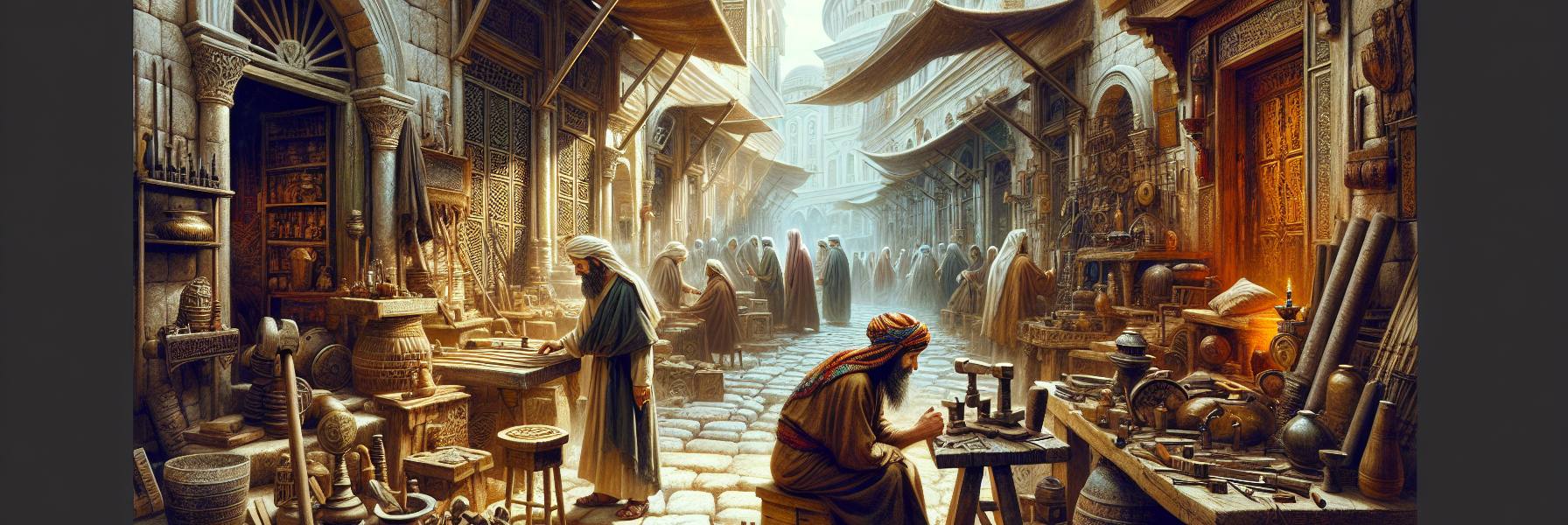

The heat rose from the cobblestones in visible shimmers, distorting the edges of the grand houses lining the street. I sat in the shadowed corner of my small workshop, the scent of cedar and olive wood thick in the air. My hands, usually so sure with mallet and chisel, were still. Before me, a merchant from the north, a man whose robes were too fine and whose voice was too loud, was holding forth on his latest acquisition. His words were a torrent, a ceaseless flow of self-congratulation and petty gossip about the temple officials and the king’s court. Each syllable was a small weight added to a scale inside me, a pressure building behind my teeth.
I had resolved to keep my mouth muzzled, to not even speak what was good. It seemed the only way. To open my lips in this climate felt like pouring fresh water into a sand pit. It would be swallowed without a trace, or worse, twisted into something to be used against me. So I remained silent, a stone in the river of his arrogance. But the anguish within me only grew hotter, my thoughts a fevered swirl. The more I held it in, the more it burned, a fire kindled in my bones. I could feel the words pressing against the back of my throat, a dam about to break.
Finally, I could bear it no longer. I lifted my head, and my voice, when it came, was rough and low, as if unused for a season.
“Lord,” I began, not looking at the merchant but through the open door to the sun-baked street beyond. “Let me know my end, and what is the measure of my days. Let me understand how fleeting I am.”
The merchant fell silent, his pompous narrative cut short. He stared at me as if I had sprouted a second head. I paid him no mind. The prayer was not for him. It was the long-contained truth finally given breath.
“Behold, you have made my days a few handbreadths,” I continued, my gaze falling to my own hands, calloused and stained with wood grain. “My lifetime is as nothing before you. Surely all mankind stands as a mere breath.” The word ‘breath’—*hevel*—escaped my lips. A puff of air. A vapor. The same word old Solomon used when he called everything under the sun meaningless. A morning mist burned away by the rising sun.
I thought of the merchant and his wealth, of the kings and officials he so loved to discuss. “Surely a man goes about as a shadow.” I could see his shadow now, stretched long and thin by the afternoon light, a distorted, insubstantial thing. “Surely for nothing are they in turmoil; man heaps up wealth and does not know who will gather it.”
The merchant, looking uncomfortable, made a hurried excuse about another appointment and left, his fine robes swishing. The workshop was quiet again, save for the buzzing of a fly and the distant cry of a street vendor. My outburst was over, but the weight had not lifted; it had merely changed its form. Now it was a deep, resonant ache of understanding.
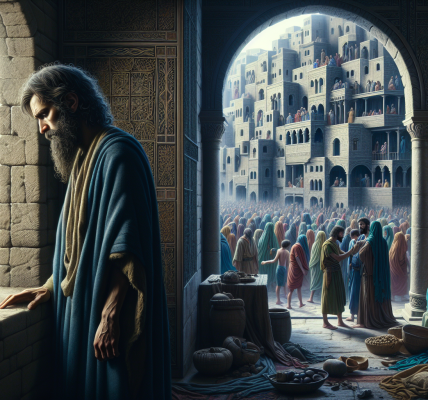
I rose and walked to the doorway, leaning against the frame. The city was bustling, a hive of activity. People moved with purpose, their faces set in lines of ambition, worry, or fleeting joy. And all of it, every transaction, every plan, every triumph, was a structure built on sand. A breath.
“And now, O Lord, for what do I wait?” The question was a whisper, carried away by the same breeze that stirred the dust at my feet. “My hope is in you.”
That was the heart of it, the only solid thing in a world of shadows. The only reality that would not fade or be gathered by another. The silence I had imposed on myself earlier had been born of frustration and a fear of futility. The silence that settled on me now was different. It was a listening silence. A waiting.
I knew the discipline required. I had to be stripped of my delusions, to see the true brevity of my own strivings, before I could properly hold onto the one thing that was eternal. The chastisement of a man for his sin, the Lord consuming like a moth what is dear to him—this was not the rage of a capricious deity. It was the severe mercy of a father, sanding away the rotten parts to save the core of the wood.
“Hear my prayer, O Lord,” I murmured, the words falling into the quiet of the shop. “And give ear to my cry. Hold not your peace at my tears. For I am a sojourner with you, a guest, like all my fathers.”
A sojourner. The word fit. It acknowledged the transience, the handbreadth of days, without despair. A guest dwells in a place that is not their own, but they are there under the protection and provision of the host. My life was a brief journey, but I was not walking the road alone. My hope was not in the durability of my own constructions—the things I built with my hands, the words I spoke, the legacy I might leave. They were all, in the end, a fleeting breath. My hope was in the enduring, steadfast love of the One who held my journey in His hands.
I turned back to my workbench. The half-carved piece of olive wood waited. It was no longer just a project to be sold. It was an act of stewardship, a prayer made with my hands for the few handbreadths of days I had been given. The silence around me was no longer a prison, but a sanctuary.