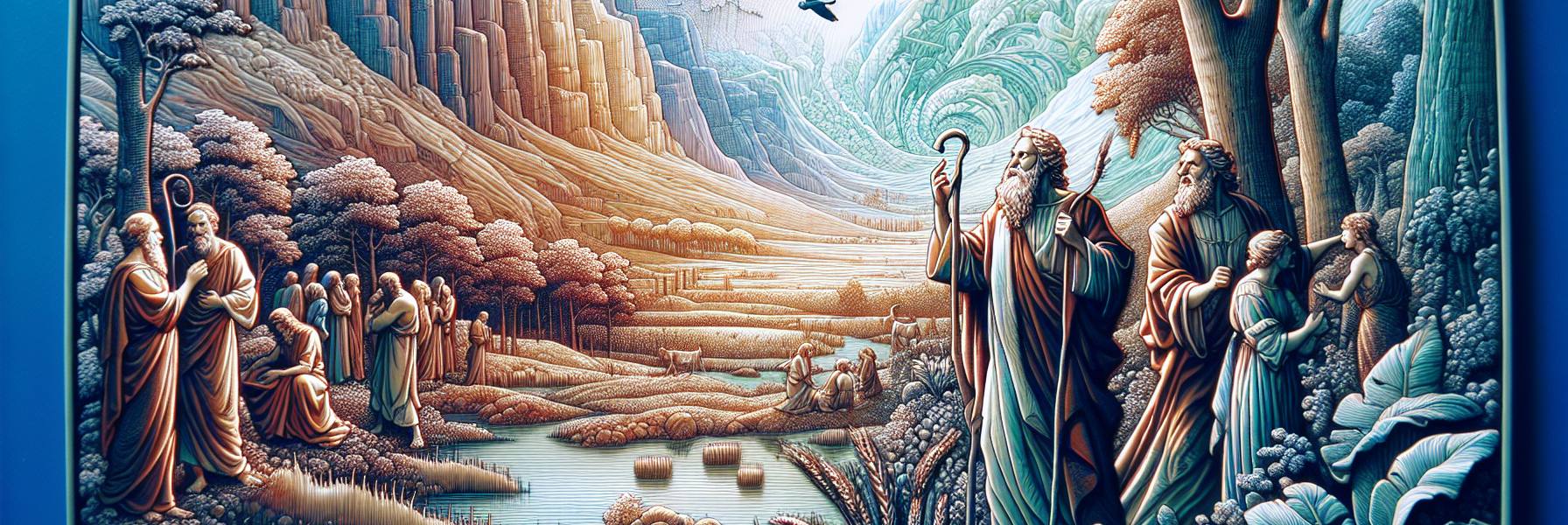

The air in those early days carried a different weight. It was thick with the memory of a voice that had walked in the garden in the cool of the day, a memory that was not yet a legend but a recent, searing truth. Adam, the first man, knew that voice intimately. He had heard its judgment and, later, its promise. He had felt the weight of a world broken by his own hand, and he had also felt the strange, hard comfort of a future secured beyond his own failure.
He lived, the book would later say, for nine hundred and thirty years. It is a number that stretches the mind, but to Adam, it was simply a life. It was a life of learning the stubbornness of soil that now yielded thorns among the grain. It was a life of watching his wife, Eve, her face a map of their shared joy and sorrow, as she held their third son, Seth. In Seth’s eyes, Adam sometimes thought he saw a quiet reflection of Abel’s goodness, a lineage of hope that Cain’s violence had not been able to extinguish.
Seth grew in the long shadow of his father’s stories. He learned the contours of the lost garden not as a myth, but as a place his father had been banished from. He learned that God could be approached, but with a reverence that was now necessitated by a great and terrible distance. When Adam finally closed his eyes, his body returning to the dust from which it was so intimately taken, the world felt older. Seth was a man of one hundred and five years, yet he felt the weight of a new solitude. He had his own sons and daughters, a bustling, noisy clan that filled the valleys, but the last man who had spoken face-to-face with God was gone.
Seth lived nine hundred and twelve years in total. His own son, Enosh, was a man of a different temperament. In his days, the book notes quietly, people began to call upon the name of the Lord. It wasn’t a sudden, unified revival. It was a slow turning, like a plant seeking a sliver of light. The name of Yahweh became a whisper on the lips of a few, a plea in the darkness, a declaration against the growing clamor of a world learning to build, to forge, to forget. Enosh carried this fragile thread of devotion for nine hundred and five years, passing it to his son Kenan, who passed it to Mahalalel, who passed it to Jared.
The generations were like great, ancient trees, their roots deep in the same soil, their branches witnessing centuries of sunrises. They saw the slow migration of families, the founding of the first crude cities, the subtle shift in the hearts of men from calling upon God to calling upon their own strength. The air began to taste different; it carried the smoke of forges and the pride of new inventions. Yet in the line of Seth, the thread, though worn thin, remained unbroken.
Then came Enoch, the son of Jared.
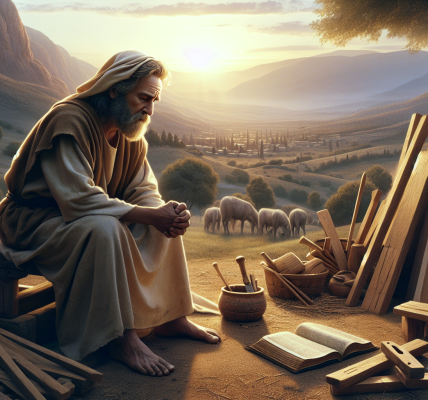
He was a quiet man, not given to the grand pronouncements of some of his forefathers. He tended his flocks and raised his family, a man of seven generations removed from the Garden. But there was a quality to his walk, a rhythm to his life that was distinct. He did not merely believe in God; he walked with God. The Hebrew word implies a steady, habitual companionship, a turning of one’s entire path to run parallel with the Divine. For three hundred years, Enoch walked this way. He saw the world curving further from its original design, the divine likeness in men growing fainter with each birth, like a coin worn smooth from too much handling.
And then, one day, he was not. The record is stark in its simplicity: “Enoch walked with God; then he was no more, because God took him away.” There was no funeral pyre, no grave dug into the red clay. There was just an absence where a presence had been. His son Methuselah, a man already well into his own long life, was left with this staggering mystery. His father had not died. God had simply found his company so agreeable that He had invited him home, bypassing the curse of dust altogether. It was a promise whispered into the fabric of a dying world: death is not the final word for those who walk with God.
Methuselah lived longer than any man ever would—nine hundred and sixty-nine years. His name became a byword for antiquity. His life was the entire pre-flood world in microcosm. He was born into a time when his grandfather, Jared, could have told him stories of Adam’s grandsons. He died the very year the great rains began. His long life was a testament, a final period of grace, a last chance for a civilization to turn back. He saw it all: the rise of mighty men, the filling of the earth with violence, the slow fading of the image of God from the faces of his descendants. All but one.
For Methuselah had a grandson named Noah.
Noah was a man out of time. In an age of roaring chaos, he found grace in the eyes of the Lord. The thread of faith, passed from Adam to Seth, from Enosh to Enoch, now rested on his shoulders. He was a righteous man, blameless among the people of his time. Like his great-grandfather Enoch, he walked with God. He heard the same voice that had once walked in the garden, a voice now heavy with a grief as deep as the foundations of the earth.
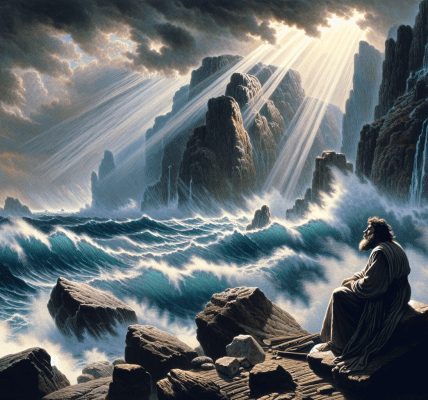
As Methuselah took his last breath, a life of near a millennium concluding, the skies were darkening. Noah, having finished the immense, absurd task of building a vast ship on dry land, was leading his family and the chosen animals up the ramp. The door was about to be shut. The long, patient record of generations—begetting, living, working, dying—was reaching its cataclysmic pause. The legacy of Adam was being preserved in the hold of an ark, the quiet walk of Enoch finding its echo in the footsteps of one last righteous man, stepping from a doomed world into a terrifying, watery hope.