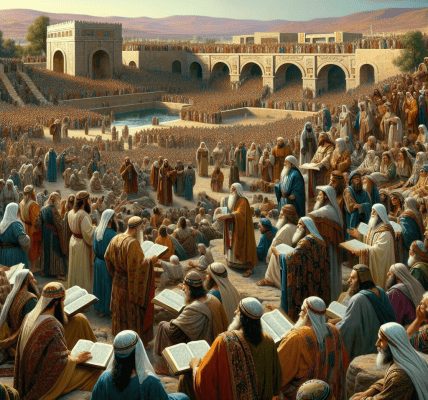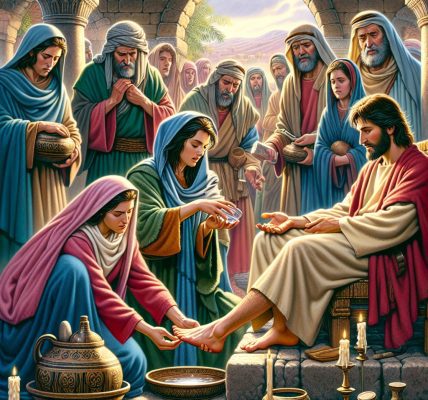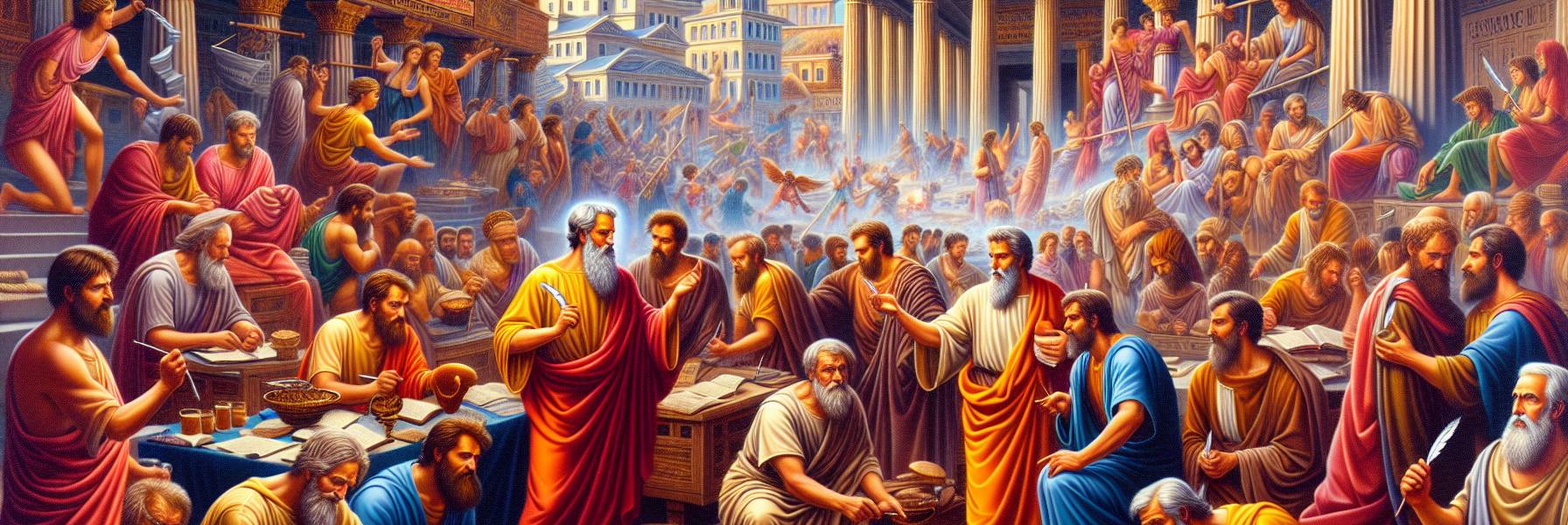

In the bustling city of Corinth, where merchants hawked their wares and philosophers debated in sun-drenched squares, a profound spiritual battle was unfolding—one not of swords and shields, but of hearts and minds. The Apostle Paul, having poured his very soul into the fledgling church there, now took up his pen to write a letter that would echo through the ages. His words, etched with divine inspiration, sought to unveil a mystery as paradoxical as it was beautiful: the treasure of God’s glory housed in the fragile clay of human vessels.
Paul began by recounting the weight of his calling. He and his fellow laborers had not lost heart, though the path before them was strewn with trials that would have shattered lesser men. They carried within them a sacred trust—the ministry of the gospel, entrusted to them by the mercy of God Himself. This was no ordinary message; it was the very light of creation, the radiance that had spoken worlds into being, now focused into the person of Jesus Christ.
Yet, Paul knew that this glorious light was often veiled to those perishing in darkness. The god of this age, a malevolent spirit of deception, had blinded the minds of unbelievers. They stumbled in a shadowland, their spiritual eyes sealed shut, unable to perceive the brilliant illumination of the gospel. But for those whose hearts had been opened by grace, the veil was lifted. They beheld, as in a mirror, the face of God in Christ—a countenance of boundless love, righteousness, and truth.
Here, Paul introduced the central paradox of their existence. “We have this treasure,” he wrote, “in jars of clay.” He painted a vivid picture for the Corinthians: imagine a common earthenware pot, rough-hewn from the dust of the ground, fragile and easily cracked. It was the humblest of containers, used for storing water, grain, or oil. Nothing about its appearance suggested value or permanence. Yet, within this ordinary vessel, one might place a king’s ransom—gems that caught the fire of the sun, gold that gleamed with eternal light.
So it was with the followers of Christ. They were these very jars of clay—frail, mortal, bearing the scars of their humanity. They knew weariness, hunger, and sorrow. They faced persecution that left them battered, perplexed by circumstances they could not control, and at times struck down by forces arrayed against them. But within them dwelled the immeasurable treasure of the Holy Spirit, the very life and power of God.
This divine arrangement, Paul explained, served a glorious purpose: to show that the surpassing power belonged to God and not to them. If the messengers were impressive in their own right—eloquent orators, mighty miracle-workers, figures of unshakable strength—then observers might attribute the success of the gospel to human ability. But God, in His infinite wisdom, chose the weak and foolish things of the world to confound the wise. The cracks in the clay allowed the light inside to shine forth all the more brilliantly. The treasure was everything; the jar was nothing.
Paul then detailed the realities of their earthly sojourn, each hardship a brushstroke in a portrait of grace. They were hard-pressed on every side, yet not crushed. Enemies surrounded them, troubles pressed in from all directions, but they were not destroyed. They were perplexed, often finding themselves in situations with no visible way out, yet they never descended into the despair of those without hope. They were persecuted, hunted and harried by those who hated the name of Jesus, but they were never abandoned by their Lord. They were struck down, sometimes beaten to the very dust, but never destroyed.
How was this possible? Because they carried about in their bodies the dying of Jesus. Every affliction, every rejection, every pang of suffering was a sharing in the crucifixion of their Savior. It was a fellowship of His sufferings, a participation in the cup He drank. And just as He was raised from the dead by the glory of the Father, so too the life of Jesus was being manifested in their mortal flesh. Their daily dying was the very soil from which resurrection life sprang forth.
This was not a grim fatalism, but a vibrant, hope-filled reality. Death was at work in them, but life was at work in the Corinthians and all who heard and believed the word they proclaimed. Paul’s faith was unwavering: “I believed, and therefore I spoke.” Knowing that the same Spirit who raised Jesus from the dead dwelt in him, he could not remain silent. The gospel was a fire in his bones, a truth that demanded proclamation, regardless of the cost.
He looked beyond the transient struggles of the present, fixing his gaze on an eternal weight of glory. The slight, momentary afflictions they endured—though they felt anything but slight in the moment—were achieving for them something far beyond comparison. He compared it to a master craftsman, patiently working on a masterpiece. The chisel blows, the sanding, the heat of the furnace—all were preparing them for an inheritance that would never fade, a glory that would outshine the sun.
So, they did not lose heart. Though their outer self, the jar of clay, was wasting away—subject to illness, aging, and the decay of a fallen world—their inner self was being renewed day by day. With every prayer uttered in weakness, every act of obedience in trial, every choice to love in the face of hatred, the Holy Spirit was refashioning them into the image of Christ. Their spirits were being strengthened, their faith refined, their hope anchored ever more firmly in the promises of God.
Their present afflictions were light and momentary when viewed through the lens of eternity. They were but a breath, a sigh, in the grand symphony of redemption. And they were producing a glory that was substantial, heavy, eternal—a glory that would dwarf the sufferings of this age, rendering them insignificant by comparison.
Therefore, Paul concluded, they set their eyes not on what was seen, but on what was unseen. The visible world was temporary, passing away like a morning mist. The persecutions, the slander, the physical pain—these were part of the landscape of a fading age. But the unseen realities—the love of the Father, the fellowship of the Son, the indwelling of the Spirit, the hope of resurrection, the promise of a new heaven and a new earth—these were eternal. They were the fixed stars by which they navigated the stormy seas of life, the certainties that gave them courage to press on, jars of clay carrying an incorruptible treasure, until the day they would see face to face.