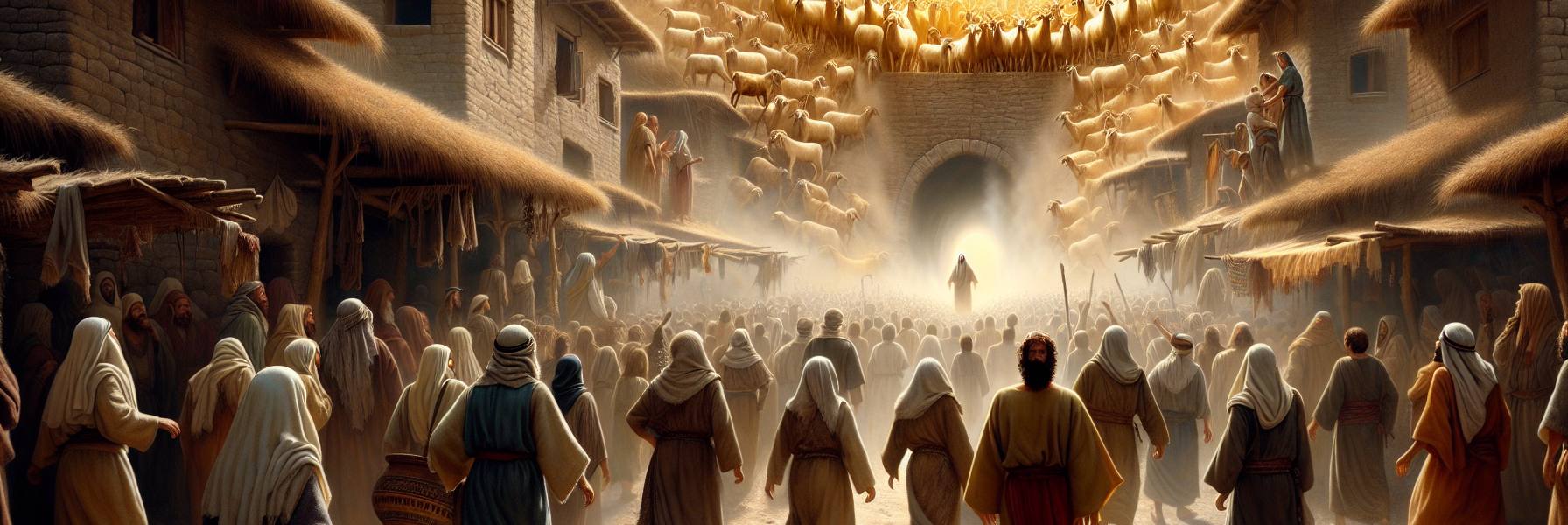

The sun hung heavy and golden over the dusty road leading into the village, its heat shimmering above the packed earth. Jesus walked with his disciples, their sandals kicking up small puffs of pale dust that settled on the hem of their robes. The air was thick with the sounds of village life—the distant bleating of goats, the chatter of women drawing water from the well, the rhythmic clang of a blacksmith’s hammer.
They were on their way to teach in the synagogue, and as was his custom, Jesus taught as he walked, his voice a calm, steady current amidst the noise. The disciples listened intently, their minds wrestling with his parables about the narrow door and the kingdom of God.
Suddenly, Jesus stopped. His gaze, which had been sweeping the crowd, fixed upon a woman who was entering the synagogue. She was bent over at the waist, her spine cruelly twisted so that she could not straighten herself at all. For eighteen long years, a spirit of infirmity had held her in this bondage. Her world was the dirt of the street, the feet of passersby, and the lower legs of the furniture in her home. She saw the sky only as a sliver of blue between the rooftops, and the faces of her friends and family only as fleeting, pitying glances from above.
She moved with a painful, shuffling gait, her gnarled hands resting on her knees for the little support they could offer. The lines on her face were not just from age, but from a lifetime of looking down. She was a familiar sight in the village, a living monument to suffering, and most had grown accustomed to her affliction, their compassion worn thin by the relentless passage of time.
Jesus watched her, and his heart, which was ever tuned to the frequency of human sorrow, swelled with a profound compassion. He saw not just the twisted body, but the weary soul within, the dignity that had been eroded year after year, the prayers that had seemingly gone unanswered.
He moved through the crowd, which parted for him. He walked directly to the woman and stood before her. From her perspective, she saw only his dusty sandals and the hem of his robe. Then, his voice, gentle yet imbued with an authority that silenced the very air around them, called to her.
“Woman,” he said, and the word was not a label but a title of respect.
She slowly, painfully, tilted her head back as far as her condition would allow, and her eyes, old and tired, met his. In them, she saw not pity, but a fierce, loving power.
“You are set free from your infirmity,” Jesus declared.
As the words left his lips, he laid his hands upon her. A warmth, like the first light of dawn after a long, cold night, spread from his touch through her contorted frame. It was not a violent shock, but a deep, unlocking sensation. Muscles and sinews that had been clenched in a permanent fist for nearly two decades began to relax. Vertebrae, long compressed and misaligned, clicked gently into their rightful places. The oppressive weight that had forced her gaze earthward for so long simply vanished.
For the first time in eighteen years, she straightened up.
Her back uncurled, her shoulders pulled back, and her head rose. The world, which had been a narrow lane of dust and feet, exploded into a panorama of color and light. She saw the deep blue of the sky, the sun-drenched white of the synagogue walls, the green leaves of a distant fig tree. She saw the faces of the people around her, their mouths agape in astonishment. And she saw the face of Jesus, smiling at her, his eyes shining with shared joy.
A great cry of praise burst from her lips, a sound of pure, unadulterated gratitude to God. “Glory to God! Glory to God!” she repeated, her voice strong and clear, her hands raised to the heavens she could now see in their entirety.
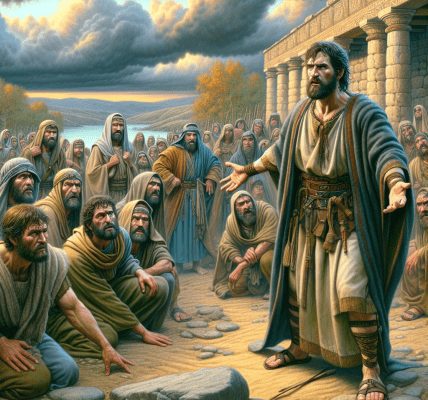
But the ruler of the synagogue, a man named Jairus, was indignant. He did not see a miracle; he saw a violation. The law was clear: the Sabbath was for rest. His face flushed with anger, but he did not dare confront Jesus directly. Instead, he turned to the crowd, his voice tight with outrage.
“There are six days on which work ought to be done!” he proclaimed. “Come on those days and be healed, and not on the Sabbath day!”
His words hung in the air, a cold splash of legalism on the warm moment of mercy.
The Lord turned to him, and his gaze, which had been so tender with the woman, was now sharp and penetrating.
“You hypocrites!” Jesus answered, his voice carrying through the courtyard. “Does not each one of you on the Sabbath untie his ox or his donkey from the manger and lead it away to water it?”
He paused, letting the simple logic of the question settle on them. Every man there performed this small act of mercy for his livestock on the Sabbath, considering it a necessity, not a labor.
“Ought not this woman, a daughter of Abraham whom Satan bound for eighteen years, be loosed from this bond on the Sabbath day?”
The question was a thunderclap of divine perspective. He had reframed the entire event. This was not about work; it was about warfare. This was not about labor; it was about liberation. He had not merely healed a body; he had plundered the kingdom of darkness and set a captive free. He called her a “daughter of Abraham,” affirming her full standing in the covenant community, a dignity her condition had stripped from her in the eyes of many.
As he said these things, all his adversaries were put to shame. They had no rebuttal. Their legalistic objections crumbled before the magnificent reality of a human life restored. The entire crowd, seeing the woman standing tall and radiant, her face transformed from suffering to joy, rejoiced at all the glorious things that were done by him. The law of love had triumphed over the letter of the law, and in that synagogue, on that Sabbath, the true rest and restoration of God’s kingdom had broken through.