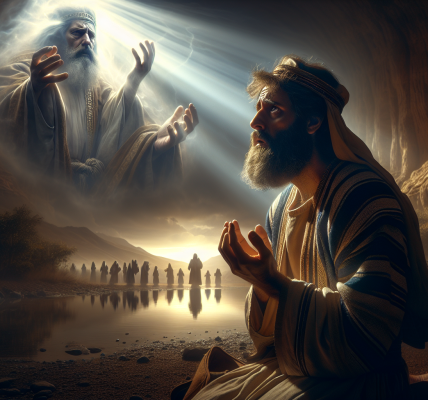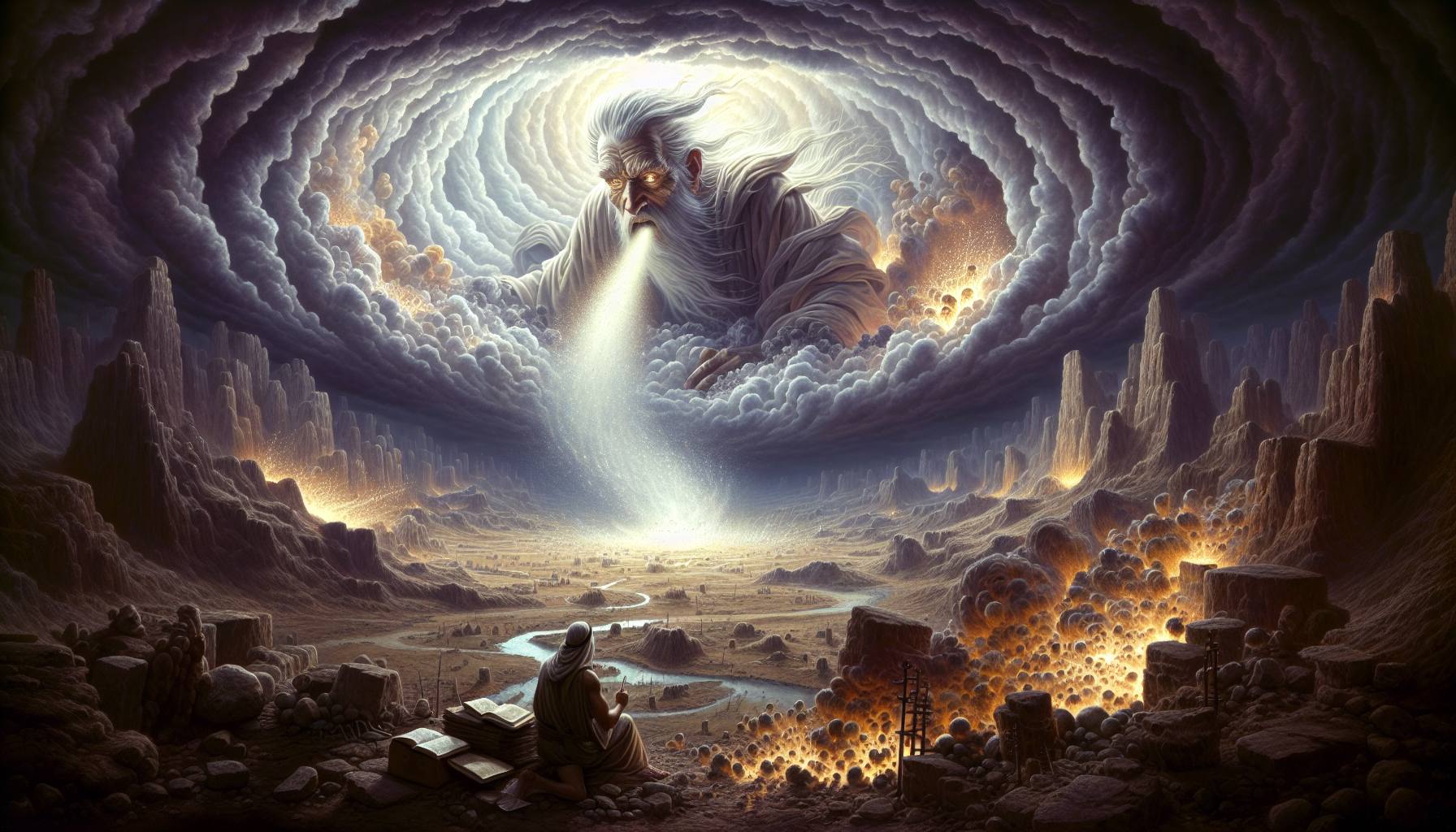

In the midst of the whirlwind, a voice thundered, not in wrath but in sovereign authority, causing the very foundations of the earth to tremble. Job, who had sat in dust and ashes, now found himself enveloped by the divine storm, his ears attuned to the One who spoke from the tempest.
“Who is this that obscures my plans with words void of knowledge?” the voice declared, echoing across the desolate plains where Job had lamented. “Brace yourself like a man; I will question you, and you shall answer me.”
Job’s breath caught in his chest as the presence of the Almighty pressed upon him, not with cruelty but with a weight of glory that made his previous complaints seem like whispers in an endless hall.
“Where were you when I laid the earth’s foundation?” the voice continued, each word unfolding like the dawn of creation itself. “Tell me, if you understand. Who marked off its dimensions? Surely you know! Who stretched a measuring line across it? On what were its footings set, or who laid its cornerstone—while the morning stars sang together and all the angels shouted for joy?”
Job could only bow his head, his mind reeling at the imagery of celestial joy at the birth of the world—a world he had only ever walked upon, never formed.
“Who shut up the sea behind doors when it burst forth from the womb,” the voice pressed, “when I made the clouds its garment and wrapped it in thick darkness, when I fixed limits for it and set its doors and bars in place, when I said, ‘This far you may come and no farther; here is where your proud waves halt’?”
In his heart, Job saw the roaring oceans, vast and untamable by mortal hands, yet cradled and commanded by the voice that now addressed him. He remembered the fearsome power of the sea, yet here was the One who had swaddled it at its birth.
“Have you ever given orders to the morning,” the voice inquired, “or shown the dawn its place, that it might take the earth by the edges and shake the wicked out of it? The earth takes shape like clay under a seal; its features stand out like those of a garment, so that the wicked are denied their light and their upraised arm is broken.”
Job thought of the daily miracle of sunrise, how it exposed and transformed the world, and he knew he had never commanded it, never even understood its purpose fully.
“Have you journeyed to the springs of the sea or walked in the recesses of the deep?” the voice challenged. “Have the gates of death been shown to you? Have you seen the gates of the deepest darkness? Have you comprehended the vast expanses of the earth? Tell me, if you know all this.”
Silence was Job’s only reply, for he had not walked in the abyss nor beheld the thresholds of eternity.
“What is the way to the abode of light,” the voice continued, “and where does darkness reside? Can you take them to their places? Do you know the paths to their dwellings? Surely you know, for you were already born! You have lived so many years!”
A gentle irony touched the words, and Job felt the smallness of his own lifespan compared to the ageless works of God.
“Have you entered the storehouses of the snow or seen the storehouses of the hail, which I reserve for times of trouble, for days of war and battle? What is the way to the place where the lightning is dispersed, or the place where the east winds are scattered over the earth?”
Job recalled the fierce storms that had taken his children, the hail that had destroyed his flocks, and he understood that these, too, were under divine sovereignty, kept in storehouses he could not access.
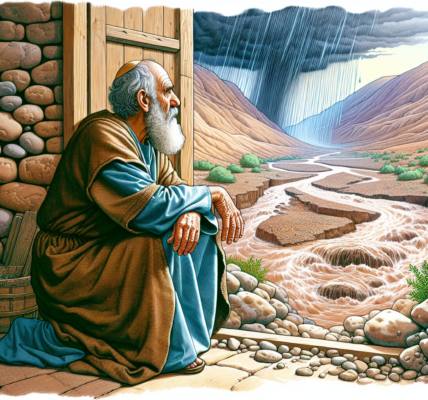
“Who cuts a channel for the torrents of rain, and a path for the thunderstorm, to water a land where no one lives, an uninhabited desert, to satisfy a desolate wasteland and make it sprout with grass? Does the rain have a father? Who fathers the drops of dew? From whose womb comes the ice? Who gives birth to the frost from the heavens when the waters become hard as stone, when the surface of the deep is frozen?”
The questions kept coming, painting a tapestry of creation so intricate and vast that Job’s sufferings, though real and profound, now seemed part of a grander design he could not fathom.
“Can you bind the chains of the Pleiades? Can you loosen the cords of Orion? Can you bring forth the constellations in their seasons or lead out the Bear with its cubs? Do you know the laws of the heavens? Can you set up God’s dominion over the earth?”
Job looked up at the night sky, the same stars under which he had wept, and realized they were not random lights but part of an ordered cosmos governed by laws beyond his comprehension.
“Can you raise your voice to the clouds and cover yourself with a flood of water? Do you send the lightning bolts on their way? Do they report to you, ‘Here we are’? Who gives the ibis wisdom or gives the rooster understanding? Who has the wisdom to count the clouds? Who can tip over the water jars of the heavens when the dust becomes hard and the clods of earth stick together?”
The questions turned to the creatures of the earth and sky, the mundane and the majestic, all sustained by a wisdom Job did not possess.
As the voice finally quieted, the whirlwind stilled, and Job found his own voice, though it was but a whisper. “I am unworthy—how can I reply to you? I put my hand over my mouth. I spoke once, but I have no answer—twice, but I will say no more.”
In that moment, Job did not receive an explanation for his suffering, but he encountered the One who held all things together—the Creator whose wisdom and power were beyond dispute, whose care extended even to the most desolate places, and in whose presence his own questions found their rest.