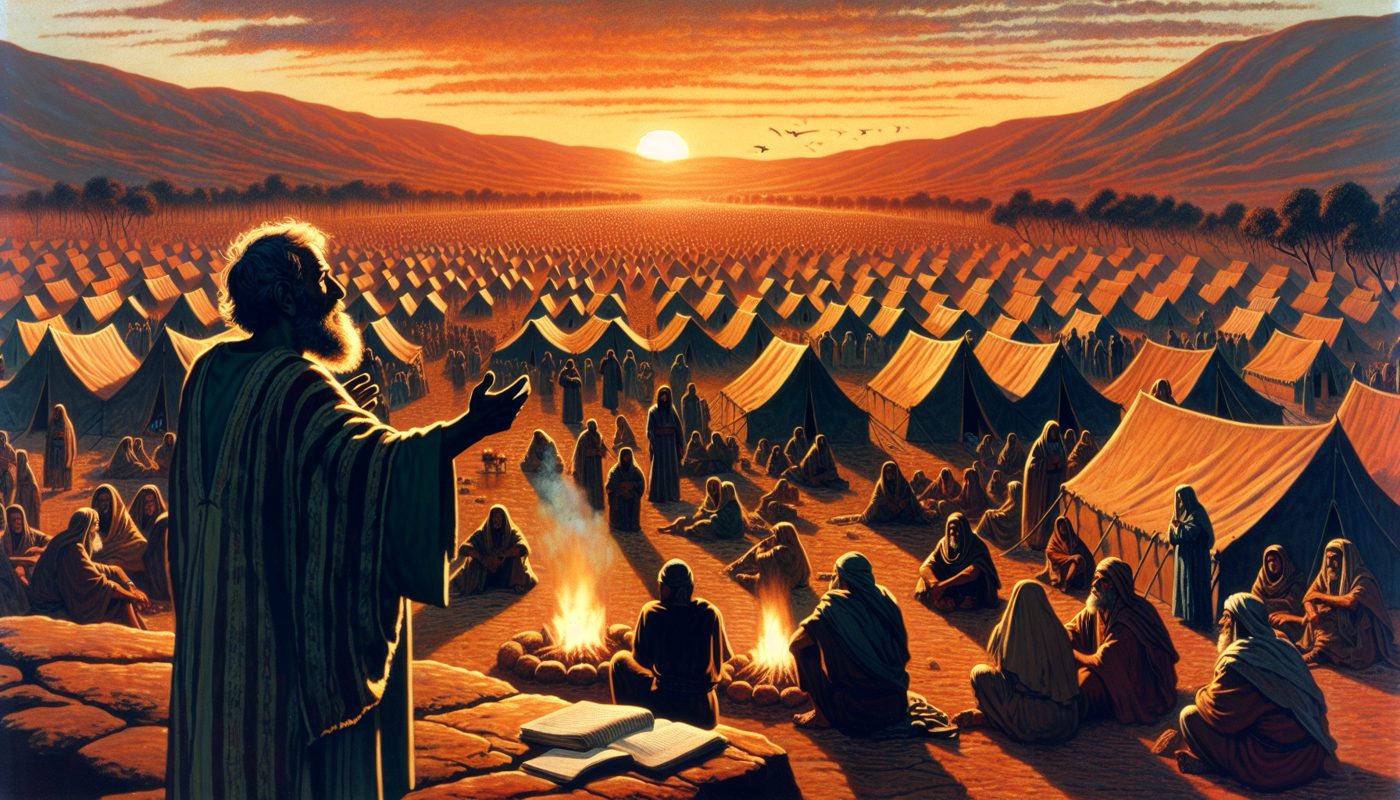
Moses does not soften the terms. In Deuteronomy 11, he sets before Israel a plain choice: blessing if they obey, curse if they turn away. The chapter opens with a command to love the Lord and keep his charge, his statutes, his ordinances, and his commandments always. That word “always” presses the demand beyond a single moment into a sustained posture. The people are not being asked for a one-time pledge. They are being told to build their entire life around the Lord’s instructions.
Moses grounds the command in what the people themselves have seen. He does not appeal to secondhand reports. He says plainly that he is not speaking to the children who have not known the Lord’s chastisement, his greatness, his mighty hand, and his outstretched arm. The adults standing before him watched the Lord destroy the army of Egypt in the Red Sea. They saw the water overflow the chariots and the horsemen. They lived through the wilderness, and they saw the earth open its mouth to swallow Dathan and Abiram, along with their households, their tents, and every living thing that followed them. Moses says, “Your eyes have seen all the great work of the Lord which he did.” The evidence is not distant. It is written into their memory.
Because they have seen this, they are to keep the whole commandment so that they may be strong and go in and possess the land. The land itself is described in terms that contrast sharply with Egypt. In Egypt, they sowed seed and watered it with the foot, like a garden of herbs. That required human labor and irrigation channels. The land they are about to enter is different. It is a land of hills and valleys that drinks water from the rain of heaven. The Lord himself cares for it. His eyes are on it from the beginning of the year to the end. The land does not depend on their irrigation systems. It depends on the Lord’s provision of rain.
That rain is tied directly to obedience. If they diligently listen to the commandments, to love the Lord and serve him with all their heart and soul, then he will give the rain in its season—the former rain and the latter rain. That rain will allow them to gather grain, new wine, and oil. Grass will grow in the fields for their cattle, and they will eat and be full. The promise is concrete: obedience leads to a functioning agricultural cycle, full barns, and satisfied households.
But the warning is equally concrete. If their heart is deceived and they turn aside to serve other gods and worship them, the Lord’s anger will be kindled. He will shut up the heavens so that there is no rain. The land will not yield its fruit. They will perish quickly from the good land the Lord is giving them. The threat is not abstract. It is a direct reversal of the blessing. The same sky that brings rain can be sealed. The same land that yields abundance can become barren.
Moses does not stop at the external conditions. He tells them to lay up these words in their heart and in their soul. They are to bind them as a sign on their hand and as frontlets between their eyes. They are to teach them to their children, talking about them when they sit in the house, when they walk on the road, when they lie down, and when they rise up. They are to write them on the doorposts of their houses and on their gates. The purpose is that their days and the days of their children may be multiplied in the land, as long as the heavens are above the earth. The instruction is not merely for the present generation. It is designed to create a culture of remembrance that outlasts Moses himself.
The chapter then restates the conditional promise. If they diligently keep all the commandment, to love the Lord, to walk in all his ways, and to cleave to him, then the Lord will drive out the nations before them. They will dispossess nations greater and mightier than themselves. Every place where the sole of their foot treads will be theirs, from the wilderness to Lebanon, from the Euphrates River to the Mediterranean Sea. No man will be able to stand against them. The Lord will lay the fear and dread of them on all the land they tread. The military success is not a matter of their strength. It is a direct result of their loyalty to the Lord.
Moses then makes the choice explicit. He sets before them this day a blessing and a curse. The blessing comes if they listen to the commandments of the Lord. The curse comes if they do not listen but turn aside to go after other gods that they have not known. The language is stark. There is no middle ground. The blessing and the curse are not distant possibilities. They are set before them now, at this moment, as they stand on the edge of the Jordan.
When the Lord brings them into the land, they are to set the blessing on Mount Gerizim and the curse on Mount Ebal. Moses identifies the location: beyond the Jordan, behind the way of the going down of the sun, in the land of the Canaanites who dwell in the Arabah, opposite Gilgal, beside the oaks of Moreh. The geography is specific. The ceremony is not optional. The land itself will witness the declaration of the terms.
The chapter closes with a reminder that they are about to cross the Jordan to go in and possess the land. They will possess it and dwell in it. And they are to observe all the statutes and ordinances that Moses sets before them this day. The entire chapter is a single sustained argument: the Lord has acted, the land is different, the rain depends on obedience, the choice is real, and the mountains are waiting. Moses does not leave room for ambiguity. He leaves room for decision.
Comments
Comments 0
Read the discussion and add your voice.
Members only
Sign in to join the conversation
We keep comments tied to real accounts so the discussion stays clean and trustworthy.
No comments yet. Be the first to add one.