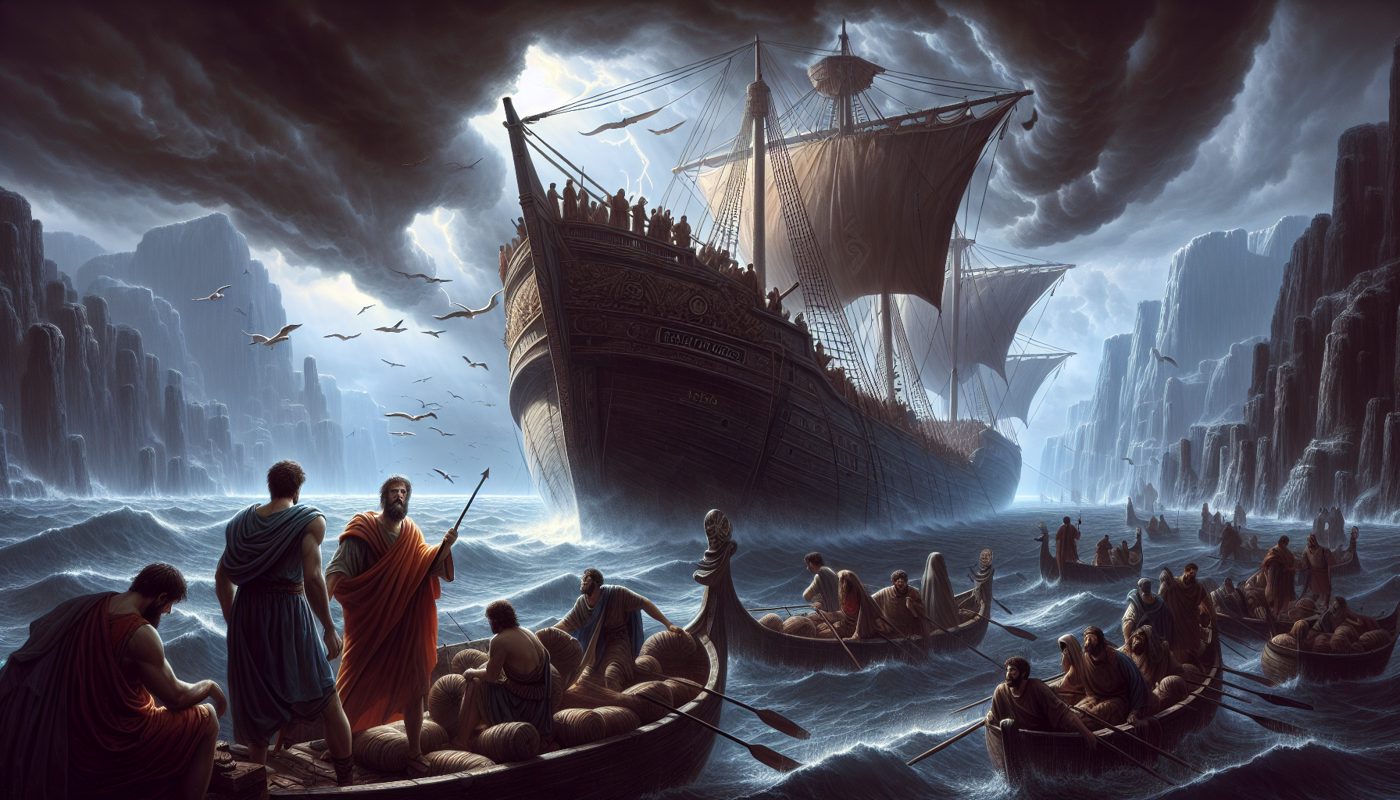
The decision to sail had already been made before Paul spoke. At Fair Havens on Crete, with the Fast past and winter closing in, the centurion Julius listened not to the prisoner but to the ship's master and owner. The majority advised pressing on to Phoenix, a harbor better suited for wintering. When a soft south wind rose, they weighed anchor, believing they had secured their purpose.
Then the wind changed. Euraquilo, the tempestuous northeast gale, struck from the island. The ship could not face it. They gave way and were driven, running under the lee of Cauda only with difficulty. There they secured the boat, undergirded the hull, and lowered the gear, fearing they would be cast onto the Syrtis. The storm did not relent.
For days they labored. On the second day they threw the freight overboard. On the third they cast out the ship's tackling with their own hands. For many days neither sun nor stars appeared. All hope of being saved was taken away.
Then Paul stood among them. He did not soften his words. He told them they should have listened and not set sail from Crete, sparing themselves this injury and loss. But he also told them to be of good cheer. An angel of the God whose he was had stood by him that night, saying, 'Fear not, Paul; thou must stand before Caesar: and lo, God hath granted thee all them that sail with thee.' Paul declared his belief that it would be exactly as he had been told, though they must be cast upon a certain island.
The fourteenth night came. Driven across the Adriatic, the sailors sensed they were nearing land. They sounded and found twenty fathoms, then fifteen. Fearing rocky ground, they let go four anchors from the stern and wished for daylight.
The sailors attempted to flee. Under pretense of laying out anchors from the foreship, they lowered the boat. Paul spoke to the centurion and the soldiers: 'Except these abide in the ship, ye cannot be saved.' The soldiers cut the boat's ropes and let it fall away.
As day approached, Paul urged everyone to eat. For fourteen days they had waited, fasting, taking nothing. He told them this was for their safety: not a hair would perish from any of their heads. He took bread, gave thanks to God in the presence of all, broke it, and began to eat. They all took courage and ate. There were two hundred and seventy-six souls on board. When they had eaten enough, they lightened the ship by throwing the wheat into the sea.
When day came, they did not recognize the land. They saw a bay with a beach and decided to drive the ship onto it. They cast off the anchors, loosed the rudders, hoisted the foresail, and made for the beach. But they struck a place where two seas met. The bow stuck fast and remained unmovable. The stern began to break up under the violence of the waves.
The soldiers counseled killing the prisoners, lest any swim away and escape. But the centurion, wanting to save Paul, stopped them. He ordered those who could swim to jump overboard and get to land first. The rest followed on planks and pieces of the ship. In this way, all escaped safely to the land.
Comments
Comments 0
Read the discussion and add your voice.
Members only
Sign in to join the conversation
We keep comments tied to real accounts so the discussion stays clean and trustworthy.
No comments yet. Be the first to add one.