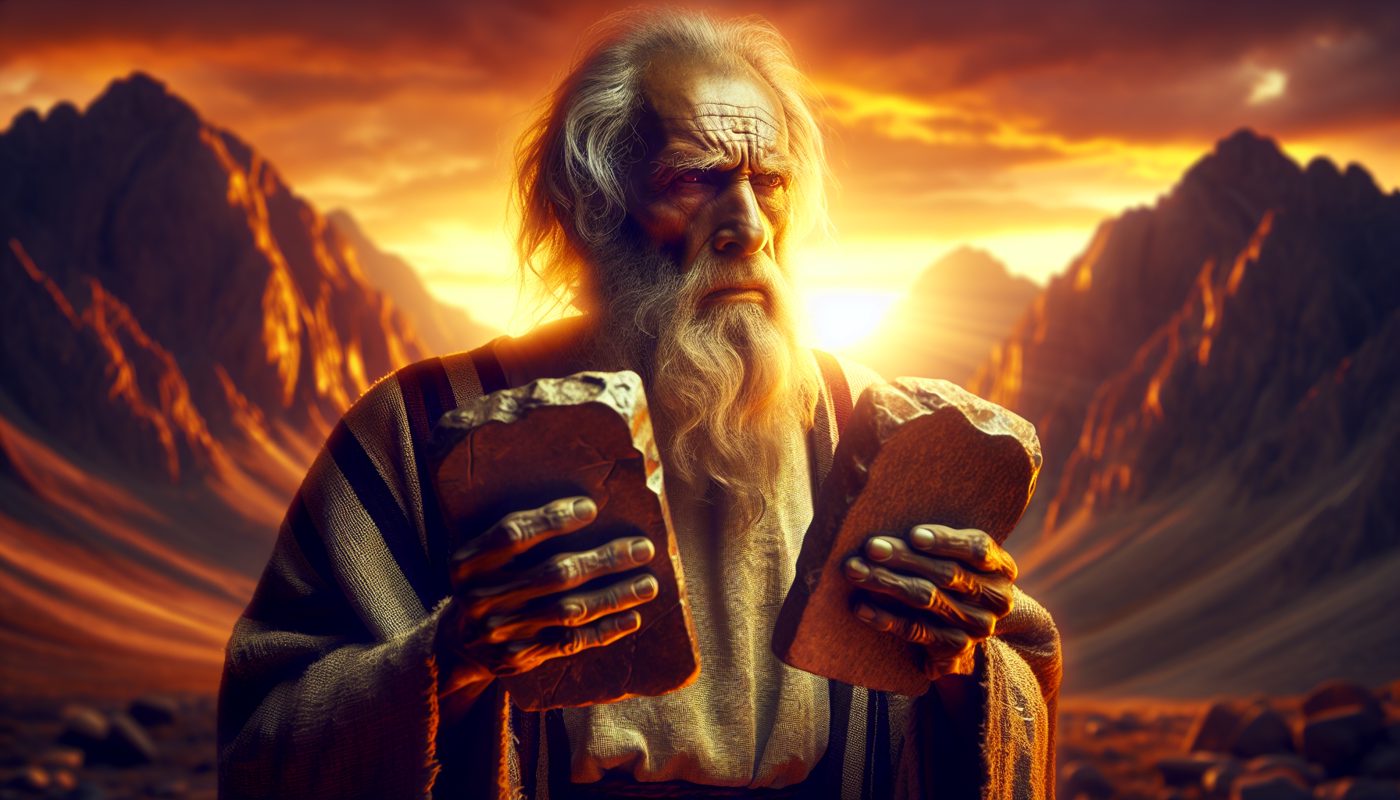
The Lord commanded Moses to cut two new stone tablets like the first ones, promising to write on them the words that had been on the tablets Moses broke. Moses was told to be ready by morning and to present himself alone on the top of Mount Sinai—no man was to come with him, no flocks or herds were to graze near the mountain. Moses rose early, hewed the tablets, and climbed Sinai with the stones in his hands.
The Lord descended in a cloud and stood with Moses there, proclaiming the name of the Lord. As the Lord passed before him, the voice declared: “The Lord, the Lord, a God merciful and gracious, slow to anger, and abundant in lovingkindness and truth, keeping lovingkindness for thousands, forgiving iniquity and transgression and sin, but who will by no means clear the guilty, visiting the iniquity of the fathers upon the children and the children's children to the third and fourth generation.”
Moses bowed quickly to the ground and worshiped. He pleaded with the Lord to go in the midst of Israel, calling them a stiff-necked people, and asked for pardon of their iniquity and sin, and that the Lord would take them as His inheritance.
The Lord answered by declaring a covenant. He promised to do marvels before all the people—works not done in any nation on earth—so that all Israel would see the terrible thing the Lord would do with them. The Lord then gave commands: drive out the Amorite, Canaanite, Hittite, Perizzite, Hivite, and Jebusite; make no covenant with the inhabitants of the land; break down their altars, dash their pillars, cut down their Asherim. The Lord said, “You shall worship no other god, for the Lord, whose name is Jealous, is a jealous God.”
The Lord warned against making covenants with the people of the land, because they would lead Israel into harlotry after their gods, eating their sacrifices, and taking their daughters, who would make Israel's sons play the harlot after their gods. The command was clear: no molten gods.
The Lord then restated the feast of Unleavened Bread, to be kept seven days in the month Abib, the month of the exodus from Egypt. The firstborn of every womb belonged to the Lord—the firstling of cow and sheep, and the firstling of a donkey to be redeemed with a lamb or its neck broken. The firstborn of sons were to be redeemed. No one was to appear before the Lord empty-handed.
The Sabbath command was repeated: six days of work, rest on the seventh, even during plowing and harvest. The feasts of Weeks and Ingathering were to be observed. Three times a year all males were to appear before the Lord Jehovah, the God of Israel. The Lord promised to cast out nations and enlarge borders so that no man would covet the land when the people went up to appear before Him.
Additional instructions were given: not to offer the blood of the sacrifice with leavened bread, not to leave the Passover sacrifice until morning, to bring the first of the firstfruits to the house of the Lord, and not to boil a kid in its mother's milk.
The Lord told Moses to write these words, because after the tenor of these words He had made a covenant with Moses and with Israel. Moses stayed on the mountain with the Lord forty days and forty nights, eating no bread and drinking no water. He wrote on the tablets the words of the covenant, the ten commandments.
When Moses came down from Sinai with the two tablets of the testimony, he did not know that the skin of his face shone because he had spoken with the Lord. Aaron and all Israel saw the shining skin and were afraid to come near him. Moses called to them, and Aaron and the rulers of the congregation returned to him. Moses spoke to them, and afterward all the children of Israel came near, and he commanded them everything the Lord had spoken on the mountain.
When Moses finished speaking, he put a veil over his face. But whenever he went in before the Lord to speak with Him, he took the veil off until he came out. Then he would speak to Israel what he was commanded, and the people would see his face shining. After that, Moses would put the veil back on his face until he went in to speak with the Lord again.
Comments
Comments 0
Read the discussion and add your voice.
Members only
Sign in to join the conversation
We keep comments tied to real accounts so the discussion stays clean and trustworthy.
No comments yet. Be the first to add one.