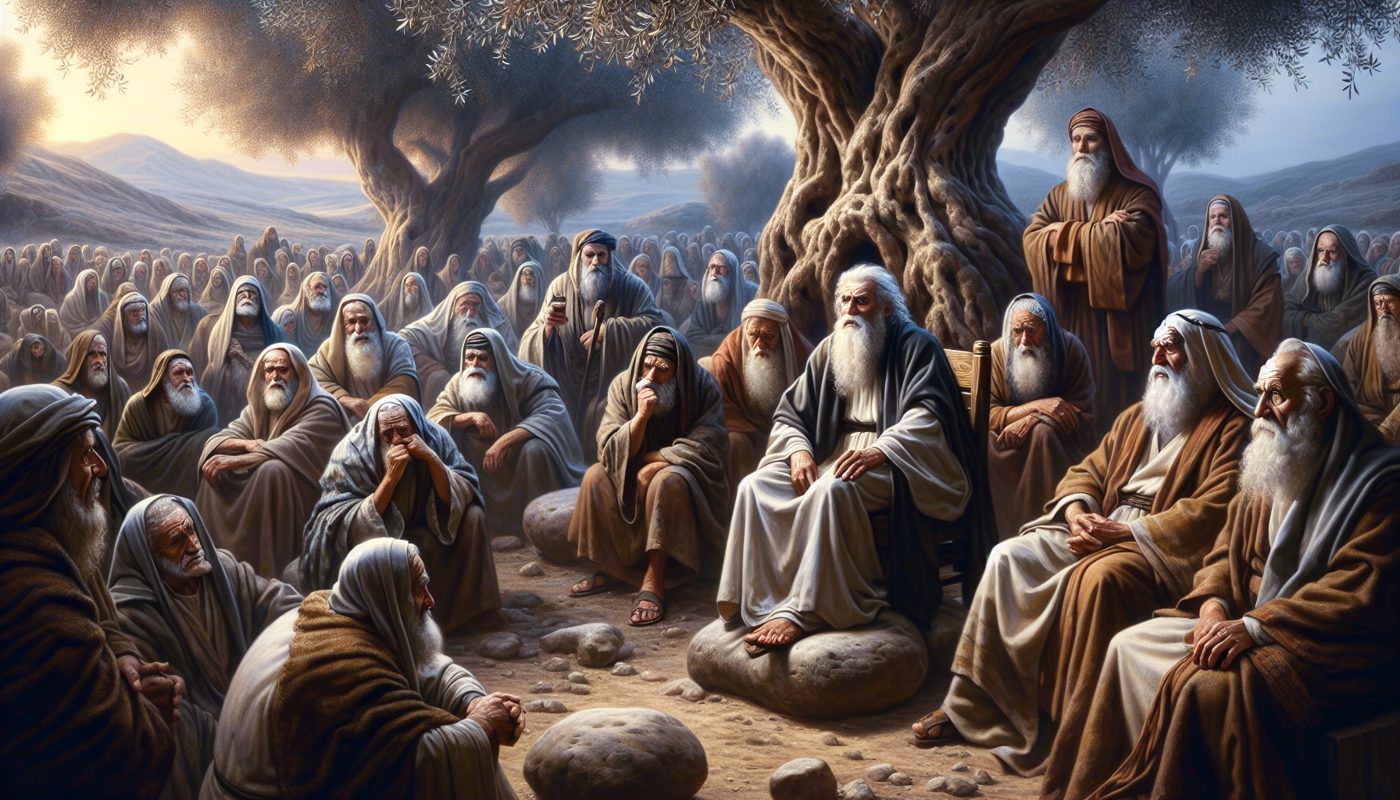
The elders of Israel came to Samuel at Ramah with a single demand. They did not come seeking counsel or asking for a prophet’s prayer. They came as a delegation, and their spokesman laid out the case plainly: Samuel was old, his sons did not walk in his ways, and they wanted a king to judge them like all the other nations.
Samuel had appointed his sons Joel and Abijah as judges in Beer-sheba, but the chapter records that they turned aside after dishonest gain. They took bribes and perverted justice. The text does not elaborate on their corruption beyond that, but it was enough to give the elders their pretext. The elders did not ask Samuel to remove his sons or to appoint better judges. They demanded a king.
The request displeased Samuel. The chapter does not say whether Samuel was hurt by the personal slight or grieved by the rejection of the Lord’s order. What it does say is that Samuel prayed to the Lord. He did not argue with the elders or rebuke them on the spot. He took the matter to God.
The Lord’s response cut to the heart of the matter. He told Samuel that the people had not rejected Samuel; they had rejected the Lord from being king over them. The Lord traced this rejection back to the exodus from Egypt, saying that just as the people had forsaken Him and served other gods throughout their history, so now they were doing to Samuel.
Then the Lord gave Samuel a command that seems almost contradictory. He told Samuel to listen to the people and grant their request, but also to solemnly warn them and show them the manner of the king who would reign over them. Samuel was to give them what they wanted, but not before they understood exactly what they were asking for.
Samuel delivered the warning with precision. He told the people that a king would take their sons for his chariots and horsemen, to run before his chariots, to serve as captains and soldiers, to plow his ground and reap his harvest, and to make weapons of war. He would take their daughters to be perfumers, cooks, and bakers. He would take their best fields, vineyards, and olive groves and give them to his servants. He would take a tenth of their seed and their vineyards for his officers. He would take their servants and their best young men and their donkeys for his work. He would take a tenth of their flocks. And the people themselves would become his servants.
Samuel ended the warning with a grim prophecy. When that day came, the people would cry out because of the king they had chosen for themselves, but the Lord would not answer them on that day.
The people refused to listen. They repeated their demand with even greater insistence. They wanted a king to judge them, to go out before them, and to fight their battles. They wanted to be like all the other nations. That was the core of their demand: not justice, not protection, but conformity to the nations around them.
Samuel took the people’s words back to the Lord. And the Lord gave the final word: listen to their voice and make them a king. Samuel then dismissed the men of Israel, telling each to go back to his own city. The chapter ends there, with no king appointed yet, only the Lord’s permission and the people’s stubborn insistence.
The chapter does not tell us what Samuel felt as he sent the elders home. It does not describe the faces of the elders or the mood of the crowd. It gives only the bare bones of the transaction: a request, a prayer, a warning, a refusal, and a divine concession. The weight of the chapter rests on the fact that Israel rejected the Lord as their king and chose instead to be like the nations, fully aware of the cost.
Comments
Comments 0
Read the discussion and add your voice.
Members only
Sign in to join the conversation
We keep comments tied to real accounts so the discussion stays clean and trustworthy.
No comments yet. Be the first to add one.