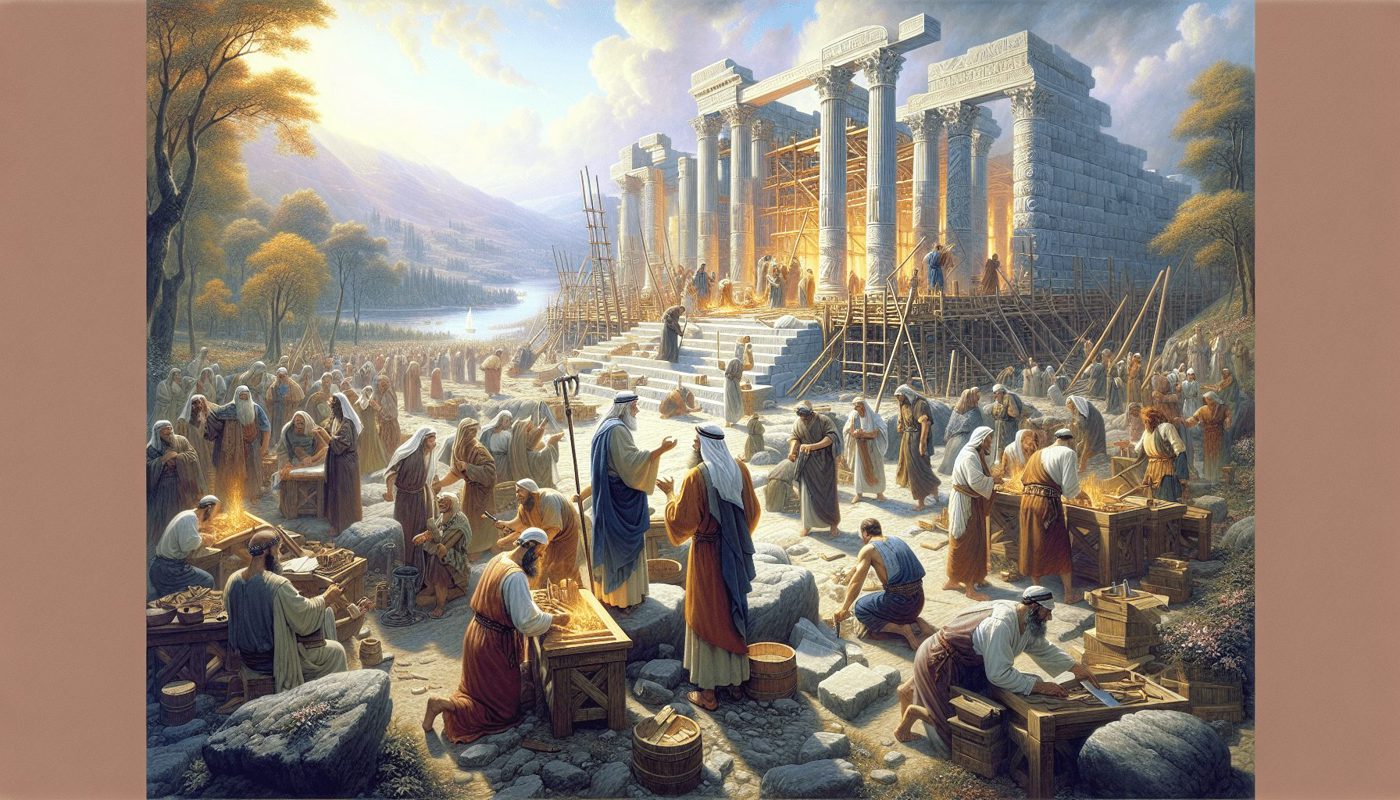
The chronicler opens the account of the Temple with a precise location. Solomon began to build the house of the Lord in Jerusalem, on Mount Moriah, where the Lord had appeared to his father David. This was not an arbitrary site. It was the place David had prepared, the threshing floor of Ornan the Jebusite, a spot already marked by divine encounter. The chronicler anchors the work in a specific history, not in general piety.
The building began in the second month of the fourth year of Solomon's reign. The chronicler gives the date plainly, without embellishment. This was a royal project, ordered by a king, and the record keeps the timing exact. No spiritualizing of the season appears in the text. The work simply started when Solomon said it would.
The foundations of the house of God measured sixty cubits in length and twenty cubits in breadth, using the old standard of measure. The chronicler states these numbers without commentary. The dimensions are given as fact, not as symbolism. The Temple was a structure of real proportions, built on a foundation that could be measured and recorded.
The porch before the house matched the breadth of the house at twenty cubits, but its height reached one hundred and twenty cubits. The chronicler notes that Solomon overlaid the entire porch within with pure gold. This is the first mention of gold in the chapter, and it sets the tone for what follows. The house was not merely built; it was covered in gold.
The greater house, the main hall, was paneled with fir wood and then overlaid with fine gold. On the gold overlay, the craftsmen worked palm trees and chains. The chronicler does not explain the meaning of these designs. They are simply recorded as part of the ornamentation. The house was garnished with precious stones for beauty, and the gold used was gold of Parvaim, a specific source that the chronicler names without further explanation.
The overlay of gold extended to the beams, the thresholds, the walls, and the doors. On the walls, the craftsmen engraved cherubim. The chronicler lists each element methodically: beams, thresholds, walls, doors, cherubim. Nothing is left out. The house was a single, unified work of overlay and carving, every surface treated with the same care.
The most holy house, the inner sanctuary, was twenty cubits square, matching the breadth of the house. Solomon overlaid it with fine gold amounting to six hundred talents. The weight of the nails used in the overlay was fifty shekels of gold. The upper chambers were also overlaid with gold. The chronicler gives these weights and amounts with the same precision he used for the dimensions. The cost is not hidden or spiritualized. It is stated plainly.
Inside the most holy house, Solomon made two cherubim of image work and overlaid them with gold. The wings of these cherubim stretched twenty cubits in total. Each wing measured five cubits, one reaching to the wall of the house, the other touching the wing of the other cherub. The cherubim stood on their feet, their faces turned toward the house. The chronicler describes their position and orientation without interpreting their posture. They were simply there, facing inward.
Solomon made a veil of blue, purple, crimson, and fine linen, with cherubim worked into the fabric. The veil separated the holy place from the most holy. The chronicler lists the colors and the material, but he does not explain the symbolism of the colors or the cherubim. The veil is a piece of the structure, recorded like the gold and the wood.
Before the house, Solomon set up two pillars. Each pillar was thirty-five cubits high, with a capital on top of five cubits. He made chains for the oracle and placed them on the tops of the pillars, along with a hundred pomegranates on the chains. The pillars were set up before the temple, one on the right and one on the left. Solomon named the right pillar Jachin and the left pillar Boaz. The chronicler gives the names, but he does not explain what they mean. The pillars stood as named objects, part of the Temple's entrance, recorded for the record.
The chapter ends with the pillars in place. The chronicler does not add a summary or a moral. He does not tell us what the Temple meant or how the people responded. He simply records that Solomon built the house of the Lord on Mount Moriah, with gold, with cherubim, with pillars, and with a veil. The work was done, and the chronicler wrote it down.
Comments
Comments 0
Read the discussion and add your voice.
Members only
Sign in to join the conversation
We keep comments tied to real accounts so the discussion stays clean and trustworthy.
No comments yet. Be the first to add one.