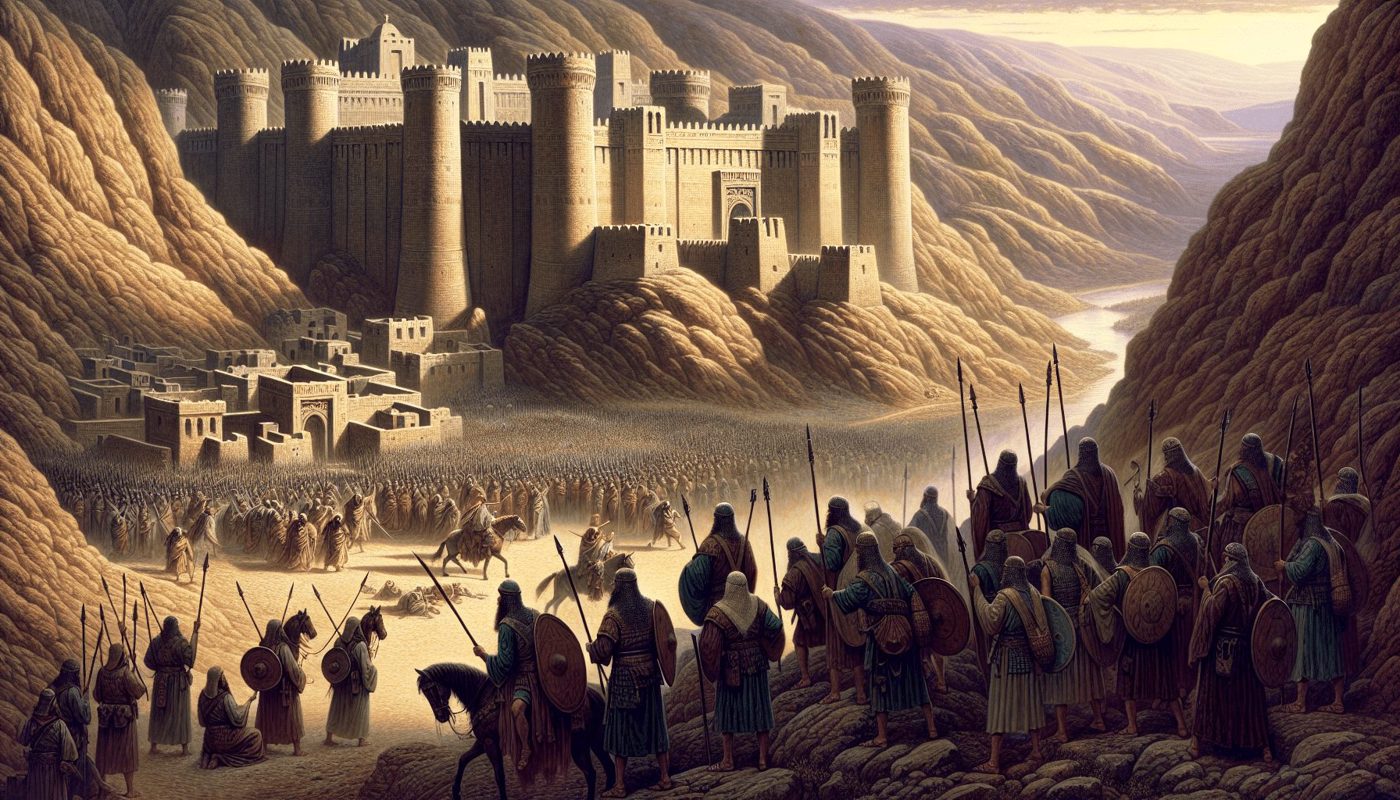
The siege of Rabbah ended not with David leading the charge, but with David waiting in Jerusalem. The text is blunt: at the turn of the year, when kings normally went to war, Joab led the army out, ravaged Ammonite territory, and besieged the capital. David stayed behind. Joab struck the city and overthrew it. The victory belonged to Israel, but the king was not on the field when the walls broke.
When the city fell, David went to Rabbah to collect the spoils. The crown of the Ammonite king was taken from the defeated ruler's head. It weighed a talent of gold—roughly seventy-five pounds—and was set with precious stones. David put it on his own head. The gesture was not mere vanity; it was the visible transfer of sovereignty. The king of Ammon was gone, and David now wore his crown.
David also brought out the plunder of the city, and it was very much. The text does not itemize the gold, silver, or goods, but it emphasizes the scale: exceeding much. Then came the treatment of the captured people. David brought them out and set them to work with saws, iron harrows, and axes. The language is harsh, and the verbs are blunt. The Chronicler does not soften it. David did this to all the cities of Ammon. Then he and all the people returned to Jerusalem.
The chapter then shifts. The war with Ammon was finished, but war with the Philistines resumed. The location was Gezer. There a man named Sibbecai the Hushathite killed Sippai, who was described as one of the sons of the giant. The phrase carries weight: the giant had offspring, and those offspring fought Israel. After this engagement, the Philistines were subdued—but not for long.
Another battle followed. This time Elhanan the son of Jair killed Lahmi, the brother of Goliath the Gittite. The detail is precise: the staff of Lahmi's spear was like a weaver's beam. The reader of Samuel knows that same description was used for Goliath's spear. The giant's kin carried the same kind of weapon. The Chronicler is tying these later fights directly to the earlier confrontation with Goliath.
Then there was war at Gath itself. There the Chronicler describes a man of great stature who had six fingers on each hand and six toes on each foot—twenty-four digits in all. This man also was born to the giant. The text does not call him a freak or a monster; it simply records the physical detail and then notes his lineage. He was part of the same family that had troubled Israel for generations.
This man defied Israel, and Jonathan the son of Shimea, David's brother, killed him. The name Jonathan appears without fanfare. He is not the famous Jonathan, son of Saul, but a nephew of David. The Chronicler does not pause to celebrate him. He simply records the act: the giant's son defied Israel, and David's relative struck him down.
The chapter closes with a summary: these were born to the giant in Gath, and they fell by the hand of David and by the hand of his servants. The wording is careful. David is named first, but the actual killing was done by his men—Sibbecai, Elhanan, Jonathan. The king's hand was present in the authority that sent them, but the blows were struck by others. The giants of Gath were not a single threat; they were a bloodline, and that bloodline was ended not in one battle but in a series of engagements after the fall of Rabbah.
The Chronicler offers no moral reflection on the treatment of the Ammonites or the killing of the giants. He does not explain why David stayed in Jerusalem or why the giants kept appearing. He simply reports what happened. The chapter is a record of completion: the Ammonite capital was taken, its king's crown was seized, and the giant line in Philistia was cut down piece by piece. The wars did not end, but the threats that had loomed largest were finished.
Comments
Comments 0
Read the discussion and add your voice.
Members only
Sign in to join the conversation
We keep comments tied to real accounts so the discussion stays clean and trustworthy.
No comments yet. Be the first to add one.