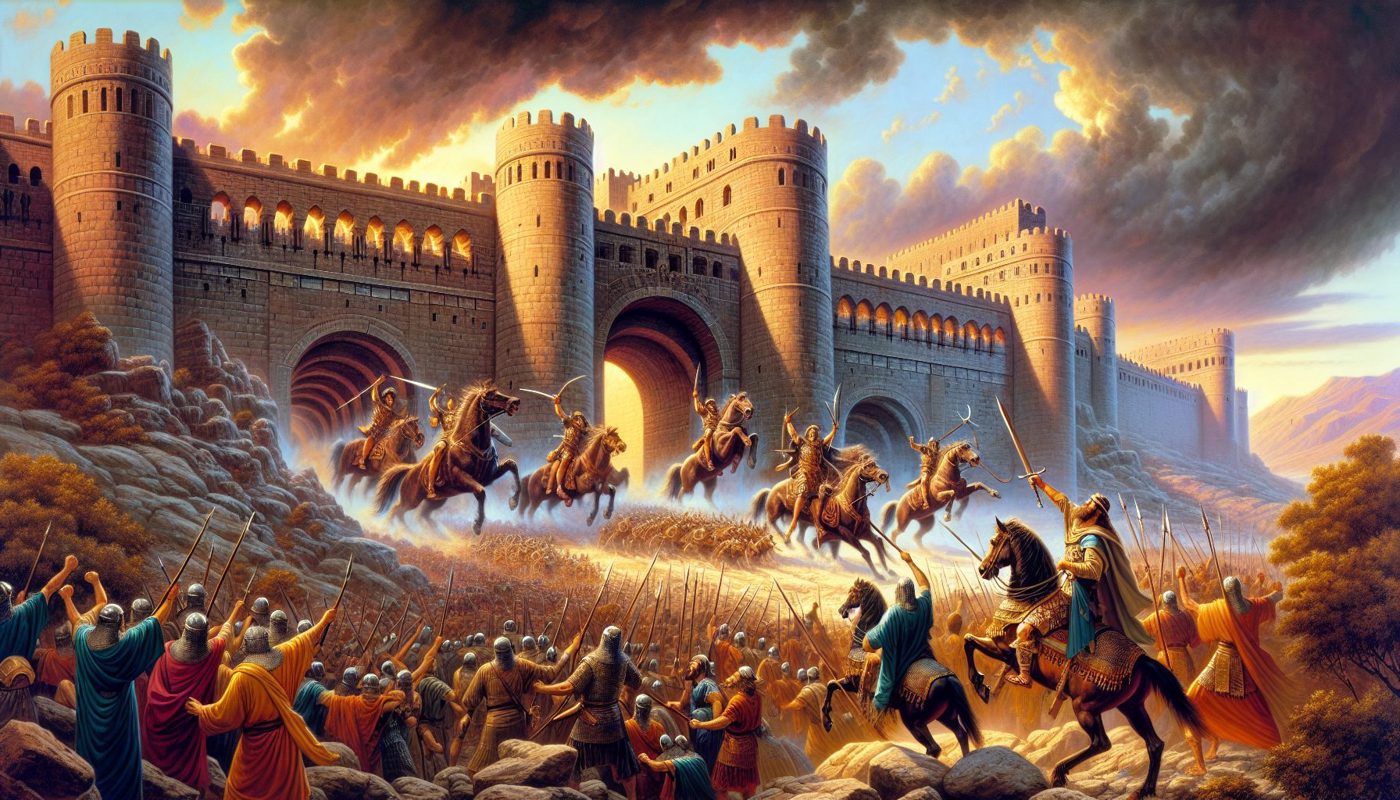
The chapter opens at the turn of the year, the season when kings customarily go to war. Joab led the army out, ravaged the land of the Ammonites, and then laid siege to their capital, Rabbah. David stayed behind in Jerusalem. Joab struck the city and overthrew it. The text does not explain why David remained, nor does it describe the siege in any detail. What matters is that Rabbah fell, and the king came to collect the spoils.
David took the crown of the Ammonite king from his head. It weighed a talent of gold—roughly seventy-five pounds—and was set with precious stones. David placed that crown on his own head. He also brought out a great quantity of plunder from the city. The crown was not merely a trophy; it became part of David's regalia, a visible sign that the throne of Ammon had been transferred to Israel.
Then David dealt with the people of Rabbah. He brought them out and set them to work with saws, iron harrows, and axes. The phrasing is blunt: he cut them with these tools. Whether this means forced labor or execution is not clarified in the chapter itself. What is clear is that David applied the same treatment to all the cities of the Ammonites. Afterward, he and all the people returned to Jerusalem.
The narrative then shifts abruptly. There is no transition, no summary of David's reign. Instead, the text records a series of battles against the Philistines, each featuring a single combat against a giant. The first occurred at Gezer. Sibbecai the Hushathite killed Sippai, who is described as one of the sons of the giant. The Philistines were subdued.
A second war with the Philistines followed. Elhanan son of Jair killed Lahmi, the brother of Goliath the Gittite. The detail given is that the staff of Lahmi's spear was like a weaver's beam—a thick, heavy shaft that would require great strength to wield. Elhanan is not David; he is a different warrior, and this is a different giant from the one David faced in his youth.
Then there was another war at Gath. There the text describes a man of great stature who had six fingers on each hand and six toes on each foot—twenty-four digits in all. He also was born to the giant. When this man defied Israel, Jonathan son of Shimea, David's brother, killed him. The chapter does not say how Jonathan killed him, only that he did.
The chapter closes with a summary statement: these four men were born to the giant in Gath, and they fell by the hand of David and by the hand of his servants. The phrase is careful. David himself is credited, but so are his warriors. The giant's line at Gath was cut down not by a single hero but by the king and his fighting men together.
What stands out in this chapter is the compression. The fall of Rabbah, the subjugation of the Ammonites, and the elimination of Philistine giants are all reported in the same flat tone. There is no celebration, no theological commentary. The crown is taken, the people are dealt with, the giants are killed. The chapter simply records that these things happened under David's authority, and then it moves on.
The giants at Gath are described with precise physical detail—the weaver's-beam spear, the extra fingers and toes. These details anchor the account in the concrete. These were real men, unusually large, armed with heavy weapons, and they challenged Israel. Each was met by a specific Israelite fighter, and each was killed. The repetition of the phrase “born to the giant” emphasizes that this was a family or a line of warriors, not a random collection of large individuals.
The chapter offers no moral or lesson. It does not say that David's victory over Rabbah was just, nor does it explain why the giants had to die. It simply reports the events as they happened. The reader is left to draw whatever conclusions the broader narrative of Chronicles may provide. For this chapter alone, the point is that the Ammonite capital fell, its king's crown was taken, and the giant clans of the Philistines were defeated in battle by David's men.
Comments
Comments 0
Read the discussion and add your voice.
Members only
Sign in to join the conversation
We keep comments tied to real accounts so the discussion stays clean and trustworthy.
No comments yet. Be the first to add one.