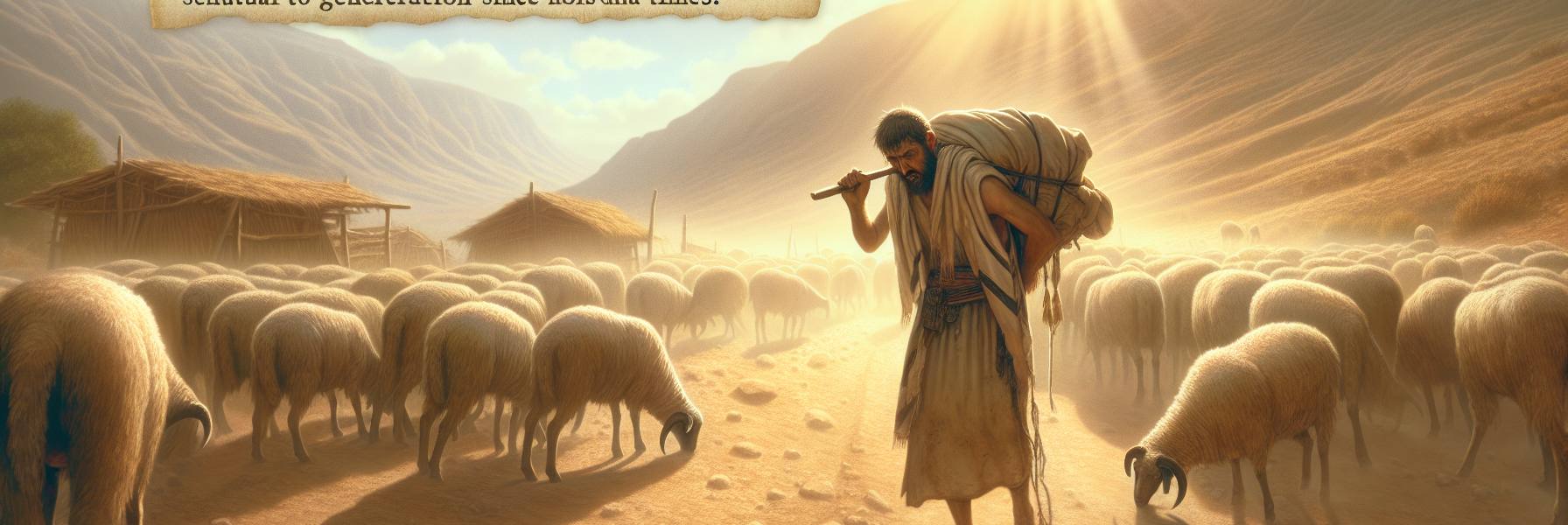

The heat was a living thing that summer. It lay upon the shoulders of the men and dogs alike, a heavy wool cloak that could not be shaken off. Eliav felt it more than most, for his discomfort was twofold. There was the sun, hammering the pale rocks of the hills until they shimmered, and there was the other thing, the secret uncleanness that had begun a week ago. A slow, persistent seepage that was not blood, but rendered him, he knew, just as separate.
He’d noticed it first after hauling a stubborn ewe from a fissure. A dampness, a chilling wrongness. By the second day, there was no denying the flux. The Law, whispered from father to son since Sinai, echoed in his skull: *Any bed on which the one with the discharge lies shall be unclean, and everything on which he sits shall be unclean.*
His small house became a map of contamination. He withdrew to a corner of the packed-earth floor, spreading a rough goat-hair blanket that was his alone. His wife, Miryam, moved with a careful, sad silence. She understood. When he handed her his sleeping mat to air outside, their fingers did not touch. Her eyes, when they met his, held no reproach, only a weary acceptance. This was the way of things. The holiness of the camp demanded it.
The isolation was a taste in his mouth, sour as unripe olives. He took his meals apart, on a flat stone. The simple clay cup he used felt conspicuously alien on the shelf. If he touched it, it was defiled. If he sat on the three-legged stool, it was defiled. The rules were meticulous, a fence around a sacred mystery he did not claim to understand, only to obey. It wasn’t about sickness, not as the Egyptians might have thought. It was about a disruption in the order of a life, a creeping shadow that touched what was normal and made it unfit for the presence of the Holy.
On the eighth day, the flux ceased. A fragile hope, dry as a gourd, rattled within him. But the Law was precise. Seven days of cleanness were required. Seven more days of watching, of praying the dampness did not return. He counted them like a miser counts coins, each sunrise a small treasure.
Finally, on the morning of the fifteenth day, he rose. The clean, dry linen of his loincloth was a profound relief. He took two turtledoves from the wicker cage, their feathers grey and soft in his calloused hands. Their muted cooing was the sound of hope.
The walk to the Tabernacle enclosure was short, but he felt every step. The world seemed sharper. The chatter of women at the well, the smell of baking bread from a nearby tent, the dust kicked up by children’s feet—it all belonged to a world from which he had been an exile. He approached the outer court, the acrid-sweet smell of the altar fires filling his nostrils. He waited, birds in hand, until a young priest, his linen robes bright in the sun, noticed him.
“The flux,” Eliav said, his voice rough from little use. “It has left me. I have kept the days.”
The priest nodded, his face neither kind nor unkind, merely official. This was the work: to be a gatekeeper between the clean and the unclean, the holy and the common. He took the birds. One would be a sin offering, a recognition that this condition, like all flaws of the flesh, touched upon the realm of trespass. The other, a burnt offering, a gift of totality, a rising smoke of restoration.
Eliav watched as the priest worked with efficient, holy hands. The twist of the bird’s neck for the sin offering was swift. The blood was caught, dabbed on the horns of the altar, the rest poured out at its base. The second bird, for the burnt offering, was prepared and laid upon the wood. The fire took it with a crackle and a hiss, the smoke climbing straight and thin into the cloudless blue.
No voice spoke from the heavens. No warmth flooded his limbs. But as the priest turned to him and gave a slight, final nod, the weight lifted. It was not a dramatic feeling, but a deep, quiet settling. The fence was gone. He could touch his wife’s hand. He could sit at his own table. He could, if he chose, join the congregation tomorrow.
He turned for home, the empty cage swinging at his side. The same heat lay on the land. The same dust coated his sandals. But the world had been given back to him. It was a theology written not in scrolls, but in the body: a story of loss, of patient abiding in the prescribed order, and of a return made possible not by one’s own power, but by the meticulous, costly grace of a God who provided a way through the blood of small, helpless things. The silence around him was no longer the silence of isolation, but the spacious, clean silence of peace.