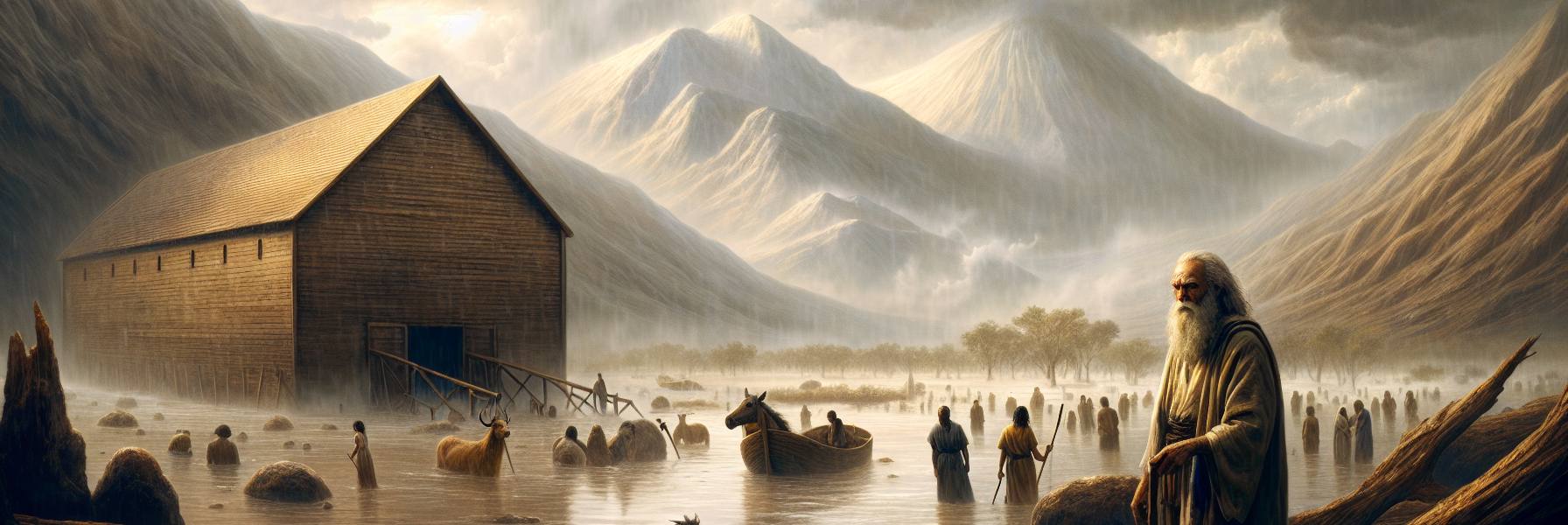

The air, after the flood, was a different thing. It did not yet carry the old, familiar scents of tilled earth and settled dust. Instead, it smelled of deep, secret water and of things freshly born or freshly dead. A vast, aching silence lay upon the mountains of Ararat, broken only by the suck of mud and the distant, lonely cry of a bird exploring the new contours of the world.
Noah stood at the entrance of the ark, his hands resting on the rough, pitch-stained timber. He was an old man, older than the drowned world, and his bones felt heavy with the memory of the deep. He looked at his family—Shem, Ham, Japheth, their wives—their faces gaunt with a year of shadowed, floating life. They were all he had. All there was.
God spoke to Noah and his sons. The voice was not in the thunder, for the storm was past. It was in the quiet, a resonance in the new stillness. “Be fruitful,” it said, and the words felt like a command etched into the very substance of the air. “Multiply and fill the earth.” It was the first command given to Adam, now given again, a second start written on a washed slate.
Noah listened, the weight of it settling on his shoulders. Then God laid out the terms of this new world. “Every moving thing that lives shall be food for you.” It was a startling concession. In the old world, perhaps, there had been only greens and fruits. Now, in this raw, emptied place, the fear and the dread of humanity would be upon every beast. They could be eaten, but with a condition—a sacred line drawn in the blood. “You shall not eat flesh with its life, that is, its blood.” Life belonged to God alone. To consume the blood was to claim the life, and that was not humanity’s right. It was a law of reverence, a curb for the appetite in a world where appetite would now reign.
Then God said something that made Noah’s breath catch. It was about accountability, a reckoning not just for man, but for man from the animals. “For your lifeblood I will require a reckoning: from every beast I will require it and from man. From his fellow man I will require a reckoning for human life.” The sanctity of the image of God was now under a universal law. A beast that killed a man would be held to account. A man who killed a man—his fellow—would be held to account by his fellows. It was the grim, necessary seed of justice, planted in the mud of the new earth.
“Whoever sheds the blood of man, by man shall his blood be shed,” God said, and the words were iron. “For God made man in his own image.” It was not vengeance. It was a terrifying guardianship of the divine imprint. To murder was to attack the image of God Himself. The responsibility for maintaining this awful, holy order was now placed in human hands.
Then God spoke again to Noah, and to his sons with him. He established a covenant. A promise. Not just with them, but with every living creature that had shuddered in the dark hold of the ark. “Never again,” God said, and the promise seemed to still the very wind. “Never again shall all flesh be cut off by the waters of the flood. Never again shall there be a flood to destroy the earth.”
As a sign for this everlasting covenant, God set his warrior’s bow in the clouds. Noah saw it first after a passing shower, as the sun strained through the retreating veil of rain. There, against the bruised grey, was an arc of breathtaking colour—violet, blue, green, yellow, orange, red—a luminous bridge that touched nothing, a weapon of war hung up and resting. “When I bring clouds over the earth,” God said, “the bow will be seen in the clouds, and I will remember my covenant.” The sight did not bring fear, but a strange, fragile peace. The bow was not aimed at the earth. It was aimed away, its string slack. A reminder to God Himself of His own restraint.
The seasons turned. The family came down from the mountains. They found a valley where the earth was soft and forgiving. Noah, the tiller of the ground from the old world, became a husbandman again. He planted a vineyard. It was an act of profound hope, to put a vine into the ground and wait years for it to bear fruit, trusting in the regularity of sun and rain, trusting in the promise symbolized by the bow.
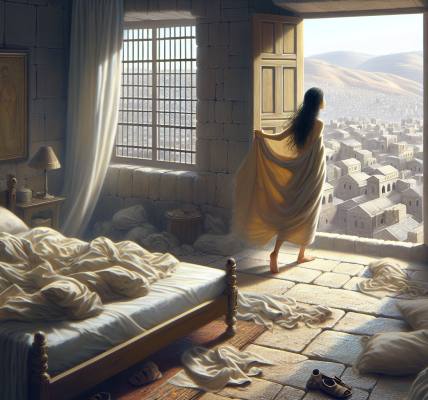
Years later, the vines bore heavy clusters. Noah harvested them, crushed the grapes, and let the juice ferment in skins. He drank the wine. He drank too much of it. The old man, the survivor of God’s wrath and the bearer of God’s covenant, lay uncovered in the dank gloom of his tent, lost in a stupor that drowned memory.
Ham, his son, came into the tent. He saw his father’s nakedness, the vulnerable, shameless exposure of the one who had been their pillar. Instead of turning away, instead of covering him, Ham went out and told his brothers, a kind of ugly mirth in his voice. “Look at the great Noah,” he might have said.
Shem and Japheth heard. A deep shame washed over them—not for themselves, but for their father. They took a garment, laid it across their own shoulders, and walking backwards, their faces turned away, they entered the tent and draped the cloth over their father’s naked form. They saw nothing.
When Noah awoke from his wine, he learned what his youngest son had done to him. The knowledge was a colder, more private flood. The corruption was not gone; it had ridden in the ark with them. It was in the mocking eye, in the failure of reverence, in the exposure of weakness for sport.
His words, when they came, were heavy and prophetic, smelling of earth and curse and blessing. He did not curse Ham directly, but Canaan, Ham’s son. “A servant of servants shall he be to his brothers.” It was a fate of subservience, a legacy of dishonour born from a moment of dishonour.
Then he turned to Shem and Japheth. “Blessed be the Lord, the God of Shem,” he said, making Shem’s blessing primarily theological—a closeness to the Divine. To Japheth he granted enlargement, a spreading out. “Let him dwell in the tents of Shem.” It suggested a sharing, a fellowship under the broader blessing.
After this, Noah lived for centuries more, a relic of the drowned age watching over the spreading generations. He saw the beginnings of strife, the gathering of peoples, the slow forgetting of the ark and the bow. But after every rain, he would look up. And there it would be—the silent, colourful bow in the cloud, a promise hanging in the sky, a reminder that mercy now sat on the throne above the waters, and that the God who had washed the world clean was patient, bound by His own word, waiting in the long, slow afternoon of history.