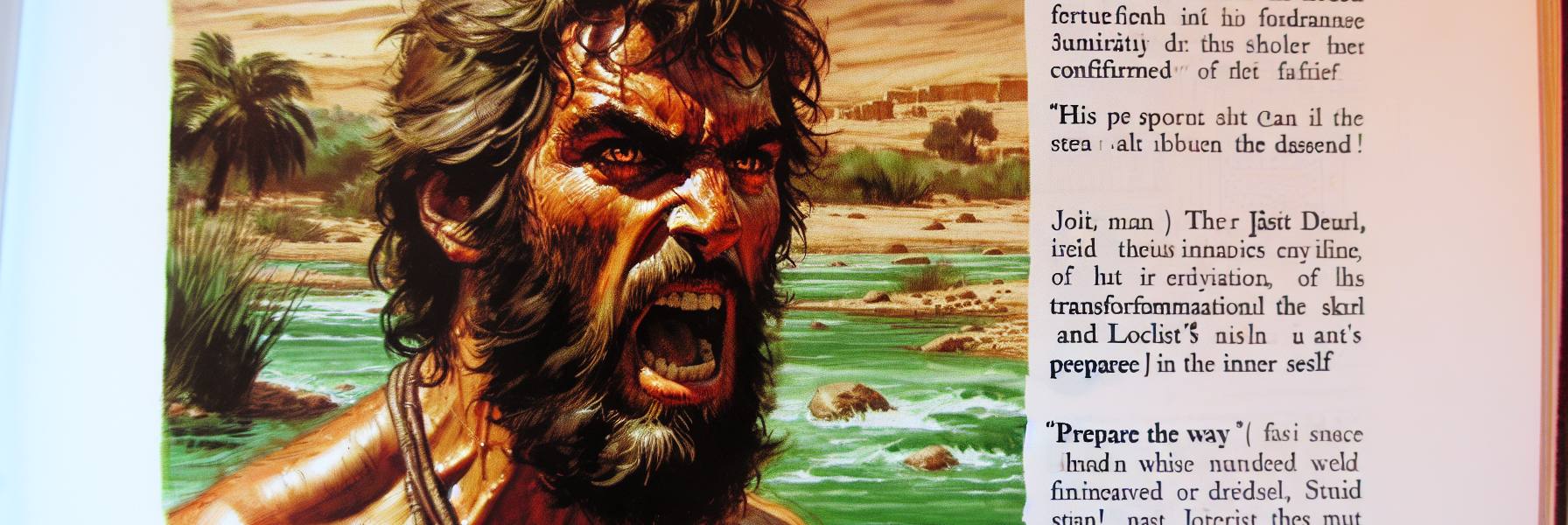

The story begins not with a king, but with a voice. A voice that seemed to rise from the very stones of the wilderness, carried on the dry, hot wind that scoured the barren slopes east of the Jordan. It belonged to a man dressed in camel’s hair, his skin leathered by sun and austerity, his diet the stark simplicity of locusts and wild honey. John. People traveled from Jerusalem, from all over Judea, drawn by a rumor of prophecy revived. They came to the river, not to a temple, and found him there, waist-deep in the green-brown water, speaking of a repentance that wasn’t about ritual, but about rupture. A turning inside out. “Prepare the way!” he would shout, his eyes holding a fire that made comfortable men uneasy. The way, he said, was not for him. One was coming, so much greater that John felt unfit to even kneel and loosen his sandal-strap.
One day, amid the crowd of tax collectors and soldiers, Pharisees and fishermen, a man from Galilee joined the throng. He didn’t stand out in any particular way; his hands were calloused from wood, his frame sturdy. His name was Jesus, of Nazareth. When he waded into the water to meet John, something in his quiet dignity gave the Baptist pause. John protested, a hushed, urgent argument lost in the river’s murmur. But Jesus insisted, and John consented. As he lifted Jesus from the water, the heavens didn’t just open, they were torn apart. It was a violent, rending image, as if the fabric separating the divine and the earthly was ripped from top to bottom. A dove descended, not like a bird in flight, but with a deliberate, gentle settling. And a voice, not of thunder, but of profound, intimate affirmation: “You are my Son, whom I love; with you I am well pleased.” It was a moment of seismic quiet, witnessed yet somehow deeply private.
Immediately—Mark’s favorite word, a sense of urgent purpose—that same Spirit drove Jesus out, further into the emptiness. The wilderness wasn’t a backdrop for meditation; it was an arena. For forty days he was among the wild beasts, the heat of day giving way to the penetrating cold of desert nights. Angels attended him, yes, but their presence didn’t negate the reality of the hunger, the loneliness, the piercing, logical whispers of the adversary. The temptations were not cartoonish, but profound perversions of the identity just declared at the river: to turn stone to bread, to claim a kingdom without the cross, to test the Father’s promise. He emerged leaner, focused, the peace of resolved conflict upon him.
John’s voice was silenced, taken by Herod and thrown into a dungeon. With the forerunner’s work complete, Jesus returned to Galilee, the message crystalizing in his proclamation: “The time has come. The kingdom of God has come near. Repent and believe the good news!” It wasn’t a distant promise; it was a present reality, breaking in like the first light over the hills of Capernaum.
Walking along the pebbled shore of the Sea of Galilee, the smell of salt and dried fish in the air, he saw Simon and his brother Andrew. They were casting a net, a circular throw that spread like a canopy before sinking into the deep. His call was deceptively simple. “Come, follow me, and I will make you fishers of men.” No lengthy discourse. They looked at him, at each other, at their nets—their livelihood, their identity. In a decision that made no worldly sense, they left the nets lying, beached and empty, and followed. A little farther, he saw James and John, the sons of Zebedee, in their boat with their father, mending tears in the great, woven nets. The call came again. They left the boat, the nets half-repaired, their father sitting amid the tangled cords, a silent, bewildered figure receding behind them.
Capernaum became a kind of base. On the Sabbath, he taught in the small synagogue, a plain building of local stone. But his teaching wasn’t like the scribes’, who cited precedent upon precedent. He taught with an authority that was his own, a clarity that cut through layers of tradition to the beating heart of God’s intent. It unsettled people, this unborrowed certainty.
Then, in that holy space, a shriek shattered the discourse. A man possessed by an impure spirit writhed in the shadows of the congregation. “What do you want with us, Jesus of Nazareth?” the spirit screamed through the man’s contorted mouth. “Have you come to destroy us? I know who you are—the Holy One of God!” The air grew thick. Here was a recognition from the unseen world, a defiant, fearful acknowledgment. Jesus’ response was swift and stern, a command that brooked no debate. “Be quiet! Come out of him!” The convulsion that followed was violent; the man shook as if electrocuted, a final, inhumane cry tearing from his throat before he collapsed, spent and clean, on the stone floor. The silence that followed was absolute, then burst into a wave of hushed, astonished questions. “What is this? A new teaching—and with authority! He even gives orders to impure spirits and they obey him.” News of it, raw and unfiltered, began to seep into every lane and courtyard of the town.
He left the synagogue and went to Simon’s house, a low, square home of basalt rock. Simon’s mother-in-law was down with a fever, a serious thing in a time and place without medicine. They told him about her, perhaps hoping for a comforting word. He went to her, took her hand, and helped her up. The fever left her so completely, so instantly, that she didn’t convalesce; she simply got up and began to see to their needs, the energy of health restored flowing into service.
That evening, as the sun sank behind the hills of Galilee and the Sabbath ended, the whole town seemed to gather at the door. It was a scene of quiet desperation—the lame, the fevered, the tormented, carried on mats by loved ones. One by one, under the emerging stars, he healed them. He drove out many demons, who knew him and shouted their doomed recognition, but he would not permit them to speak. It wasn’t time for the testimony of hell.
In the deep dark before dawn, while the town still slept in exhausted relief, Jesus slipped away. He found a solitary place out among the rocky hills and prayed. It was a necessary rhythm, this withdrawal into the silence of the Father. Simon and the others hunted for him, finally tracking him down. “Everyone is looking for you!” they said, breathless, perhaps imagining a triumphant return to a waiting crowd. But his path was not set by popular demand. “Let us go somewhere else—to the nearby villages,” he said, “so I can preach there also. That is why I have come.” And so they went, not as celebrities, but as itinerant heralds, moving through the villages of Galilee, preaching, and driving out demons, the message and the power intertwined, a quiet, relentless invasion of a world held captive.