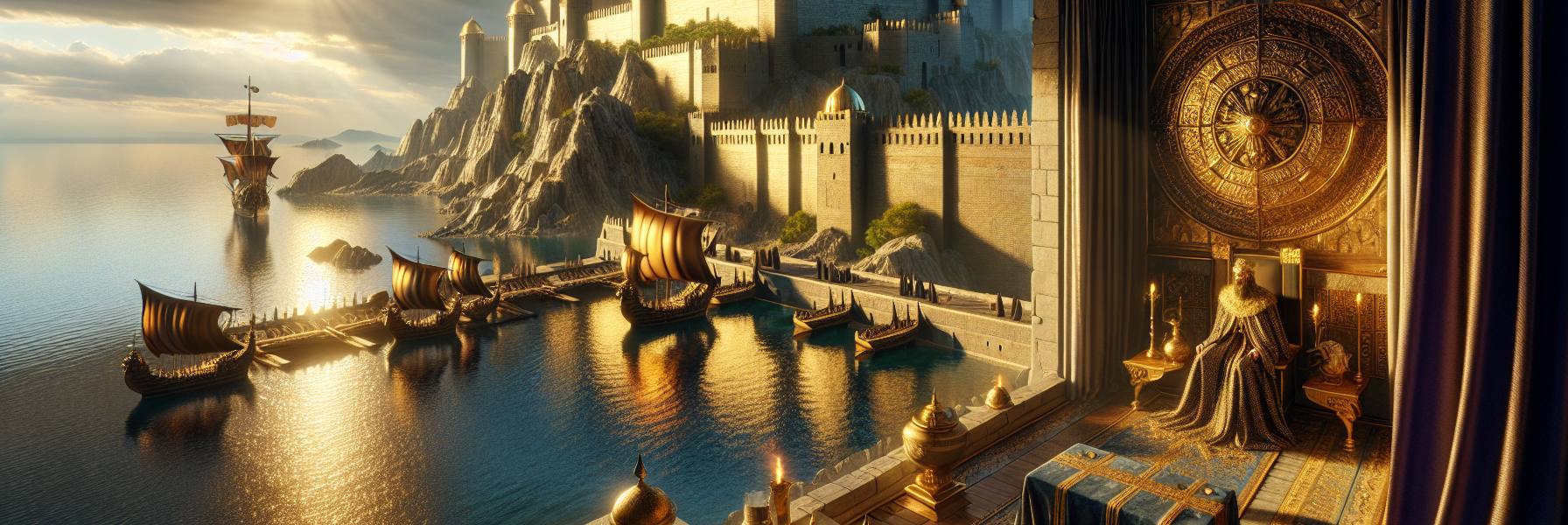

The morning sun did not so much rise over Tyre as it was reflected by it—a harsh, glittering light thrown back from gilded rooftops, from the bronze shields hung along the battlements, from the sea itself, which seemed to bow and shimmer before the island fortress. In his innermost chamber, a room sealed against the common air and perfumed with myrrh and cinnamon, the king stirred. The weight of his mantle, woven with threads of gold and studded with gems from Ophir, was a familiar pressure, a second skin of unquestioned authority. They called him a god. In the stillness before the courtiers arrived, he almost believed it.
His was a city born from the sea’s womb, a fortress of sandstone and ambition set upon the waves. The merchants who crowded its harbours were princes, and their ships, the veins of the world, carried silver from Tarshish, ivory and ebony from the coasts of Africa, fine linen from Egypt, and wine from Helbon. The dye vats produced the famed purple, the colour of twilight and of royalty, and the wealth of nations flowed into the storehouses of Tyre as rivers flow to the sea. The king, whose name was but a whisper of his office, moved through his days as the living soul of this splendour. “I am perfect in beauty,” the thought came, not as boast but as simple, accepted fact, as undeniable as the tides his mariners mastered. “I sit in the seat of the gods, in the heart of the seas.”
Wisdom was his, too, or a formidable likeness of it. He could calculate the seasons for voyages, decipher the stars for navigation, out-bargain any trader from Sidon to Gaza. His craftsmen, under his exacting eye, created marvels in gold and jewel setting, filling his treasuries with objects of desire. He understood the flow of power, the alliances sealed with gold and broken with steel. This understanding puffed him up, a slow, invisible inflation of the spirit. He looked at the mainland, at Jerusalem on its humble hill, and saw not a holy city but a market competitor, a stubborn knot in the web of his commerce.
Then, the dreams began. Not nightmares, but memories that were not his own. In them, he walked not on polished marble but on stones of fire. The air was clear and terrible, a brilliance that judged rather than illuminated. He was covered in every precious stone: carnelian, chrysolite, jasper, sapphire, emerald—a walking mountain of sacred geology. The sound was a symphony of perfect craftsmanship, tambourines and pipes woven into his very being. He was a guardian, a covering cherub, on a holy mountain. He walked amidst the stones of fire. And a voice, distant yet intimate, said, “You were blameless from the day you were created.”
He would wake, the taste of cosmic wind still in his mouth, the echo of a primal music in his ears, clutching the linen sheets of his mortal bed. The grandeur of the vision would fade, but the residue of its claim remained, fermenting in the dark cellar of his heart. The line between the allegory of his court poets—”O, god-king!”—and the eerie reality of the dream blurred. If he had once been *there*, then surely this throne, this city, was not enough. It was a stepping stone. His heart grew proud because of his beauty; he corrupted his wisdom for the sake of his splendour.
A prophet, a voice from the despised hills of Judah, spoke words that found their way to him, whispered by nervous ambassadors. They were ridiculous, of course. Talk of a net being cast, of being brought down to the pit, of dying the death of the uncircumcised by the hand of foreigners. He laughed, a dry sound in his perfumed room. He was Tyre. He was untouchable. The laws of nations did not apply to him. The God of shepherds and vineyards held no jurisdiction here, in this palace of finance and maritime power.
Yet, the inward decay was now a palpable thing. Violence entered his dealings, a new ruthlessness that went beyond shrewd business. The fleet that had been his pride became an instrument of piracy. The scales of his merchants were deliberately skewed. The beauty of the city became a weapon of arrogance, a slap in the face of the mainland. He sat, a merchant-king, and in the secret places of his heart, he concluded a final transaction: he traded the terror of the Holy for the security of his own might. He bought the lie that he had made himself.
The end, when it came, was not from the sea he commanded, but from the east. Nebuchadnezzar’s army, a patient, grinding force of land-lubbers and siege engineers, appeared on the shore. For thirteen years they worked, building a causeway of rubble and determination across the narrow strait. The king watched from his walls as the mole, that grotesque, slow finger of earth, pointed inexorably at his heart. The ships that could have broken it were somehow always out of position, their captains confused, the winds uncooperative. His wisdom, the brilliant, calculating mind, could find no flaw in the strategy, no leverage point. It had become a dull tool.
The day they broke through, the noise was not of battle cries but of collapse—the sickening groan of sandstone gates giving way, the crash of towers he had deemed eternal. The invaders, their faces strange and fierce, did not see a god. They saw a man in ridiculous, glittering robes, hiding among the sacks of dyed wool in a warehouse. They dragged him out into the smoke and the screaming. The last thing he saw, as the sword of a common soldier, a man who knew nothing of Ophir or the stars of the zenith, swung towards him, was the sky. It was not the polished lapis of his throne room ceiling. It was a wide, pitiless, empty blue, the very same that once covered the mountain of God. A voice, not his own, spoke within the ruins of his mind: *You have come to a dreadful end, and you shall be no more.*
And far away, in the dust and heat of exile, a man named Ezekiel set down his vision, his words carrying the weight of dual realities—the fate of a proud king and the shadow of a deeper, older fall. The ships of Tarshish wept in the harbours for their master, for in one moment of terror, they had seen the ultimate truth: all the brilliance in the world is just a reflection. The source of the light is elsewhere.