
The smell of burning cedar was the first thing that told Maron everything was finished. It wasn’t the smoke from cooking fires, that familiar, greasy haze that hung over the Sidonian quarter at dusk. This was a different scent—sharp, resinous, and expensive. It was the smell of wealth catching fire.
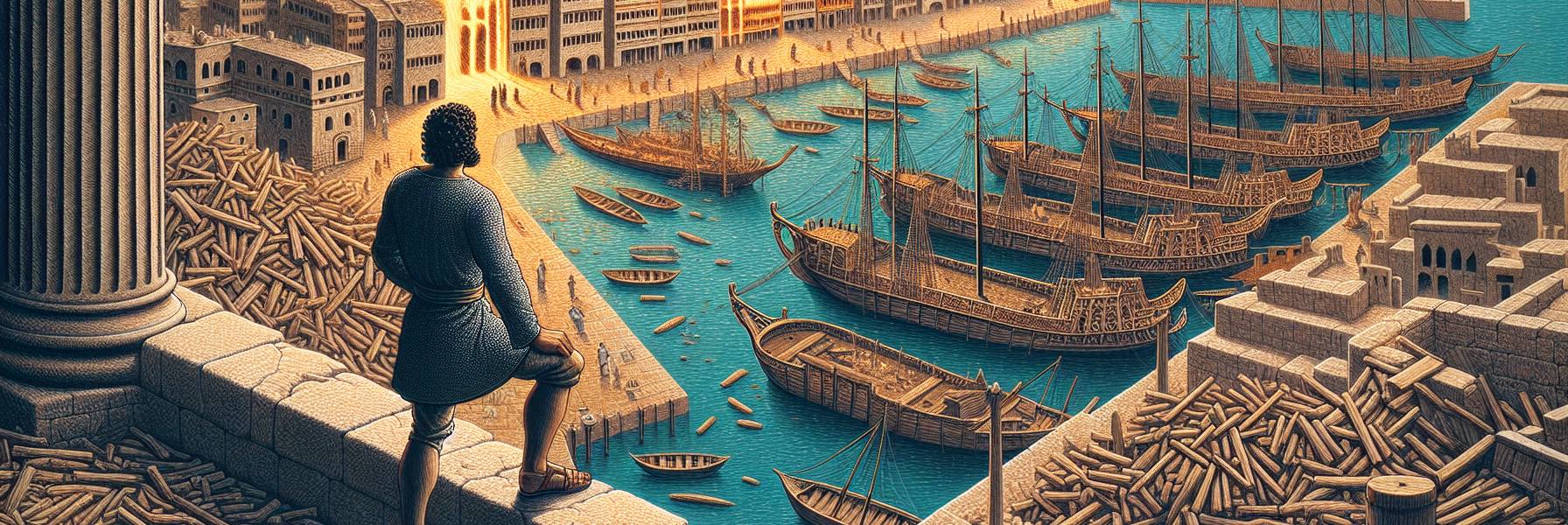
He stood on the flat roof of his warehouse, a structure of good Phoenician limestone that leaned slightly toward the harbour, as if yearning for the sea. From here, he could see the chaos unfolding in the great twin harbours of Tyre. The Sidonian harbour to the north was a mess of splintered masts and sinking hulls. The Egyptian harbour to the south fared little better; the bronze chain that could be raised to seal its entrance lay in twisted, molten ruins on the mole. Ships that had once carried linen from Memphis, tin from Tartessos, and ivory from Cush were now kindling for a conqueror’s bonfires.
A voice, guttural and raw, shouted from the street below. It was Old Laban, the potter, his tunic stained with clay and soot. “They’ve broken the sea gate! They’re in the lower city!”
Maron didn’t answer. He watched a particularly fine merchant galley, its purple sail embroidered with the sign of the sea-serpent, list and then vanish beneath the wine-dark water. He’d insured a cargo of Cypriot copper on that vessel just a week ago. The contract, written on fine papyrus, was now worth less than the ash drifting on the wind.
The siege had lasted thirteen years. Thirteen years of the shrill, alien cries from the Assyrian camps on the mainland, thirteen years of watching the great King Sennacherib’s engineers build a mole of rubble and earth across the strait, turning their island fortress into a peninsula. They had laughed at first. “Let him try to bridle the sea,” the merchants had scoffed over cups of spiced wine. “The sea is our mother. She does not wear a yoke.”
But the sea had been silenced. The mole was complete. And now the dragon of Assyria had crawled across it.
The inside of Maron’s warehouse was a cavern of shadows and memories. Bolts of Tarshish wool, smelling of lanolin and long journeys. Alabaster jars of Gaza wine. A stack of ivory tusks, yellowed and smooth. It was all just dead weight now. He walked past it, his sandals whispering on the stone floor. In a small, windowless room at the back, he kept his personal ledger. Not the official one for the trade guild, but a smaller, wax-coated tablet where he recorded things the guild need not know.
He took a bronze stylus from a shelf. His hand, which had steadied itself in a hundred storms off the coast of Libya, trembled. He pressed the point into the wax.
*Year 13 of the siege. The day the music stopped. They are burning the ships. The harbour is red with fire. Sidon is silent. Kittim is a ghost. There is no market in Tarshish. The thread is cut.*
He stopped. The words felt like epitaphs. Kittim—Cyprus—had fallen years ago, a precursor to this. Its pine forests, which had provided the ribs for their ships, now provided siege towers for their enemy. Sidon, their mother-city up the coast, had been sacked so thoroughly it was said the very fish in its harbour swam through blood. And Tarshish, that far, mythical source of silver in the west… who would sail there now? The great trade routes, the veins and arteries of Tyrian life, were severed.
A crash from the street, closer now. The sound of splintering wood and shattering pottery. The Assyrians were methodical. They would loot, then burn.
Maron left the tablet on the small table. He walked back out into the main warehouse, toward a large amphora propped in the corner. He shoved it aside with a grunt. Behind it, set into the wall, was a niche covered by a thin slab of marble. He pried it open. Inside was a small object wrapped in linen. He unwrapped it carefully.
It was a terracotta figurine of Ashtart, the Lady of Tyre. Her face was painted, her arms outstretched. A cheap thing, really, the kind a poor fisherman’s wife might buy at a shrine for a half-shekel. His mother had given it to him the day he bought his first share in a coastal trader. “Let her face the prow,” she had said. He had never done so, ashamed of its crudeness before the gold-and-ivory idols in the great temple of Melqart. But he had kept it.
He held the cool clay in his hand. From outside came a new sound, weaving through the shouts and crashes: a low, rhythmic, dreadful thudding. War drums. The heartbeat of the empire.
He thought of the words of the travelling prophet from Judah, the one who had passed through years ago, when the siege was young and still a novelty. A gaunt man with eyes that seemed to see the bones beneath the skin of the world. He’d stood in the agora and spoken not of armies, but of emptiness.
*“Wail, O ships of Tarshish, for your fortress is destroyed!”* the man had cried, his Hebrew accent harsh on the smooth Phoenician syllables. *“When word comes from Cyprus, they will be stricken with silence. Cross over to Tarshish; wail, you inhabitants of the coast! Is this your joyous city, whose origin is from days of old? Who planned this against Tyre, the bestower of crowns, whose merchants were princes, whose traders were the honoured of the earth?”*
Maron had thrown a rotten fig at him. The man hadn’t flinched. He’d just fixed his terrible, pitying gaze on him and continued: *“The LORD of hosts has planned it, to defile the pompous pride of all glory, to dishonour all the honoured of the earth.”* He’d spoken of the city becoming a forgotten prostitute, singing a forgotten song with a broken harp. He’d said the profits would be set apart for the LORD, stored up for a future purpose. Nonsense. The God of a dusty, landlocked hill country had no jurisdiction here, on the throne of the sea.
Now, holding the little idol, Maron understood. The prophet hadn’t been predicting an event. He’d been describing a truth that was already alive, a rot they had been too rich and too busy to smell. Their glory wasn’t being taken. It was being revealed for what it always was: a magnificent, hollow shell. They had traded everything for this—for wool, for wine, for metal, for a name whispered from Gaza to Greece. And in the end, it had traded them.
He heard the warehouse door groan on its hinges. Heavy, booted feet. The clank of scale armour.
Maron didn’t turn. He placed the figurine of Ashtart back into the niche, not as an act of prayer, but as an act of burial. He did not replace the marble slab.
Let them find it. Let them find this cheap, powerless thing. It was as good a marker as any for a tomb.
The drumming outside was inside him now, a funeral march in his veins. He thought not of the silver left in his vault, but of the sound of the rigging humming in a west wind off the open sea. A sound he would never hear again. The city, the great merchant, was stripped bare. The song was over. All that remained was the wailing, and soon, not even that. Just the long, silent seventy years the prophet had spoken of, a lifetime of forgetting, while the waves, their old mother, washed indifferently over the blackened stones.