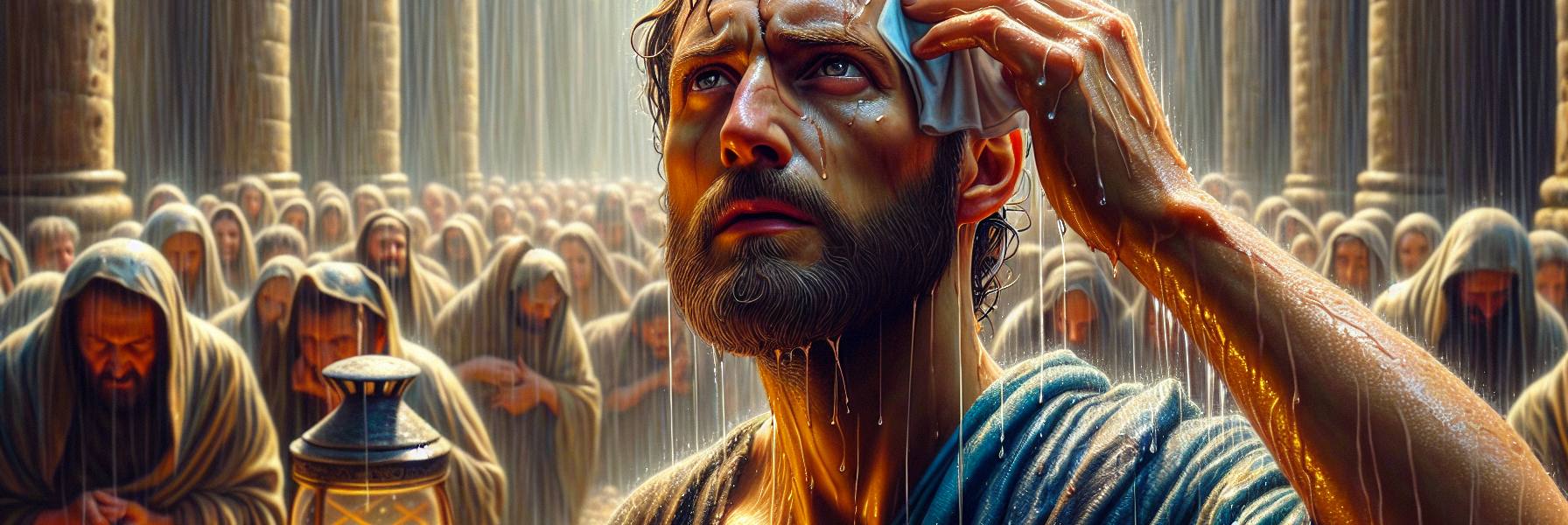

The rain in Thessalonica had a particular weight to it, a greasy, persistent drizzle that seemed less to fall from the sky than to seep from the very stones of the city. It was the kind of damp that found its way into the marrow of your bones, into the cracks of clay oil lamps, and into the spirit of a community trying to forge something new in an old, indifferent world.
Lucius wiped the moisture from his brow with a calloused hand, his fingers tracing the scar that ran from his temple to his jaw—a souvenir from a riot in the agora two summers past. He stood in the back of the crowded upper room, the air thick with the smell of wet wool, baking bread, and human warmth. He was listening, but he was not hearing. His eyes were fixed on a man named Gaius, who was speaking with a fervent, polished tongue about the mysteries of the Spirit, his voice rising and falling in practiced rhythms. Lucius’s own tongue felt like a lump of clay in his mouth. He could mend a net, argue a price for mackerel, shout down a rival fisherman, but these elegant words of prophecy, these sudden bursts of what they called ‘tongues’—they eluded him. A familiar, cold knot of resentment tightened in his gut.
Later, as the shared meal concluded, the tension surfaced. A widow named Phoebe, her eyes red-rimmed from more than the smoke of the lamps, had brought a concern about the distribution of goods for the poor. Gaius, full of the energy of his own spiritual revelation, cut her off with a wave of his hand. “Sister, these earthly matters are but shadows. We must seek the higher gifts!” His tone was not unkind, but it was dismissive, a teacher to a slow child. Lucius saw the woman’s face crumple, the fragile hope in her eyes extinguished. Something hot and sharp flared within him.
He found Gaius by the doorway, pulling on his cloak. “You shamed her,” Lucius said, his voice low and gravelly, carrying the salt of the sea.
Gaius turned, surprised, then offered a patient smile. “Brother Lucius, I only meant to direct us toward greater things. The body has many parts, some for speaking, some for… other service.” He didn’t mean it cruelly, Lucius knew. That was the worst of it. It was the benign negligence of a man so enthralled by the melody of his own faith that he’d grown deaf to the dissonance around him.
“You have the voice,” Lucius muttered, the old bitterness rising. “You speak with the tongues of men and of angels. I mend nets.”
That night, Lucius couldn’t sleep. The rain had stopped, leaving a bruised purple sky over the silent harbor. He lit a single lamp and unrolled a scrap of parchment, a letter from Paulos, the strange, intense apostle who had planted this little fellowship. He’d read it before, hearing the words in Paulos’s rasping, earnest voice. But tonight, they landed differently.
*If I speak in the tongues of men and of angels, but have not love, I am a noisy gong or a clanging cymbal.*
The words seemed to peel back the roof of the upper room. He saw Gaius’s beautiful, empty words ringing out over Phoebe’s bowed head—clang, clang, clang. A spiritual noise. Nothing more.
He read on, the lamp flame guttering. *And if I have prophetic powers, and understand all mysteries and all knowledge… but have not love, I am nothing.*
Lucius sat back, the parchment resting on his knees. He had envied the knowledge, the mysteries. He had coveted the speaking gift. But Paulos was calling it *nothing*. A profound, terrifying emptiness. His resentment began to curdle into a different, more uncomfortable feeling: a sickening recognition.
The letter laid love bare, not as a sentiment, but as a brutal, daily archaeology of the heart. *Love is patient and kind.* Lucius thought of his impatience with his young apprentice, Marcus, who still fumbled with the knots. He thought of his lack of kindness to Gaius, whom he had judged and despised in his heart. *Love does not envy or boast; it is not arrogant or rude.* The indictment was precise. His envy was a constant companion. His interactions with Gaius were often rude, clothed in a bluntness he mistook for honesty.
The words became a mirror, and the face he saw was not a hero of the faith, but a wounded, striving man who gave away his cloak to a beggar one day and begrudged a fellow believer his eloquence the next.
Days turned into weeks. Lucius did not suddenly become eloquent. The scar on his face did not fade. But a subtle shift occurred, one so quiet he hardly noticed it himself. He began to listen more to Phoebe than to formulate his rebuttal to Gaius. He spent a long, patient afternoon showing Marcus, for the tenth time, how to repair a torn sail, his hands moving with a gentle firmness that surprised them both.
The test came during a fierce autumn storm. A trading vessel from Corinth, carrying several believers known to the community, was reported dashed against the rocks north of the harbor. The news swept through the fellowship like a cold wind. In the panic and grief, Gaius stood and began to pray—a long, theologically rich prayer about the sovereignty of God and the hope of resurrection. It was doctrinally flawless, a beautiful tapestry of words.
Lucius felt the old impulse rise: to resent the performance, to retreat into sullen silence. But the words from the parchment had done their work. He waited. When Gaius finished, there was a heavy, awkward silence. The beautiful words hung in the air, not touching the raw, weeping wound in the room.
Lucius cleared his throat. He had no beautiful words. He simply stood, his fisherman’s frame solid in the flickering light. “My boat is whole,” he said, his voice rough but clear. “The sea is still angry, but it will bend to an experienced hand. I need two strong arms to man the oars, and two more to help pull survivors from the water. Who will come?”
He did not look at Gaius. He looked at the task. And from the back, Gaius, his fine cloak discarded, stepped forward. “I will come,” he said, his prophetic voice now flat with determination.
They did not speak in the boat, fighting the towering grey waves. There was no time for eloquence, only for shouted commands, for straining muscle, for the shared, terrifying purpose of pulling three half-drowned, shivering men from the clawing sea. Back on shore, wrapped in rough blankets, Lucius saw Gaius not as the fluent speaker, but as a man with bleeding hands from the oars, kneeling in the sand to pour a cup of wine for a coughing survivor.
Later, in the dim light of dawn, the two men sat exhausted by the hearth in Lucius’s small house. The silence between them was no longer hostile; it was the quiet of shared labor, of a burden carried.
“I did not help Phoebe,” Gaius said suddenly, staring into the embers. “I spoke over her. My gift… it was a clanging cymbal.”
Lucius nodded slowly, poking the fire with a stick. “And I envied your cymbal,” he replied. “I thought the sound was everything.”
“What is it, then?” Gaius asked, his voice weary. “If it is not the speaking, or the knowing, or even the dying for a cause?”
Lucius thought of the cold fury of the sea, and the warmth of the man next to him who had pulled against it. He thought of the patient, unglamorous work of teaching Marcus, of the quiet dignity restored to Phoebe when someone finally just *listened*.
“It’s the boat in the storm,” Lucius said finally, the words coming slowly, imperfectly. “It’s the oar in the blistered hand. It’s staying when you want to leave. It’s listening when you want to speak. It’s… it’s bearing all things, I suppose. Even a brother you don’t understand.”
He didn’t quote the letter. He didn’t need to. For the first time, he wasn’t reading words on parchment; he was living in the hard, unadorned space between them. It was not a perfect picture. He knew his temper would flare again. Gaius would still get lost in abstractions. But for now, in the soot and salt and shared exhaustion, the greatest of these had found a shape. It was not a feeling. It was a choice, made again in the grey light of a Thessalonian dawn, to pick up the oar and row.