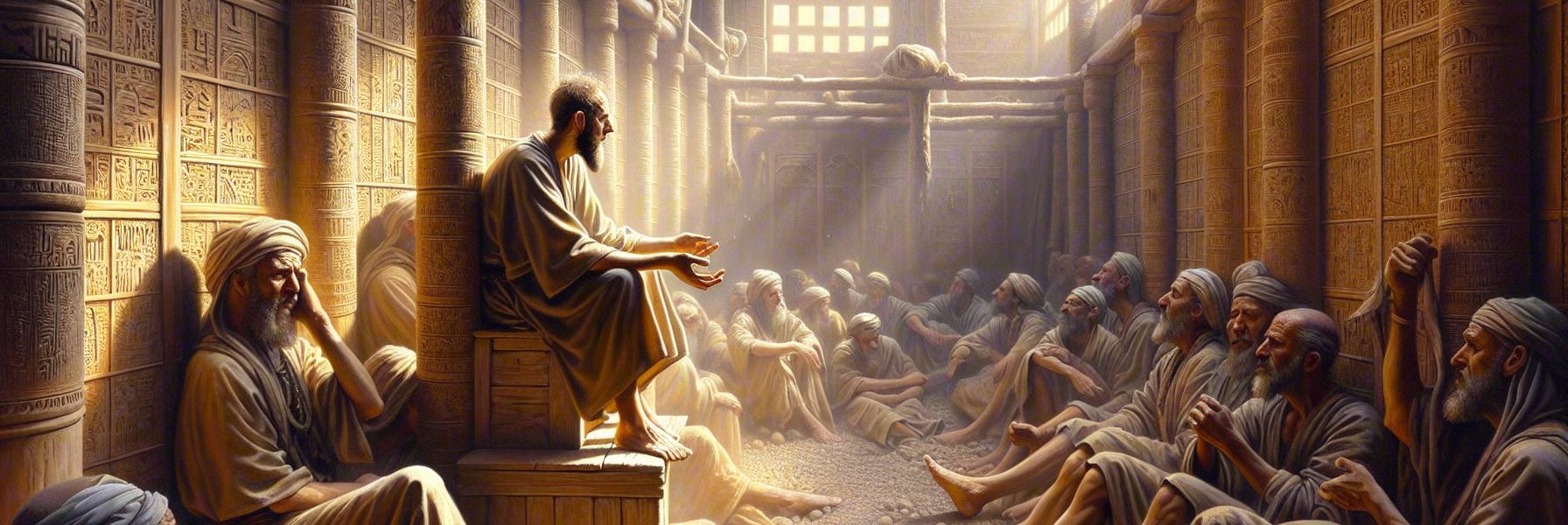

The heat in the chamber was a palpable thing, a dry, dusty weight that seemed to press the very air from the room. Ezekiel shifted on the packed-earth floor, his back against the sun-warmed wall, feeling the grit of the day settle in the lines of his hands. The exiles from Judah who shared this cramped dwelling in Tel-abib were quiet, a silence born not of peace, but of a weary, confused tension. They spoke of kings and empires as a man lost in the desert speaks of distant oases—with a mixture of desperate hope and deep skepticism.
A heaviness, different from the heat, began to gather in his spirit. It was not a sudden thunderclap, but a slow, inevitable rising, like the tide in the great sea. He knew its signature. The hand of the Lord was upon him, not as a crushing force, but as a gravity that pulled all his scattered thoughts into a single, terrible focus.
“Son of man,” the voice came, not through his ears, but into the fabric of his understanding, “put forth a riddle, and speak a parable to the house of Israel.”
His eyes, though open, no longer saw the worried faces of his countrymen. Instead, they saw a landscape of symbols, vivid and stark under a Middle Eastern sun.
“A great eagle,” he began, his own voice sounding distant to him, “with great wings, with long pinions, full of feathers, which had diverse colours.” The image burned in his mind’s eye: the imperial eagle of Babylon, its wingspan casting a shadow over kingdoms, its feathers a riot of the plunder of nations—gold from Lydia, lapis from Urartu, purple from Tyre. It was Nebuchadnezzar in all his terrifying, gorgeous power.
The eagle came to Lebanon. Ezekiel could smell the resinous scent of the high mountains. “And took the top of the cedar.” Not a felling, but a precise, royal plucking. He saw the ruthless horticulture of empire: the choicest shoot, the young twigs, carried away to a land of merchants, to a city of traffickers. The king, Jehoiachin, young, noble, a scion of David’s line, ripped from the highland of Judah and planted in the flat, alien clay of Babylon.
Then the parable turned. The same great eagle took of the seed of the land. This was different. This was a planting. “And set it as a willow tree,” Ezekiel murmured, seeing the political maneuver with dreadful clarity. The seed was Zedekiah, the puppet king, uncle to the exiled Jehoiachin. Nebuchadnezzar had planted him in Jerusalem, not as a mighty cedar, but as a pliable, water-loving willow, meant to bend to the imperial wind. The king of Babylon “planted it by great waters,” securing his vassal with treaties and oaths, swearing by the very God of Israel in a covenant of fealty. The willow was to remain a low, spreading vine, its branches turning toward the eagle who planted it, its roots dependent on the water he provided.
A stillness filled the room. The exiles were leaning forward, caught in the net of the riddle.
But the vine betrayed its nature. “There was also another great eagle,” Ezekiel continued, his voice dropping. Another imperial power: Egypt, with great wings and many feathers. The willow-vine, unsatisfied, ungrateful, and fatally ambitious, “bent its roots toward him, and shot forth its branches toward him, that he might water it.” Zedekiah, chafing under the Babylonian yoke, sent envoys to Pharaoh Hophra, seeking horses and much people, breaking his sworn covenant. The vine, though planted in good soil by great waters, now sought its life from another source.
The vision sharpened, the colors bleaching into a scene of barren judgment. “Shall it prosper?” the voice within him asked, a question that hung in the stifling air. Ezekiel saw the answer unfold like a drought. The east wind, the scorching sirocco from the desert, would wither it utterly. It would be plucked up by its roots, its fruit stripped, its fresh springing leaves withered. No strong arm or great people would be needed to raise it from its bed. It would die in the very soil where it was planted to thrive.
A deep sigh escaped him. The parable was told, but the interpretation now flowed from him with the force of a breaking dam.
“Thus saith the Lord God,” he said, and the weariness was gone, replaced by a prophetic certainty that was iron and fire. The metaphors dissolved into hard, historical truth. The great eagle was the king of Babylon, who came to Jerusalem, took its king and princes to Babylon. He took of the royal seed—Zedekiah—and made a covenant with him, putting him under an oath. He took away the mighty of the land, that the kingdom might be base, unable to lift itself up, keeping the covenant that it might stand.
“But he rebelled against him,” Ezekiel declared, his finger pointing at an unseen throne in faraway Jerusalem. Zedekiah sent to Egypt for chariots and horsemen. “Shall he prosper? Shall he escape that doeth such things? Shall he break the covenant, and be delivered?”
The answer was a divine oath. “As I live, saith the Lord God, surely in the place where the king dwelleth that made him king, whose oath he despised, and whose covenant he brake, even with him in the midst of Babylon he shall die.” Pharaoh with his mighty army would be no help in the day of siege. He would be a paper reed, breaking and piercing the hand that leans on it.
The condemnation was absolute. Zedekiah had despised the oath and broken the covenant. His punishment would not be a mere political failure; it would be the direct recompense of God. The net of Nebuchadnezzar would be God’s net; the pit would be God’s pit.
Then, as suddenly as it had focused on judgment, the vision spiraled upward, beyond the failed vine and the proud eagles. A tenderness, vast and incomprehensible, seeped into the final words.
“Thus saith the Lord God; I will also take of the highest branch of the high cedar…”
Ezekiel saw it. Not an eagle’s theft, but God’s own planting. From the line of that same plucked cedar, a tender shoot, a living sprig. He would plant it upon a high and lofty mountain—the mountain height of Israel. It would take root, grow, become a noble cedar. Under its vast, sheltering boughs, every bird of every wing would dwell. All the trees of the field, all the nations, would know a profound, sheltering truth: that the high God brings low the tall tree, and makes the low tree tall. He withers the green tree, and makes the dry tree flourish.
“I the Lord have spoken it,” Ezekiel finished, his voice now a bare whisper. “And I will do it.”
The gravity lifted. The heat of the room rushed back in, the smell of dust and sweat and cooking oil. The faces around him were etched with a new kind of silence—not of confusion, but of a stunned, fearful understanding. The riddle was solved. Their fate, and the fate of the king in Jerusalem, was sealed not merely by the politics of eagles, but by the sovereign will of the One who plants and plucks up, who withers and makes flourish. It was a terrible comfort. The story was not over. A sprig remained, waiting for its mountain. But for now, in the flat Babylonian clay, the east wind was beginning to blow.