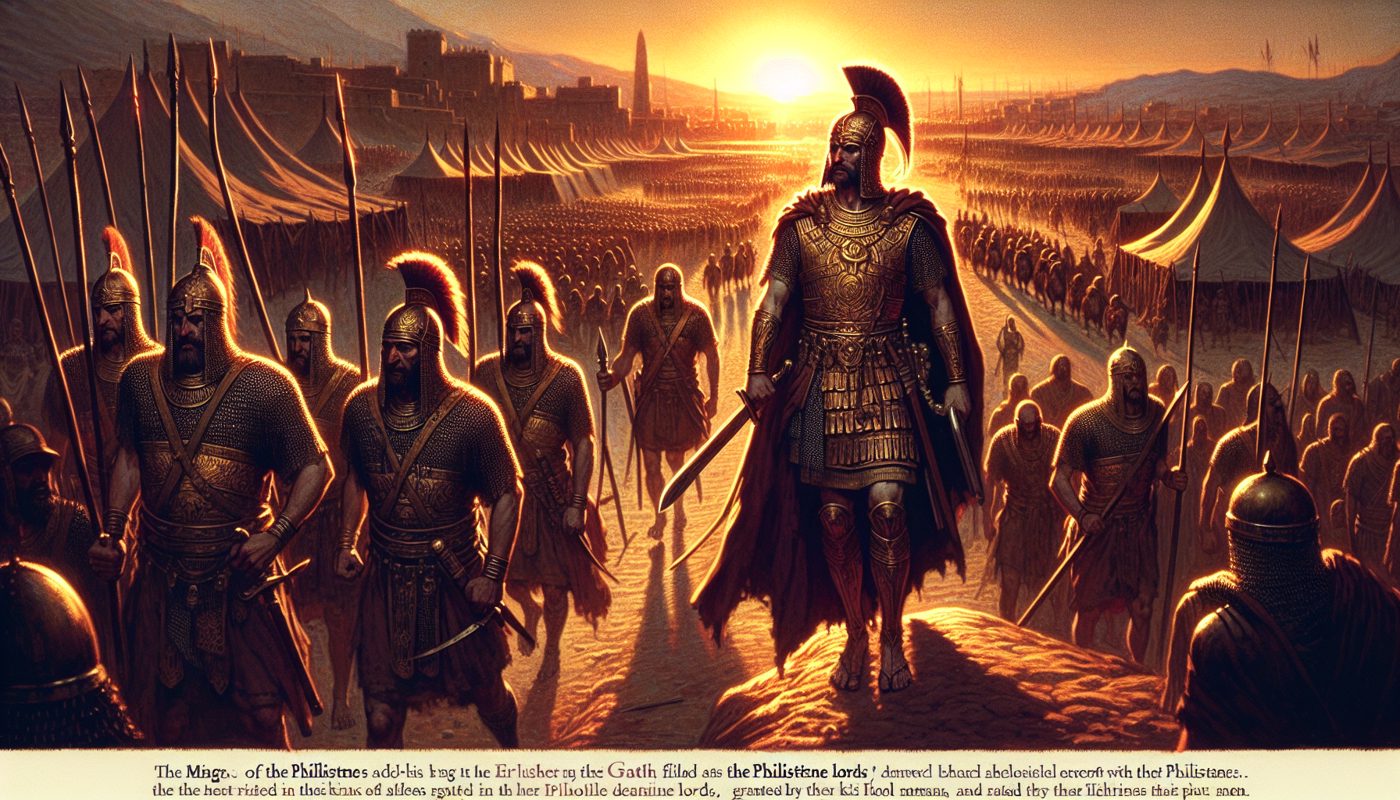
The Philistine army gathered at Aphek, the full muster of the five lords with their companies passing by in hundreds and thousands. In the rear of the column, with King Achish of Gath, marched David and his six hundred men. The sight of armed Hebrews among the Philistine host did not go unnoticed.
The princes of the Philistines demanded an answer. What were these Hebrews doing there? Achish defended David, explaining that this was David, the servant of Saul, who had been with him for years, and he had found no fault in him since the day he defected. But the princes were not persuaded.
Their anger rose. They insisted that David be sent back to the city Achish had given him. They would not let him go down to battle, for they feared he would turn against them in the fight. Their logic was blunt: what better way for a man to reconcile with his former lord than by bringing the heads of Philistine soldiers?
They reminded Achish of the old song the women of Israel sang in dances: Saul has slain his thousands, and David his ten thousands. That refrain had not faded from Philistine memory. They saw David not as a loyal vassal but as a Hebrew warrior whose reputation had been built on Philistine blood.
Achish called David aside. He swore by the Lord that David had been upright in his sight, that his conduct in the camp had been good, and that no evil had been found in him since his arrival. But the lords did not favor him. Achish told David plainly: return and go in peace, so that you do not displease the Philistine princes.
David objected. He asked what he had done wrong, what fault Achish had found in him all this time, that he could not go and fight against the enemies of his lord the king. The question was pointed. David had been living under Achish's protection and raiding on his behalf. Now he was being excluded from the main campaign.
Achish answered with high praise. He said David was good in his sight as an angel of God. But the decision was not his alone. The princes had spoken: David would not go up with them to battle. Achish repeated the order: rise early in the morning, with the servants of your lord who came with you, and depart as soon as there is light.
David rose early the next morning, he and his men, and they left the Philistine encampment to return to the land of the Philistines. The Philistine army went up to Jezreel without them. The chapter records no further protest from David, no argument, no lingering. He simply obeyed the command to leave.
The lords had acted on suspicion, not evidence. Achish himself had testified that David was blameless. But the memory of David's victories over Goliath and the Philistines was too strong. The princes would not risk having a Hebrew commander in their ranks when the battle was against Israel. Their distrust was enough to send David back.
Comments
Comments 0
Read the discussion and add your voice.
Members only
Sign in to join the conversation
We keep comments tied to real accounts so the discussion stays clean and trustworthy.
No comments yet. Be the first to add one.