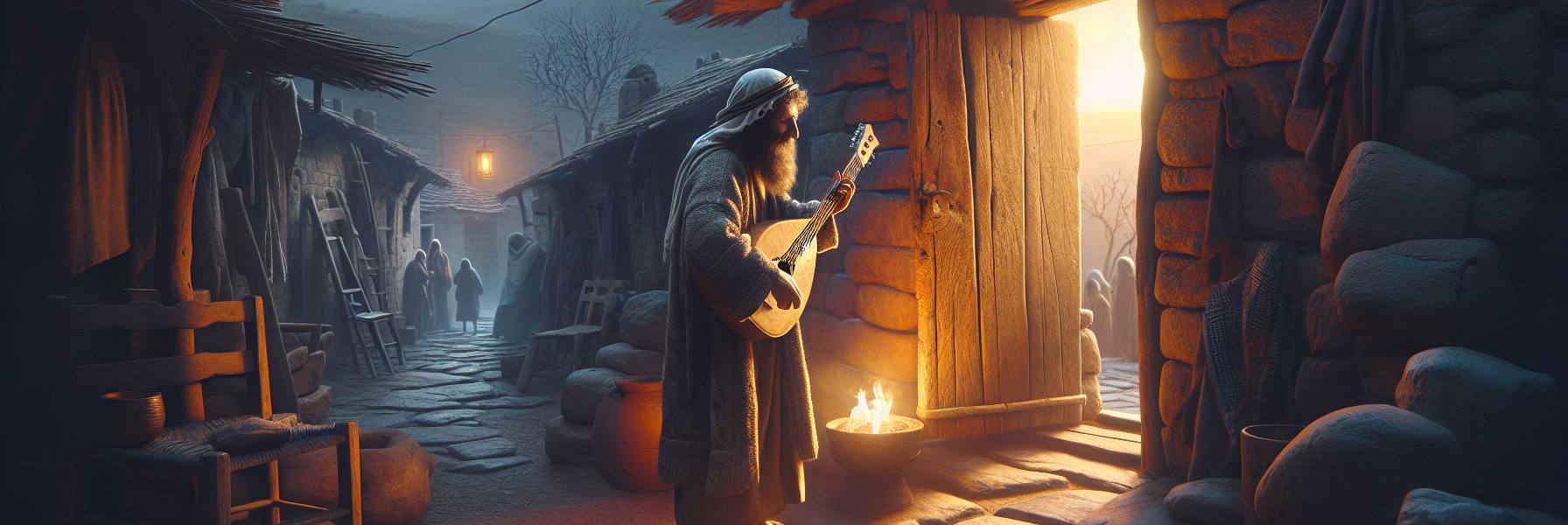

The damp chill of the night was finally retreating, chased by the first grey fingers of dawn that probed the narrow streets of the village. In a small house of rough-hewn stone, Elian stirred. It was not the light that woke him, but a familiar, restless joy—a melody half-remembered from a dream, humming just beneath his ribs. Today was the day of solemn assembly, but for Elian, the praise began long before he reached the meeting place.
He rose, the packed-earth floor cool under his feet. By the low embers of the hearth, he reached for his *kinnor*. The wood was worn smooth in places by generations of hands, the gut strings slightly frayed. He didn’t play it yet. He simply held it, feeling its weight and history, as the psalm of his grandfather echoed in his memory: *”Sing to the Lord a new song…”* A new song. It wasn’t about complexity, Elian thought. It was about the quality of the attention, the freshness of the heart offering it this particular morning, with this particular light now gilding the dust motes by the window.
The village came alive around him as he walked. The smell of baking bread mingled with woodsmoke. Children, already washed and dressed in their simple best, darted between houses. There was a palpable expectancy, a collective inhale. They gathered not in a grand temple—there was none—but in the broad, open space at the village’s heart, where an ancient olive tree spread its gnarled limbs. The assembly of the faithful, the *chasidim*, was everyone: old Miriam with her hands knotted by years of weaving, young Levi who tended the flock, the mothers with babies on their hips.
As the sun cleared the eastern hills, the praise began. It started not with a command, but with a murmur that grew, like the sound of many waters. Old Jephthah, his voice cracked but sure, intoned the opening lines, and the people took it up. *”Let Israel rejoice in their Maker; let the people of Zion be glad in their King.”* This wasn’t a sombre recitation. Feet began to move, a simple, shuffling step that stirred the dust. Hands clapped in rhythms that felt as old as the hills surrounding them. The joy was physical, earthy, a full-bodied affirmation.
Elian lifted his *kinnor* and plucked the strings. The tune was traditional, but he let his fingers find slight variations, a trill here, a deeper resonance there—his own “new song” within the ancient one. Beside him, a young man named Asher beat a steady rhythm on a hand-drum, his face alight. Others had tambourines, their jingles cutting the air like flashes of sound. The dancing grew more vigorous, not a performance, but a release. *”Let them praise his name with dancing and make music to him with timbrel and harp.”* They were embodying the words, their very movements a form of prayer.
In the midst of it, Elian felt it—a shift. The joy, so exuberant, settled into something deeper, a profound and sobering awe. The singing softened, but did not cease. The dancing became a slow, swaying circle. This was the other face of their praise. For the Lord, their King, took pleasure in his people, yes. But he also adorned the humble with victory. The words turned in Elian’s mind: *”May the praise of God be in their mouths and a double-edged sword in their hands…”*
He looked around the circle. These were not warriors. Their hands were calloused from ploughs, from needles, from tending vines. The “sword” was not of iron. It was the judgment written in the Law, the commitment to justice, to faithfulness in a world that often mocked it. Their “vengeance” was against the spiritual forces of corruption and idolatry that pressed in on their small community, the “punishment of the nations” a standing against the seductive, hollow values that surrounded them. To bind the powers of oppression, even the petty ones of greed and malice within their own hearts—this was the solemn duty that their joyful praise empowered. The assembly was their mustering, their spiritual armoury.
The high, fervent praise of the morning mellowed into a day of feasting and fellowship. Yet the conviction lingered, a quiet hum beneath the laughter and shared meals. As twilight descended, Elian found himself again at the edge of the gathering place. The celebrations in the houses were winding down. A profound stillness settled over the village.
He thought of the words: *”This is the glory of all his faithful people.”* The glory was not in triumph, not yet. It was in this daily cycle: the defiant joy at dawn, the communal strength in unity, the quiet resolve to hold the line of righteousness with their very lives. It was a hidden glory, known fully only to them and their God.
Overhead, the first stars appeared, piercing the deep blue veil of the sky. Elian did not play his harp. He simply stood, a sentinel in the quiet dark, filled with the day’s song and the sober, sustaining promise that their praise, in both jubilation and steadfastness, was a fragrance pleasing to their King. And that, for now, was more than enough.