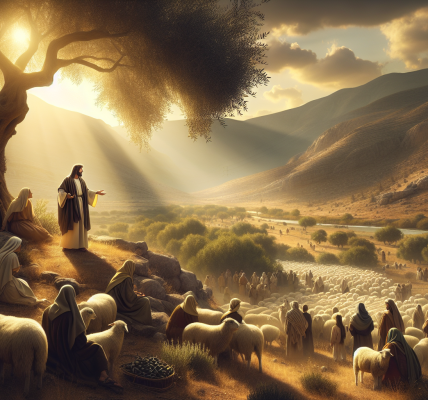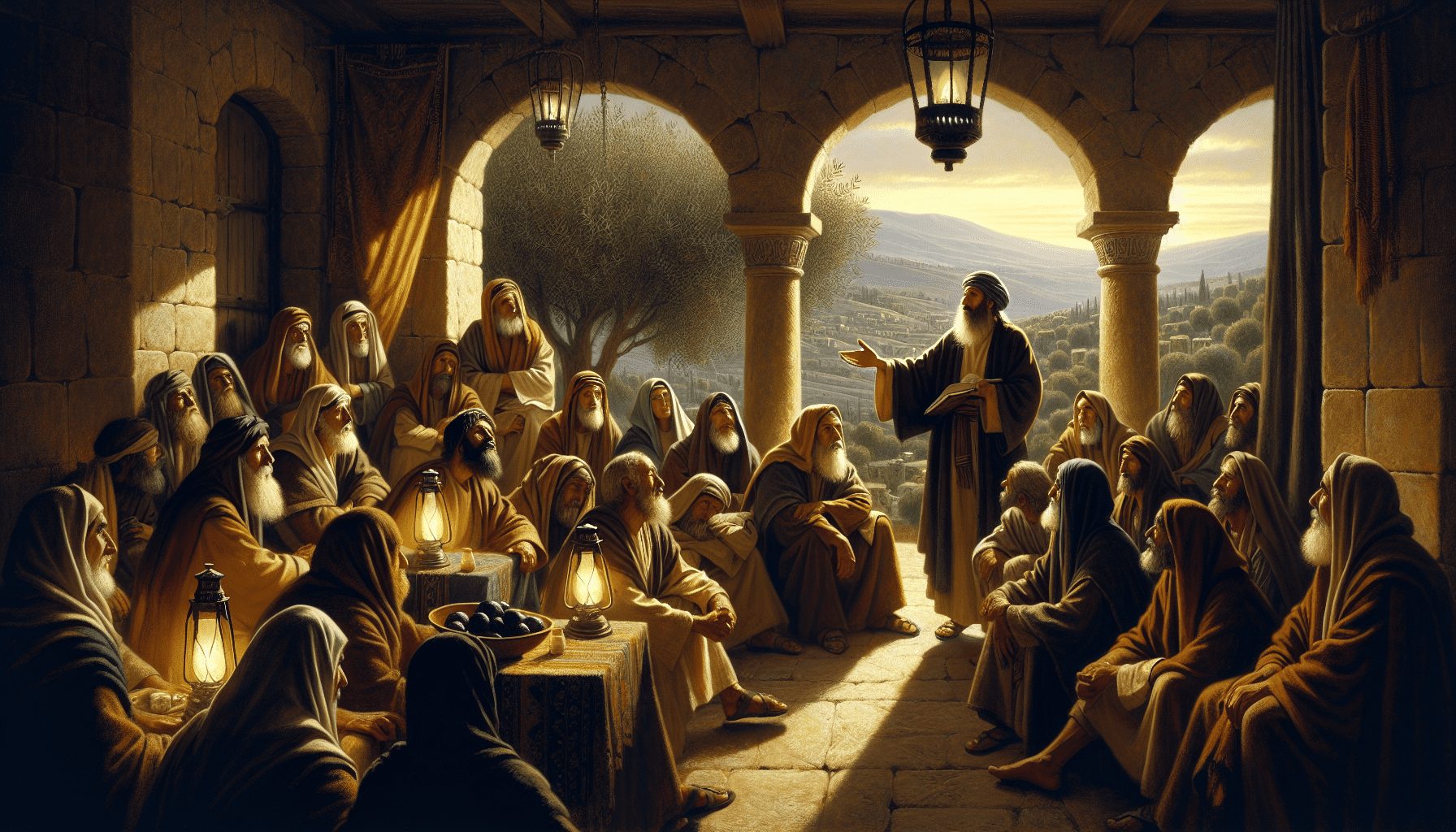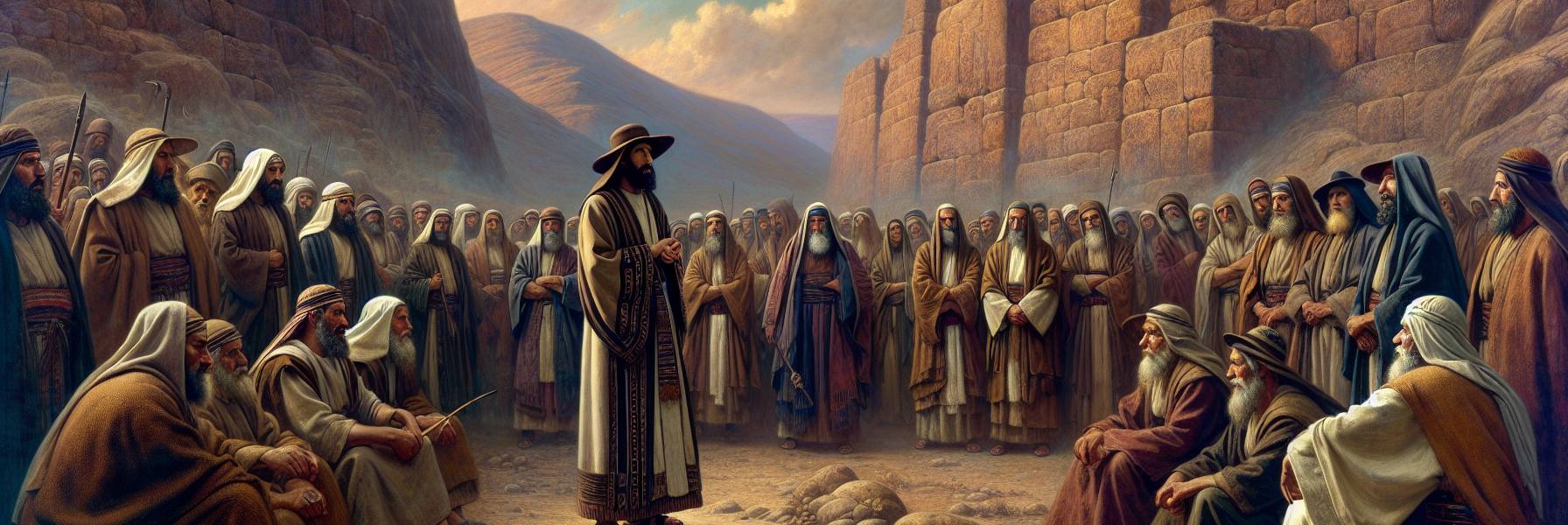

The air in Shechem was thick, a palpable weight of heat and history. It wasn’t just the late afternoon sun, heavy and golden, pressing down on the assembly; it was the memory in the stones. All Israel was there—tribes, families, elders, officers, judges—a sea of weathered faces and travel-stained robes gathered in the natural bowl of land between the twin mountains. They had come at Joshua’s summons, the old man’s voice carrying a final, grave authority none would ignore.
He stood before them not on a platform, but on a flat outcropping of grey rock, his frame lean and hard as cured leather. The years had curved his spine slightly, but his eyes, set deep in a nest of wrinkles, were clear and sharp. He did not begin with a greeting. His voice, when it came, was dry and rasping, like stone grinding on stone, and it carried without effort in the hushed space.
“This is what the Lord, the God of Israel, says.”
He spoke not of their recent victories, the fallen walls and allotted lands, but of a story far older. He took them back, back before the river Jordan parted, before the manna, before the bitter water of Marah. He spoke of Terah, father of Abraham, who lived beyond the Euphrates and served other gods. It was a strange, almost uncomfortable beginning. Roots mattered here. And Joshua was reminding them that their roots were not in this land, but in a place of foreign worship.
“I took your father Abraham from beyond the River,” Joshua’s voice continued, weaving the narrative. He led them through the wanderings, the birth of Isaac, the twin sons Jacob and Esau. He spoke of Egypt not as a place of bondage first, but as a refuge for Jacob. Then the tone darkened. “But the Egyptians mistreated us… they made us suffer harsh labor.” The crowd stirred. These stories were in their bones, recited at Passover, but hearing them here, on this soil, gave them a new, concrete reality.
Then came the deliverance. The plagues, the sea, the darkness and the drowning of chariots. Joshua described it plainly, without poetic flourish, making it more terrifying. “Your eyes saw what I did to Egypt.” He moved them through the long wilderness years—the Amorite kings Sihon and Og, their lands given to Reuben, Gad, and half of Manasseh. He mentioned Balaam, the prophet who tried to curse but could only bless, a cryptic reference that would have made the older ones nod grimly.
Finally, he brought them to the river. “You crossed the Jordan and came to Jericho.” The battles were recounted tersely: the citizens of Jericho fighting against them, the Perizzites, the Canaanites, Hittites, Girgashites, Hivites, Jebusites. “I gave them into your hands. I sent the hornet ahead of you.” A curious phrase—some in the crowd glanced at each other. Was it a plague of insects, or a metaphor for a terror that rots courage from within? Joshua did not explain.
He laid it all out, this long, unbroken thread of action: from pagan origins to slavery, from miraculous rescue to sustained providence in the desert, to the gift of the land they now stood upon. He presented it not as a list of favors, but as a single, sustained act of divine choice and power. The subtext thrummed beneath the words: *None of this was your doing.*
Then he stopped. The silence was immense, broken only by the cry of a distant hawk and the shuffling of a hundred sandaled feet. He looked out, his gaze sweeping across the tribes—Judah’s proud bearing, Benjamin’s keen watchfulness, the remote steadiness of Asher and Naphtali by the sea.
“Now,” he said, and the word fell like a hammer. “Now therefore, fear the Lord and serve him in sincerity and in faithfulness. Put away the gods your fathers served beyond the River and in Egypt, and serve the Lord.”
It was a direct challenge, an accusation wrapped in an invitation. He knew. Of course he knew. The teraphim hidden in tents, the amulets from Egypt kept for luck, the subtle accommodations to local Baals for good harvests. The wilderness generation was gone, but its compromises had left echoes.
“And if it is evil in your eyes to serve the Lord…” He paused, letting the unthinkable alternative hang in the dusty air. “Choose this day whom you will serve. Whether the gods your fathers served beyond the River, or the gods of the Amorites in whose land you dwell.”
He offered no middle ground. It was the Lord, or the alternatives they had clung to from their past or adopted from their present. Then, almost jarringly, he made it personal. His voice, for the first time, softened slightly, but with a steely resolve. “But as for me and my house, we will serve the Lord.”
The people reacted, their voices rising in a wave. “Far be it from us that we should forsake the Lord to serve other gods! It was the Lord our God who brought us and our fathers up from Egypt, from the house of slavery. He performed those great signs before our eyes. He protected us on our entire journey. He drove out all the peoples before us. We too will serve the Lord, for he is our God.”
Joshua did not smile. He did not look relieved. Instead, his expression grew more severe, the lines around his mouth deepening. He heard the enthusiasm, but he also heard its easy confidence.
“You cannot serve the Lord,” he said, his voice cutting through their assurances. The crowd recoiled as if struck. “He is a holy God. He is a jealous God. He will not forgive your rebellion and your sins. If you forsake the Lord and serve foreign gods, he will turn and bring disaster on you and make an end of you, after he has been good to you.”
This was the core of it. They saw the covenant as a contract of benefits. He was describing a marriage of absolute, terrifying fidelity. A holy God demanded a holy people. It was not a choice made once in emotion, but a daily, arduous turning away from every other solace and power.
But the people doubled down, their voices louder, more insistent. “No! We will serve the Lord!”
Joshua held up a hand, silencing them. “You are witnesses against yourselves,” he said, the words heavy with legal finality, “that you have chosen the Lord, to serve him.”
“We are witnesses,” they replied.
“Then,” Joshua said, the exhaustion of a lifetime seeming to settle on him all at once, “put away the foreign gods that are among you, and incline your heart to the Lord, the God of Israel.”
“The Lord our God we will serve,” they said, a third time, their vow now triply bound. “His voice we will obey.”
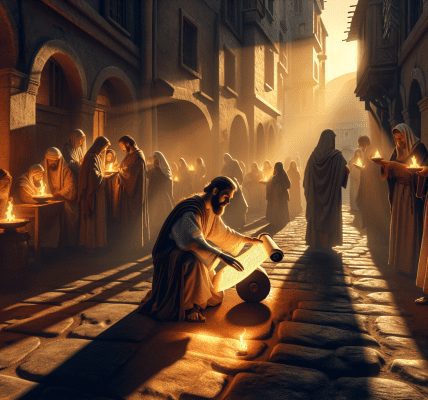
That day, Joshua made a covenant with the people. He wrote these things in the Book of the Law of God. Then he took a great stone—the same grey rock of Shechem—and he set it up under the terebinth tree that was by the sanctuary of the Lord.
“See this stone,” he said, his hand resting on its sun-warmed surface. “It shall be a witness against us, for it has heard all the words of the Lord that he spoke to us. It shall be a witness against you, lest you deal falsely with your God.”
Then he sent the people away, each to his own inheritance. The assembly dissolved, the sounds of families regrouping, of donkeys being loaded, filling the air. But a solemnity remained. They had not just listened to a speech; they had stood at a crossroads and made a promise, with a stone and their own words as eternal witnesses.
Joshua, son of Nun, servant of the Lord, died not long after, a hundred and ten years old. They buried him in the hill country of Ephraim. And Israel served the Lord all the days of the elders who outlived Joshua, and who had personally known all the work that the Lord had done for Israel.
But the stone remained. And in the quiet of the Shechem valley, under the spreading branches of the old terebinth, it stood. A silent, steadfast listener, holding in its mute bulk the echo of a choice, and the weight of a promise that would, in time, be both remembered and broken.