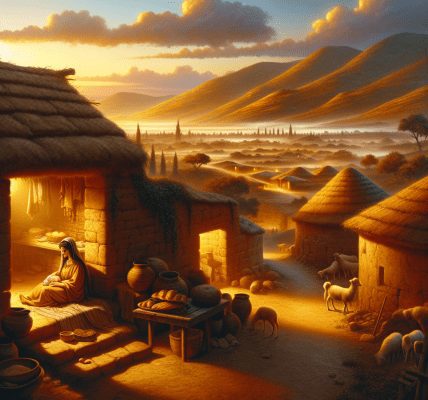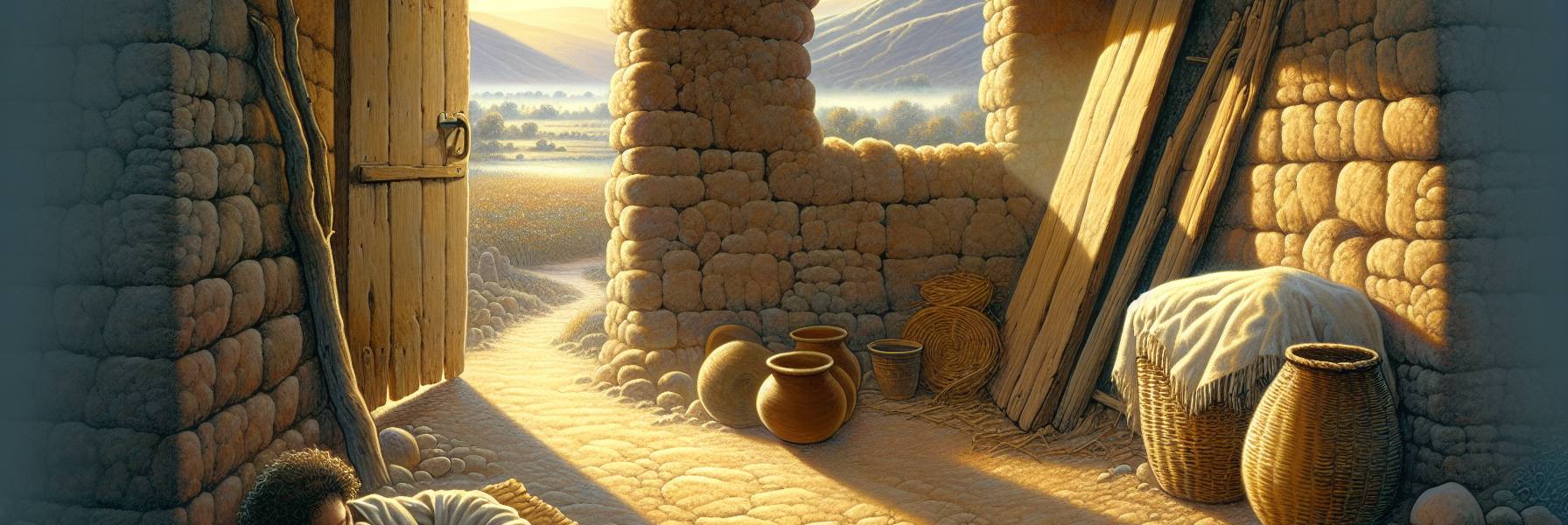

The first light of morning was the colour of pale honey, seeping through the cracks in the mud-brick wall of Amon’s house. It caught the dust motes dancing above the still-sleeping form of his youngest child, and fell across the woven basket by the door. Amon lay still for a moment, listening to the soft breathing of his family, but his mind was already outside, in the small patch of earth that was his own.
Today was the day of *terumah*, the offering of firstfruits.
The air outside was cool, carrying the faint, damp scent of dew on soil. His sandals crunched on the dry path as he walked, the hills of Ephraim rising around him like sleeping giants. His field was not large—a stubborn piece of land wrestled from the rocky hillside over years of his father’s labour and now his own. But it was his. That truth still sometimes caught in his throat, a hard knot of gratitude. He remembered his grandfather’s stories, told in the firelight, of the back-breaking work under Egyptian sun, the mud and straw, the taste of dust mingled with despair. This land was an answer to a cry he himself had never uttered, but which lived in his bones.
He reached the barley plot. The stalks stood shoulder-high, their heads bowed with a weight that was both literal and profound. They were heavy with grain, a tawny gold that shimmered as the sun cleared the eastern ridge. He did not simply grab handfuls. He walked slowly along the edge, his eyes searching. He was looking for the best, the fullest, the most perfect clusters—the first to ripen. His calloused fingers, nails rimmed with earth, were gentle as he selected them. He worked methodically, laying them carefully in the basket. The sound was a soft rustle, a whisper of abundance.
The basket grew heavy. He paused, straightening his back with a soft groan, and looked out. From this slope, he could see other terraces, other plots belonging to his cousins, his neighbours. Smoke began to curl from a few rooftops. The promised land, in this moment, was not a grand idea from a scroll; it was this scent of crushed barley, this ache in his lower back, this vista of peace.
Later, washed and wearing his best tunic—a little frayed at the cuffs, but clean—he placed the basket on the small donkey. His wife, Miriam, had woven a fresh band of blue thread around the handle. His two older children walked beside him, their excitement palpable. The journey to the sanctuary at Shiloh was not a long one, but it felt momentous. The basket rode before him like a sacred passenger.
The road grew busier as they neared the place of gathering. He saw others—faces he knew from seasons of planting and threshing—each with their own basket. Some bore figs, dark and plump. Others, grapes so deep a purple they were almost black. There was a quiet camaraderie, nods exchanged, but little talk. The weight of the occasion settled on them all.
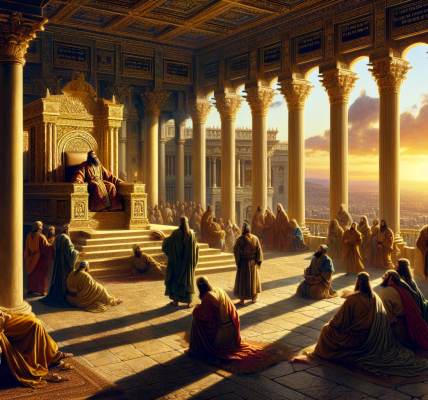
When his turn came, he lifted the basket from the donkey’s back, the weight solid and satisfying in his arms. He carried it to the priest, Eli, whose old eyes were kind. The sanctuary, the Tabernacle, stood with its quiet, solemn dignity, but all Amon could focus on was the rough texture of the basket in his grip and the faint, sweet smell of the grain.
He did not simply hand it over. He held it, and he began to speak, the words rising not from rote memory, but from a well deep within his chest.
“I declare today to the Lord your God…” he started, then corrected himself, the words of the confession making it personal, real. “*My* God. That I have entered the land the Lord swore to our fathers to give us.”
His voice, usually used for calling children or discussing the weather, grew stronger. He looked not at the priest, but through him, as if seeing the generations arrayed behind.
“My father was a wandering Aramean…” he recited, and the ancient story was no longer just a story. It was his grandfather’s sigh, his father’s weathered hands. He spoke of going down into Egypt, few in number, of becoming a great nation, mighty and numerous. He spoke of the cruelty, the cries, and the deliverance with a strong hand and an outstretched arm. He felt a peculiar shudder, as if the tears of those long-dead slaves were a salt trace on his own cheek, carried by the wind.
“And He brought us to this place…” Amon’s voice caught. He looked down at the basket, then out at the faces of his own children, watching him, their eyes wide. “He gave us this land, a land flowing with milk and honey.”
The words ‘milk and honey’ were not poetry just then. They were the taste of the goat’s cheese Miriam made, and the wild honey his son had found in a cleft rock, coming home with stings and a triumphant grin.
“And now…” he said, his voice dropping to something more intimate, a whisper meant for God alone. “And now, behold, I have brought the first of the fruit of the ground, which you, O Lord, have given me.”
Then, and only then, did he place the basket before the altar of the Lord his God. He bowed his head. The priest took it, and set it before the altar, lifting a portion heavenward in a silent motion that spoke of gift and acknowledgement.
The ritual was done. But the story was not. For then came the joy. The tithe was set aside—the tenth for the Levite, the stranger, the fatherless, the widow. Amon saw the Levites, those without land of their own, and his giving felt like a shared thread in a fabric of community. He thought of the hungry years, real and remembered. This was a safeguard against them.
That evening, back in his own village, they ate. They ate the roasted lamb, the bread without leaven, the bitter herbs that made his daughter grimace. They ate on land that was theirs. And as Amon recited the words again for his family—“We were slaves… and the Lord freed us…”—he saw his children listen, not to history, but to their own origin story. The barley in the field, the basket by the door, the prayer at the sanctuary—it was all one long, continuous sentence spoken by God, a sentence of promise and memory, and they were now a living word within it.
Later, under a sky dense with stars, Amon stood again at the edge of his field. The offered barley was gone, but the rest stood, ready for the harvest. It was not a loss. It was an anchor. He had told his story, God’s story, and in the telling, had found his own place within it once more. The land was not just soil. It was testament. And he, a simple man with dirt under his nails, was its keeper and its witness. The memory of the Egyptian sun was a ghost; the cool Canaanite night was a blessing resting on his shoulders, as real and as heavy as a basket full of firstfruits.