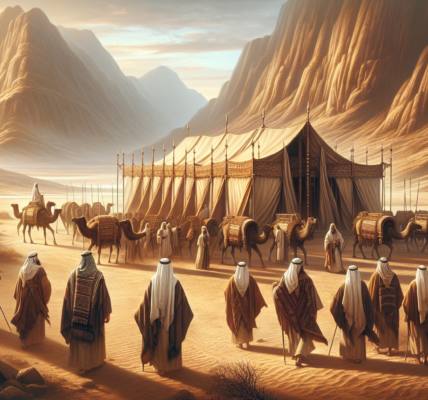

The heat had settled over the camp like a heavy wool blanket, the kind that smothers rather than warms. For seven weeks, not a whisper of cloud had grazed the endless bronze sky. The dust of the wilderness was no longer something they walked upon; it had become the very air they breathed, coating tongues and eyelids with a gritty film. At the edge of the encampment, by the tents of the tribe of Judah, a woman named Tzipporah watched her young son, Eliav, listlessly trace patterns in the dirt. His breathing was too quick, too shallow.
Tzipporah was a widow. Her husband, fallen to a fever two springs past, lived now only in the set of Eliav’s jaw and the boy’s serious eyes. The drought had taken the rest. Their small flock—her sole inheritance—had dwindled to three gaunt goats that stood motionless in the scant shade of their tent. Desperation is a quiet, simmering thing. It doesn’t shout; it hollows out a space inside you and whispers.
That evening, as the sun bled into the distant hills, the whisper became a resolve. Standing alone by the rough stone altar her household had raised, the smell of dry thyme and bitter dust in her nostrils, Tzipporah spoke aloud. Her voice was thin but clear.
“Lord, God of my fathers, you see my son. You see the emptiness of my hands. If you will send rain upon our portion of the camp, if you will cause the wadi behind our tent to run with water before the new moon, then I will give to the service of the Tabernacle my three remaining goats, and I will dedicate myself to weaving the linen for the veil for seven days, taking no bread nor wine until the work is complete.”
It was a vow. In the stillness that followed, it felt both foolish and immense, a pebble dropped into a bottomless well. She felt a strange lightness, as if the vow had lifted a weight only to replace it with a different, more sacred burden. She told no one that night, but the words echoed in the space where her heart beat a frantic rhythm against her ribs.
The next morning, her father, Shelumiel, a man whose face was a map of deep lines carved by sun and years, came to check the tent pegs against the wind that often rose before dawn. He saw the new resolve in his daughter’s movements, the purposeful way she sorted her few weaving tools.
“Daughter,” he said, his voice like stone grinding on stone. “Your spirit is troubled. Or determined. Which is it?”
Under his patient gaze, the words spilled out—the fear for Eliav, the brittle goats, the vow spoken into the twilight. She spoke of the rain, the weaving, the fast.
Shelumiel was silent for a long time. He looked from his daughter’s earnest face to his grandson’s sleeping form. The law of Moses, fresh and intricate, lay upon the people. He had heard it proclaimed at the Tent of Meeting: a father, hearing the vow of his unmarried daughter, may uphold it… or he may annul it. The burden, once spoken, was not hers alone to bear. It fell upon his house.
He thought not of authority, but of guardianship. The vow was severe. The fast, in this heat, could break her. The loss of the goats would leave her with nothing, not even the means to trade for a measure of grain. Her intention was pure, her heart brave, but her desperation had forged a chain she might not survive.
He placed a gnarled hand on her head, a gesture both tender and final. “My child, your prayer is heard. But your vow, I restrain it. You shall not fast under this sun. The goats shall remain. The Lord receives the offering of your spirit, not the ruin of your life.”
Tzipporah felt a sob rise, but it was not of sorrow. It was the collapse of a terrible, self-made tension. The vow had been a wall she had built, thinking to reach God by her own arduous climb. Her father’s words were a gate opened in that wall. The obligation dissolved, not through her own failure, but through the protective, sober love of her household. She was, in that moment, profoundly and paradoxically free.
Days crept on. The camp murmured with its own troubles. Two tents over, a young woman named Merav had vowed to abstain from the festival of the new moon if her betrothed returned safely from a scouting party. Her husband, hearing of it upon his return, had simply nodded his assent, binding her promise to them both. In another section, a widow of advanced years, not under the authority of father or husband, had vowed a donation of silver. Her word stood, immutable as a mountain.
Tzipporah watched the sky.
On the eve of the new moon, the air changed. A coolness, faint as a memory, brushed the back of the neck. The stars, usually sharp and cold, seemed to blur. And then, a scent—impossible, miraculous—the rich, profound smell of earth waiting for water.
It began not with a deluge, but with a single, heavy drop that struck the parched hide of her tent with a sound like a small drum. Then another. And then a sigh, a release, as the heavens opened. Rain fell, not in fierce slashes, but in a steady, gentle soak that drank into the dust. Tzipporah rushed outside, her face upturned, the water mingling with the salt on her cheeks. Behind their tent, in the bone-dry wadi, a trickle appeared, then a stream, gurgling over stones that had been white-hot hours before.
The vow was annulled, yet the rain had come. Shelumiel stood in the doorway of his tent, watching his daughter dance in the downpour, Eliav laughing in her arms. He understood then the deeper truth woven into the law. It was not merely about order, or the authority of fathers and husbands. It was about community, about bearing one another’s burdens, about protecting the desperate from the consequences of their own fervor. God had heard Tzipporah’s heart, not just her words. He had honored the spirit, while the law, administered with love, had guarded the body.
The next morning, under a washed-clean sky, Tzipporah took one small, sturdy goat from her pen. She had not vowed this. It was not an obligation, but a thanks offering. She walked toward the Tabernacle, the ground soft beneath her feet, the air sweet and new. She carried with her a lesson etched deeper than any vow: that the God of Israel was a God of both promise and protection, whose laws were the fences of a pasture, not the walls of a prison. And in that wide, rain-fed space, there was more than enough room for grace.