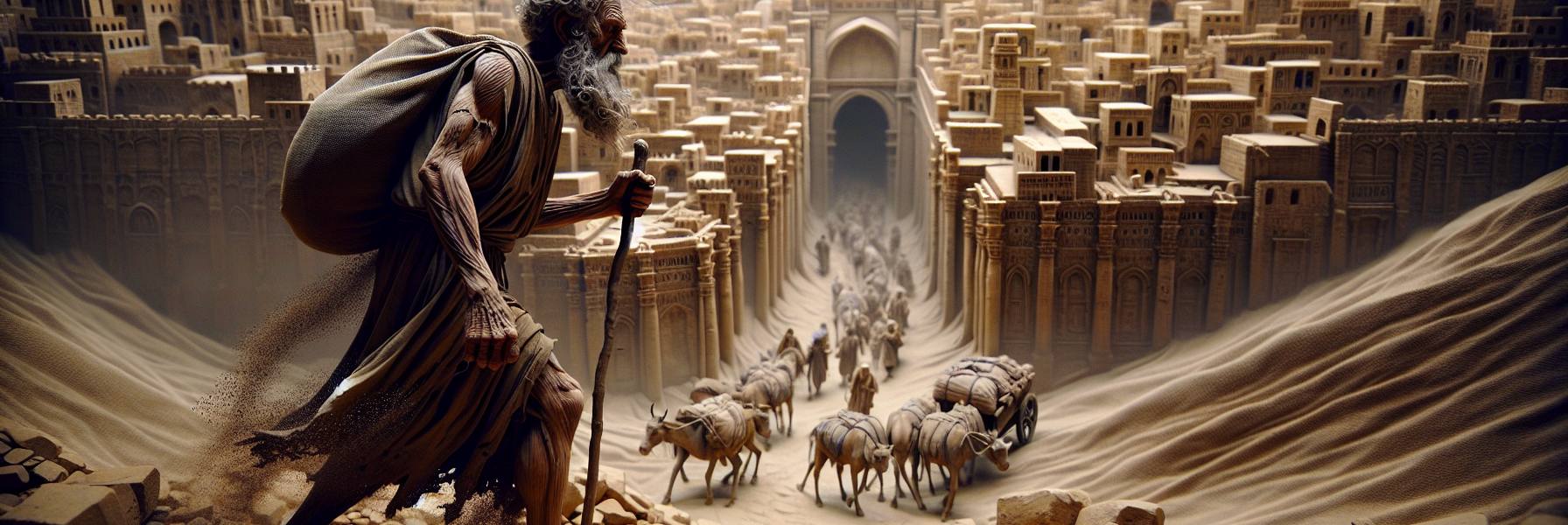

The dust was the same. That was the first thing Eliazar noticed, even before his eyes could make sense of the broken skyline of what had been Jerusalem. It was a fine, pale dust, kicked up by the straggling line of returning people and the slow, plodding hooves of their few animals. It settled on his beard, gritty between his teeth, and it was exactly as he remembered. A lifetime in Babylon, with its broad, orderly canals and its bricks that held their shape, and yet it was this dust that undid him. It was the dust of home.
He was too old for this, he thought, leaning heavily on his staff. His son, Jotham, walked ahead, the young man’s shoulders squared against a weight that was more than the bundles he carried. They were ghosts returning to a ghost of a place. The promises chanted by the prophets in the Babylonian courtyards—of a new covenant, of everlasting love—seemed to thin in this air, as fragile as the morning haze over the ruined hills.
They found their family’s plot not by any standing marker, but by the memory in Eliazar’s bones. A scatter of stones, the skeleton of a low wall, and the stubborn, gnarled trunk of an ancient fig tree, split by fire but still putting out a few green leaves. They worked in silence, their blistered hands clearing rubble. At night, the silence was worse. It wasn’t the quiet of peace, but the dense, echoing quiet of absence. The Lord’s words, *“I have loved you with an everlasting love,”* felt like something heard in a dream, beautiful and distant.
The turning point came with the rain. Not a gentle shower, but a sudden, drenching downpour that turned their dusty patch into a slick of mud. They huddled under a makeshift shelter, cold and miserable. But in the morning, the world was washed clean. And there, by the fig tree, where a channel of runoff had cut a small groove in the earth, a cluster of wild violet flowers had been revealed, their faces turned to the weak sun.
Jotham saw them first. He didn’t say anything, just crouched and touched a petal, his calloused finger surprisingly gentle. Eliazar watched his son, and the verse that had been circling in his heart like a trapped bird suddenly found its perch: *“They shall come and sing aloud on the height of Zion, and they shall be radiant over the goodness of the Lord.”* It wasn’t about the singing yet. It was about the radiance. It was there, faint as the dawn, on his son’s weary face.
Life began to stitch itself back together, not with grand gestures, but with stubborn threads. A neighbor helped them raise a beam. They traded a bronze bowl from Babylon for a pair of kid goats. One evening, as Eliazar sat by the fig tree, he heard laughter—real, unburdened laughter—from where the young people were gathering. It was the sound of a future.
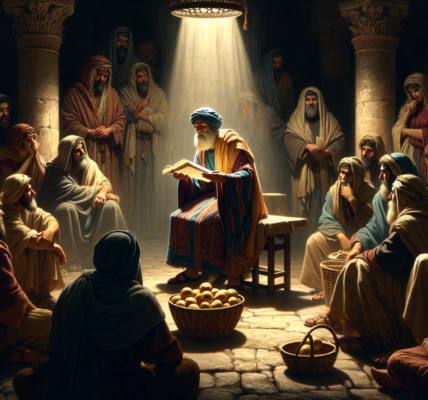
The scroll of the prophet Jeremiah was read on the Sabbath, from a copy painstakingly written in Babylon. When the reader reached the thirty-first chapter, Eliazar felt the words land in him differently, no longer as a far-off promise, but as a description of the very ache and mending he was living.
*“The people who survived the sword found grace in the wilderness.”* Yes, the wilderness was here, in this rocky soil and this struggle.
*“With weeping they shall come, and with consolations I will lead them back.”* The consolations were the violets, his son’s quiet strength, the shared loaf with a neighbor.
And then, the core of it, read aloud in the gathering twilight: *“This is the covenant that I will make with the house of Israel after those days, declares the Lord: I will put my law within them, and I will write it on their hearts. And I will be their God, and they shall be my people.”*
It wasn’t about stone anymore. He looked at his own hands, cracked and soil-stained. The law wasn’t out there, on a tablet to be obeyed from a distance. It was being written *in here*, in the willingness to forgive the long years, in the decision to build instead of to curse, in the fragile trust that this devastated place could be a home again. The writing was sometimes painful, a sharp stylus on the soft flesh of the heart, etching patience where there was bitterness, hope where there was hollow grief.
Years later, Eliazar’s granddaughter, little Miriam, would sit on his knee by the now-thriving fig tree, its branches heavy with fruit. She would ask him about Babylon.
“Was it beautiful, Grandfather?”
“It was powerful,” he would say. “And very far away.”
“And how did we know to come back?”
He would pause, feeling the deep, settled truth inside him, a law written not with ink but with lived seasons. He would watch Jotham, now a father himself, teaching his own son to prune a vine.
“We heard a song,” Eliazar would say finally, his voice rough with age. “A song from home, that our hearts finally learned to sing.”
And it was true. The vineyard was tended, the children danced at the harvest festival, and the covenant was no longer a scroll in the ark, but the rhythm of their days—a promise remembered not only in the temple, but in the texture of their lives, written on the heart, indelible.