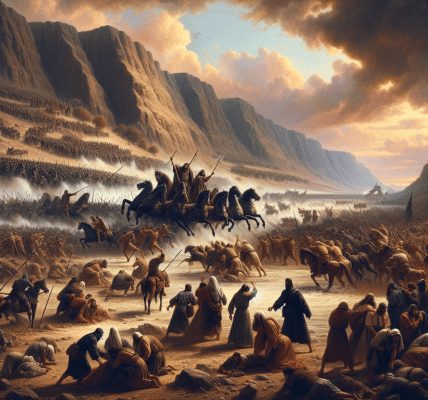

The damp cold of the hills seeped through Saul’s cloak, a chill no fire could ever touch. It was a cold that lived in the bones, in the hollow where faith used to be. For days, the Philistine host had spread across the plain of Jezreel like a slow, metallic stain, their campfires mocking the stars. And in his own tent, Saul had felt the vast silence of heaven—a silence more terrifying than any war cry. The Lord did not answer him, not by dreams, nor by Urim, nor by any prophet. It was as if the very air between earth and throne had solidified.
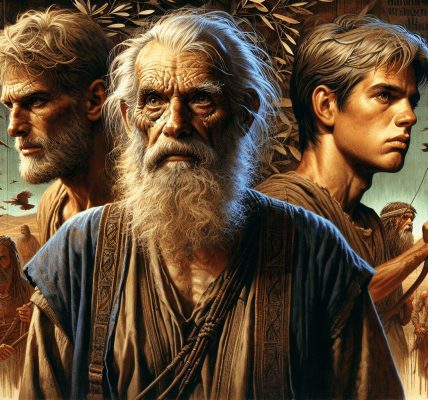
Two men moved beside him in the gloom, trusted—or perhaps merely desperate—servants. They had shed the royal insignia. Saul was a tall man, once magnificent, now a slumped giant, his beard streaked with more grey than black. “There is a woman at En-dor,” one servant had whispered, his voice swallowed by the tent’s fabric. “A mistress of a familiar spirit.” The words hung in the air, illicit, heavy with the very prohibition Saul himself had enacted. To seek out a necromancer was to tear at the seams of the law. Yet, what was law when the cornerstone of justice had withdrawn? He was not seeking guidance. He was groping for a voice, any voice, in the void.
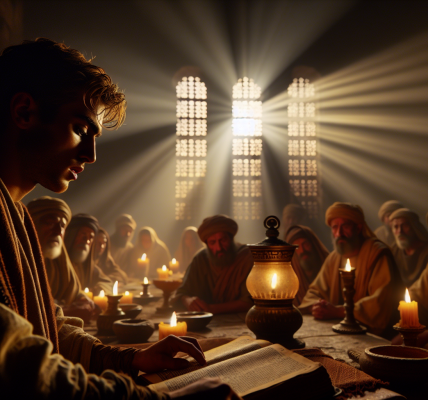
They travelled by night, a crooked journey away from the gathered armies, into the fractured hills behind the enemy lines. En-dor was a clutter of shadows, a place of goat paths and hushed rumors. The woman’s dwelling was at the village edge, cut partly into the hillside. The smell of cold earth and woodsmoke greeted them. Saul, disguised in common robes that felt like a poor shroud, spoke first, his voice a forced gravel. “Divine for me,” he said, the command bleeding into a plea. “Bring up for me the one I shall name.”
The woman’s eyes, sharp in a worn face, flickered over them. She knew the edict. “Surely you know what Saul has done,” she said, a defensive edge in her tone. “He has cut off the mediums and the spiritists from the land. Why are you laying a snare for my life to cause my death?”
Saul’s oath was swift, a brittle thing. “As the Lord lives,” he swore, invoking the very name that had abandoned him, “no punishment shall come upon you for this thing.”
A long pause. The fire popped. Then, “Whom shall I bring up for you?”
The name caught in his throat before it emerged, a whispered wound. “Samuel. Bring up Samuel for me.”
The change was immediate. The woman’s practiced concentration shattered into raw, unfiltered terror. She cried out, a sharp sound that seemed to pierce the very darkness in the room. Her eyes, wide and white, locked not on some unseen specter in the air, but directly onto Saul’s face, seeing through the grime and the common cloth to the king beneath. “Why have you deceived me?” she hissed, accusation mixing with dread. “You are Saul!”
The game was over. The hollowness in him yawned wider. “Do not be afraid,” he said, the royal tone returning, thin and cracked. “What do you see?”
“I see a divine being coming up out of the earth,” she stammered, her gaze fixed on a point behind him.
“What is his appearance?”
“An old man is coming up, and he is wrapped in a robe.”
And Saul knew. He knew the description of that mantle. He did not need to turn. A weight, colder than the hill air, pressed him down. He bowed his face to the earth and prostrated himself. The voice that came then was not from the woman. It was a memory given sound, familiar in its cadence, terrible in its clarity. It was the voice of the prophet, stripped of earthly compromise, speaking from a realm of settled truth.
“Why have you disturbed me by bringing me up?”
Saul’s words were mud, dredged from a pit of despair. “I am in great distress. The Philistines are making war against me, and God has turned away from me. He answers me no more. So I have called you, that you may make known to me what I should do.”
The silence that followed was more crushing than before. When the voice returned, it held no strategy, no tactical solace. It was merely the echo of a sentence already passed.
“Why then do you ask me, since the Lord has turned from you and become your adversary? The Lord has done for Himself as He spoke through me. The Lord has torn the kingdom from your hand and given it to your neighbor, to David. Because you did not obey the voice of the Lord and did not execute His fierce wrath against Amalek, therefore the Lord has done this thing to you this day. Moreover, the Lord will give Israel also with you into the hand of the Philistines. And tomorrow, you and your sons shall be with me.”
The words fell like stones, each one sealing a tomb. *Tomorrow.* Not in some vague future. Tomorrow. The army, the throne, the long struggle—all of it was already ash. His sons. Jonathan. The finality of it emptied him of everything, even fear. There was no room for anything but the sheer, unadorned fact of the end.
His great frame shuddered. He had not eaten for a day and a night, the fear and the journey having stolen all appetite. Now, with the last vestige of hope extinguished, his strength poured out of him onto the hard earth floor. He was a vessel with a great crack, and everything within was gone.
The woman, watching the king of Israel come undone in her humble home, was moved by a pity more potent than her fear. This was not the tyrant of the edicts. This was a broken man, more ghost than king. She approached, her voice softening. “Please, listen to your maidservant. I took my life in my hands and obeyed you. Now, you please listen to me. Let me set a morsel of bread before you. Eat, that you may have strength to go on your way.”
He refused, a weak motion of his head. But she persisted, and his servants joined their voices to hers. Finally, he rose from the ground and sat on the bed, a statue of defeat. The woman moved quickly. She slaughtered a fattened calf she had been keeping, took flour, kneaded it, and baked unleavened cakes. The smell of meat and bread, the sounds of simple, domestic life, filled the small space—a grotesque contrast to the oracle of doom that still hung in the air.
Saul ate. His sons, somewhere in the camp by the Jezreel springs, did not. The meal was a sacrament of despair, a last supper before the promised joining. Then, in the deep darkness that comes just before the dawn, he and his men rose. They left the house at En-dor and went out into the night. The woman watched them go, swallowed by the black. They walked back towards the camp, towards the waiting Philistines, towards the tomorrow that had already been written. The only sound was the scuff of their sandals on the stony path, a slow procession into the fulfillment of the word.