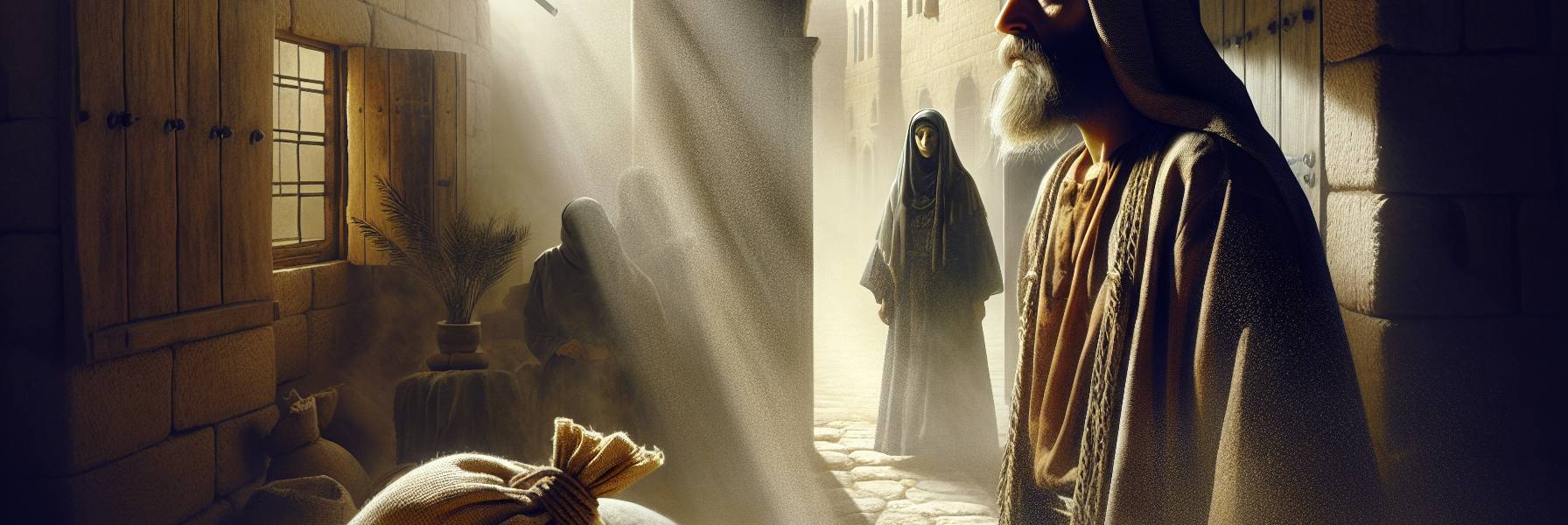

The sun was a hammer on the rooftops of the lower city, and the dust hung in the still air like a taunt. It found its way into everything—the grain sacks, the folds of her widow’s robe, the bitter corners of her mouth. She stood at her door, watching the two figures approach, their shadows short and dark beneath them. The creditor’s face was set, not unkindly, but with the finality of a stone rolled over a tomb. Beside him, his assistant avoided her eyes, studying the bleached cobbles.
“Tomorrow,” the creditor said, his voice softer than she expected. “The law is clear. Your sons… they will come to settle the debt. I am sorry.”
He said no more, and they turned away. The word *sons* echoed in the hollow place her fear had carved. She saw their faces, her boys, one with his father’s thoughtful brow, the other with his easy laugh. To become indentured, their freedom bartered for her failed struggle… it was a living death. A dry, soundless sob shook her. There was no one. No clan to rally, no reserve hidden in a floor jar. Only a single cruse of oil, a little olive oil for her lamp, the last familiar scent in the house.
Then, a name surfaced through the panic: *The man of God*. Elisha. He had passed through sometimes, a stern, wind-worn figure who carried the silence of the hills with him. Her husband, before the fever took him, had spoken of him with awe. “He is a holy man,” he’d said. “Where he walks, the shadow of the Lord moves.”
It was a desperate stitch of hope, but it was all she had. She left her boys with a neighbor and walked to the hill where the prophets gathered. Finding him was not difficult; he seemed to draw a space of quiet around him even amid the disciples. She fell before him, her story tumbling out in ragged pieces—the debt, the creditor, the two sons soon to be lost.
Elisha listened, his gaze not on her face but on something distant, as if weighing her words on a scale she could not see. “What do you have in your house?” he asked.
“Nothing, my lord,” she whispered, the confession tasting like dust. “Except a pot of oil.”
A light, strange and specific, entered his eyes. “Go,” he said. “Go around and ask all your neighbors for empty jars. Not a few. As many as you can gather. Then go inside, you and your sons. Shut the door behind you. And start to pour.”
It made no sense. Yet the clarity of his instruction was its own kind of anchor. She returned home, a frantic energy upon her. She knocked on every door in the quarter, her pleas urgent. Curiosity and pity yielded a strange harvest: borrowed jars, pots, vessels of clay and rough pottery, began to fill her small house. Her boys carried them in, stacking them against the wall, a silent, expectant audience.
When no more could be found, she barred the door. The world outside, its heat and its threats, was shut away. In the dim, close air, it was just the three of them and the gathered emptiness. Her younger son held the small, familiar cruse. It felt light, nearly dry. Her heart hammered against her ribs. This was madness.
She took the cruse, her hands unsteady, and positioned it over the mouth of the first jar. A prayer, wordless and desperate, rose in her. She tipped it.
A thick, golden stream, rich and fragrant, flowed out. It didn’t trickle. It poured, a smooth, endless ribbon of amber light, filling the jar to its brim. A gasp from her eldest. She moved to the next vessel, and the oil continued, unabated. Jar after jar, pot after pot, the miraculous tide flowed. The only sounds were the glug of the liquid and the quick, hushed breathing of her boys as they scrambled to replace full vessels with empty ones.
“Another, mother!”
“This one is ready!”
Their whispers were prayers. The cruse grew no lighter. The air grew thick with the lush, grassy scent of pure olive oil.
Finally, her eldest straightened, looking around. “There are no more jars.” His voice was filled with awe.
And as he said it, the flow stopped. The cruse was just a cruse again, humble in her hand. But all around them, catching the thin light from the high window, stood vessels full of oil, a fortune gleaming in the dusk of their home.
She returned to Elisha, her feet seeming not to touch the ground. He did not seem surprised. “Go,” he said, “sell the oil. Pay your debt. You and your sons can live on what remains.”
***
Time passed, measured in seasons of sowing and harvest, and Elisha’s path led him often through Shunem. A wealthy woman there, perceptive and devout, noted the holy man’s passing. She said to her husband, “Look, this is a holy man of God who passes by us regularly. Let us make a small room for him on the roof. We can put a bed, a table, a chair, and a lamp there for him. Then whenever he comes, he can turn in there.”
It was done. The room was simple but sturdy, a place of peace. Grateful, Elisha sought to thank her. He called for her, and she stood respectfully in the doorway. “You have gone to all this trouble for us,” he said. “What can be done for you? Shall I speak to the king or the commander of the army for you?”
Her reply was serene, rooted in contented faith. “I dwell among my own people,” she said. A gentle refusal of worldly patronage.
But later, Elisha spoke to his servant Gehazi. “What then can be done for her?”
Gehazi, a practical man, observed, “Well, she has no son, and her husband is old.”
A nod. “Call her again.”
When she stood at the door, Elisha looked at her, and his words were a quiet pronouncement. “At this season next year, you will embrace a son.”
Her composure shattered. “No, my lord, man of God,” she pleaded, a lifetime of quiet sorrow breaking through. “Do not lie to your servant.” The hope was too sharp, too dangerous, to bear.
Yet the word of the Lord was as solid as the hills. The child was born, just as said, a boy with bright eyes and a strong cry. He grew, doted upon, a living testament to promise.
Years later, during the barley harvest, the boy followed his father into the fields. The sun was high and fierce. Suddenly, he cried out, “My head! My head!” Pain, violent and searing, lanced through his skull. They carried him home to his mother. She held him on her lap, her songs useless against the fever that raged through his small frame. By noon, he was gone.
A profound, silent stillness fell upon her. She did not wail. She carried his slight body up to the prophet’s chamber, laid him on Elisha’s bed, and shut the door. She found her husband. “Please, send me one of the servants and a donkey. I must go to the man of God. I will return.”
“Why today?” he asked, baffled. “It is neither new moon nor Sabbath.”
Her answer was calm, ironclad in its evasion. “It will be well.”
She saddled the donkey and said to the servant, “Lead on. Do not slow the pace unless I tell you.”
They rode hard for Mount Carmel. Elisha, from his height, saw the small, determined figure racing toward him. “That is the Shunammite,” he said to Gehazi. “Run to meet her. Ask, ‘Is it well with you? Is it well with your husband? Is it well with the child?’”
She brushed past Gehazi, his questions unanswered, and came straight to Elisha, catching his feet. Gehazi moved to push her away, but Elisha stopped him. “Leave her alone. Her soul is in deep distress, and the Lord has hidden it from me.”
Then she spoke, her voice a raw scrape of grief and accusation. “Did I ask my lord for a son? Did I not say, ‘Do not deceive me’?”
Understanding struck Elisha. He thrust his staff into Gehazi’s hand. “Tuck your cloak into your belt. Take my staff. Go! If you meet anyone, do not greet them. If anyone greets you, do not answer. Lay my staff on the boy’s face.”
But the mother would not leave the source of the promise. “As the Lord lives and as you live,” she vowed, “I will not leave you.” So Elisha rose and followed her.
Gehazi went ahead, obeying the letter of the command. He laid the staff upon the cold, still child. There was no sound, no response. He returned to meet them on the road. “The boy has not awakened,” he reported, his tone flat with failure.
When Elisha reached the house, he went up alone to the room where the boy lay. He shut the door and prayed to the Lord. Then he did a strange, intimate thing. He lay down upon the child, mouth to mouth, eyes to eyes, hands to hands. As he stretched himself over the small form, the boy’s flesh began to grow warm. Elisha got up, paced the room, prayed again. He stretched himself over the child a second time.
Then the boy sneezed. Seven times he sneezed, a violent, life-filled convulsion, and his eyes fluttered open.
Elisha called for Gehazi. “Call the Shunammite.”
When she entered, he simply said, “Pick up your son.”
She fell at his feet, overwhelmed, then scooped up her living child, holding him so tightly he might have squealed, and walked out, the weight in her arms the only answer she would ever need to every hidden sorrow. The oil had paid a debt; the son had repaid a deeper one—a testament that in the barren places, the God of Israel was yet a God who saw, who heard, and who, in His own seasons, restored life from the very dust.