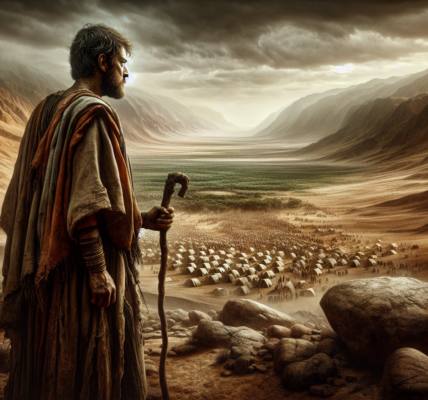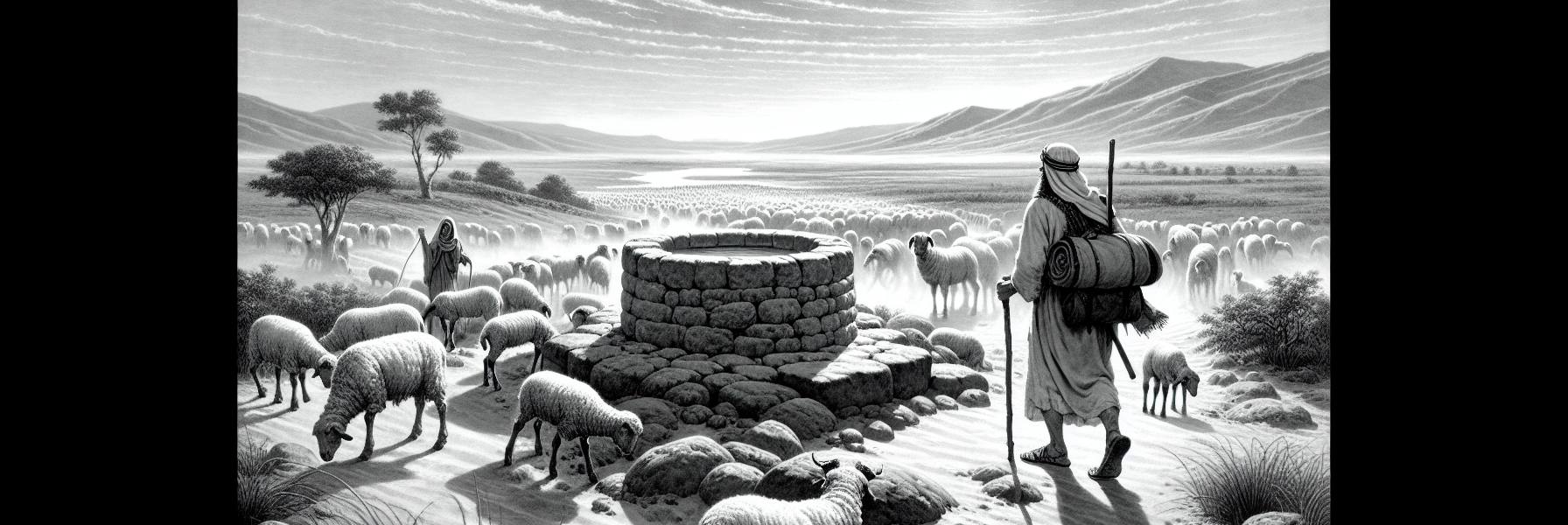

The sun was a white, searing coin in a sky bleached of color. Jacob walked, and the dust of Aram Naharaim rose in soft puffs around his sandals, coating his throat. He’d left the familiar contours of Canaan, the memory of his brother’s silent fury still a cold stone in his belly, and now this flat, vast land stretched before him, indifferent. The promise he carried—his father’s blessing, his mother’s whispered strategy—felt fragile here, a parchment scroll in a windswept plain.
He came to a well in the field, a great stone slab sealing its mouth. Not a simple drinking hole, but a community well, its lip worn smooth by generations of ropes. Three flocks of sheep were huddled nearby, their shepherds waiting, talking in low tones. There was a ritual to it, a patience. You waited for everyone, then you moved the stone together. It was the order of things.
Jacob approached, his voice rough from the road. “My brothers, where are you from?”
“We are from Harran,” they said, their eyes appraising his foreign cut of cloth.
A spark caught in his chest. “Do you know Laban, son of Nahor?”
They nodded. “We know him. And see, here comes his daughter Rachel with the sheep.”
He turned. She was walking across the hard-packed earth, leading a scattered trail of bleating ewes. The sight of her, of kin after so many solitary days, struck him with a physical force. But it wasn’t just kinship. There was a grace in her stride, a focus as she herded the animals. The other shepherds were content to wait, but something ignited in Jacob. A need to prove, to act, to connect this moment to the promise that had driven him here.
While the others were still gathering, he walked to the massive stone. It wasn’t a gentle nudge; it was a heave of shoulders and back, a grunt torn from his lungs, the muscles in his arms corded and shaking. With a gritty scrape that echoed in the quiet field, he single-handedly rolled the stone from the well’s mouth. The shepherds stared, their conversation dying. Water, dark and cool, glinted from below.
He drew water for Rachel’s flock, his movements quick and efficient. Then, before doing anything else, he stepped forward. He took Rachel’s hands in his own, which were still trembling from the strain, and he wept. Not a quiet tear, but deep, shaking sobs that seemed to come from a place of profound relief. He had arrived. He told her who he was—her cousin, Rebekah’s son. And she, her eyes wide, ran to tell her father.
Laban came out. He moved with a quick, assessing energy, and when he heard, when he saw Jacob, he embraced him, kissed him, brought him to his house. In the telling of his story, the tents of Harran felt, for a fleeting moment, like a home.
A month passed, then another. Jacob worked. He was no guest lounging in the shade; he mended pens, tracked stray lambs, bore the heat and the tedium. Laban watched, and one evening, over a meal of flatbread and lentils, he said, “Just because you are my kinsman, should you serve me for nothing? Name your wages.”
Jacob’s eyes, which had been following Rachel as she moved near the cooking fire, turned to Laban. He had loved her from that first moment at the well, a love that had grown in the close quarters of daily life. Leah, the older daughter, was there too, steady and quiet, her eyes often downcast. The text says they were lovely, but where Rachel’s beauty was a clear, captivating light, Leah’s was a softer thing, seen in the gentle curve of her cheek as she worked.
“I will serve you seven years for your younger daughter Rachel,” Jacob said, the words leaving his mouth like a vow.
Laban considered. A strong, capable man, bound for seven years. “It is better that I give her to you than to another man,” he said, a trader’s agreement. “Stay with me.”
So Jacob served. And the writer of Genesis does a remarkable thing—he makes those seven years feel both long and short. They were long in the daily grind, in the accumulation of days under the same sun. But they were short in Jacob’s heart, “so they seemed to him but a few days because of the love he had for her.” It is one of the Bible’s great, simple truths about love’s strange alchemy with time.
Finally, the end of the term. “Give me my wife,” Jacob said to Laban, “that I may go in to her, for my time is completed.”
Laban agreed. He gathered all the people of the place and made a feast. It would have been loud, full of music and food and drink that flowed well into the deepening night. The bride, veiled according to custom, was brought to Jacob in the dark. In the wine-blurred celebration, in the shadowy confines of the wedding tent, he took her as his wife.
But morning is a revealer of truths. The grey light seeped into the tent, and there, beside him, was Leah. Not Rachel. Leah.
The shock must have been a cold flood, a theft of breath. He had been deceived in the most intimate way, by the same fabric of darkness and custom he had once used to steal a blessing from his own father. The wrestler, wrestled. The supplanter, supplanted.
He stormed out, finding Laban. The words were sharp, accusation mixed with betrayal. “What is this you have done to me? Did I not serve with you for Rachel? Why then have you deceived me?”
Laban was ready. His explanation was smooth, woven with local tradition. “It is not so done in our place, to give the younger before the firstborn.” A neat trap, one Jacob could not refute without insulting the very custom he had sought to use. Laban’s voice took on a placating, businesslike tone. “Complete the week of this one’s marriage celebration, and we will give you the other also in return for serving me another seven years.”
Jacob was caught. He had Leah now, and the marriage feast, once a celebration, was now a public charade he had to see through for a full seven days. The text is brutally silent on those days—on Leah’s heart, on Rachel’s simmering humiliation, on the weight in Jacob’s chest. He completed the week.
Then, without delay, Laban gave him Rachel also as his wife. The man who had left home with nothing now had two wives, sisters, in a household taut with unspoken rivalry. He loved Rachel. He endured Leah. The scripture states it plainly: “he loved Rachel more than Leah.” It was a public fact, a private agony.
And he served Laban another seven years. The promise he carried from God still hung over him, but the path to its fulfillment was now paved with the gritty, complicated reality of human compromise, of love and resentment living under the same roof. The deceiver had found his match in the hills of Harran, and his story, and the story of a people, would be born from this tangled, painful, profoundly human beginning.