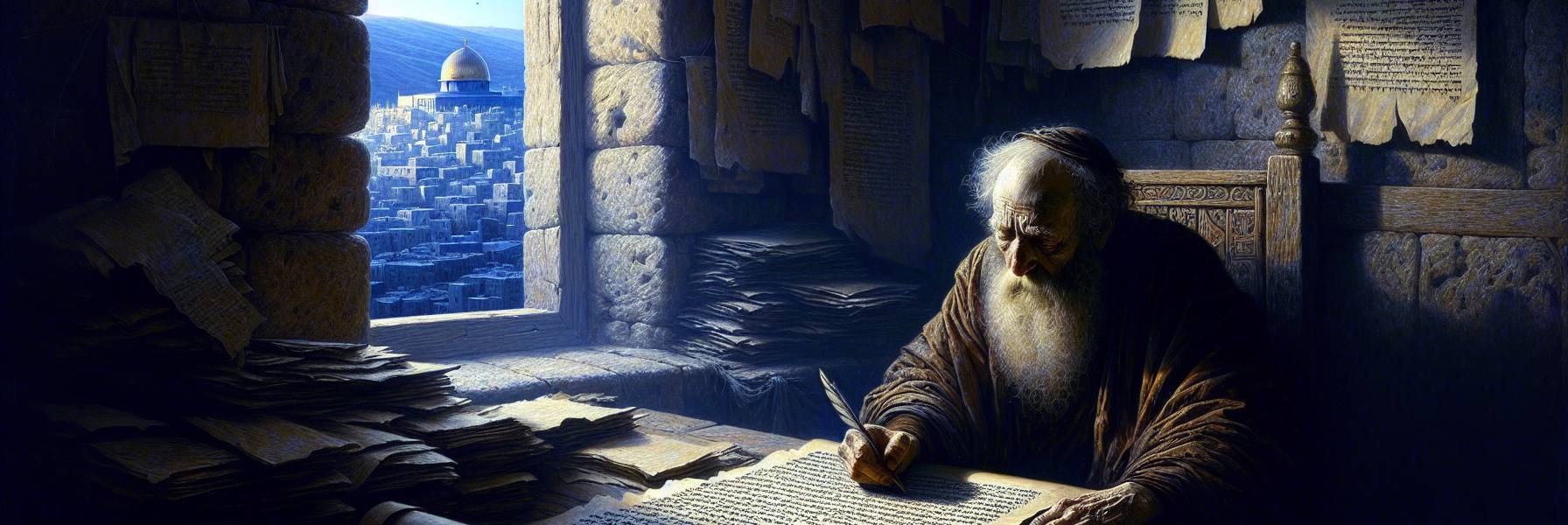

The ink was dry, but the words still trembled in the air. Eliab, an old scribe with fingers stained the color of walnuts, shifted on his stool and let the parchment curl in on itself. The predawn hush of Jerusalem was a palpable thing, a held breath. He had been copying the hymns of David, but his own soul felt like a silent stone. The words of praise, so vibrant on the page, seemed to echo in a chamber of his heart that was empty and dark.
He rose, the stiffness in his knees a familiar complaint, and moved to the narrow window. The city was a sculpture of deep blues and blacks, the Temple Mount a darker shadow against a sky just beginning to consider the idea of grey. He was about to turn back to his lamp when he saw it—a single, defiant star, piercing the fading night. Not the morning star, but some distant, steadfast sentinel refusing to be dismissed.
And the phrase from the scroll he’d just finished echoed unbidden: *Praise him, all his angels; praise him, all his heavenly hosts.*
Eliab leaned on the sill, the rough stone cool against his palms. He watched as the grey softened, bled into a pale primrose at the eastern rim. It wasn’t a sudden explosion of light, but a slow, undeniable claiming. And as the light grew, so did the sound. Not from the city below, but from the world itself. It began with the sparrows. A sleepy chirp from a nest under the eaves, then another, then a whole chorus of them, a chaotic, joyful chatter that seemed to scrub the last of the night away. *Praise him, sun and moon,* he thought.
Then the wind came. It wasn’t the howling wind of the desert, but a gentle, waking sigh that swept up from the Kidron Valley. It rustled the leaves of the few fig trees in the courtyard below, a sound like softly clapping hands. It carried the scent of damp earth and sage. *Praise him, you highest heavens and you waters above the skies.*
The sky was now a vast, clear bowl of azure. Great, ponderous clouds, glowing white at their crowns, began their stately procession from the west. They were mountains adrift, casting slow, graceful shadows that galloped over the hills of Judea. He imagined the rain held within them, the life for the barley and the wheat, and the command seemed to rise from the very rocks: *Fire and hail, snow and mist, stormy wind fulfilling his word!*
A donkey brayed loudly from a nearby street, a robust, unmelodic sound. Dogs barked in answer. The city was waking. He heard the clatter of a pot, the distant call of a water-seller. But his mind was on the wild places, the places beyond these walls. He saw in his mind’s eye the cedar bones of Lebanon, the oaks of Bashan straining upward. He pictured the crawling things in the cracks of the Negev stones—the beetles and the lizards—and the great leviathan sporting in the distant, unseen sea. *Mountains and all hills, fruit trees and all cedars! Beasts and all livestock, creeping things and flying birds!*
A profound shift was occurring within him. His own silence, his own melancholy, was not the default state of creation. It was an aberration. The world was not waiting in quietude; it was a roaring symphony of acknowledgment. The star had praised by shining. The dawn praised by arriving. The wind praised by moving. The sparrow praised by its very existence. They had no scrolls, no temples, no intricate prayers. Their being was their hymn.
He finally understood. The psalm wasn’t a command issued to a reluctant universe. It was a revelation of a constant, invisible reality. It was an invitation to listen, and then to join.
Eliab turned from the window. The first true shaft of sunlight, thick as honey, slanted through the opening and fell across his work table, illuminating the dust motes dancing in a frantic, glorious ballet. He sat down, but not to copy. He took a fresh sheet of parchment, smoothed it, and dipped his reed pen.
He did not write words of doctrine. He did not compose a new psalm. Instead, with a hand that felt strangely young, he began to draw. A clumsy, flowing line for the hills. A scatter of dots for the sparrows. A wispy circle for the sun. It was a child’s drawing, but it was his praise. His own, human praise, now woven into the great tapestry of it all.
From the street below, a young mother sang a soft lullaby to her child. A baker laughed with a customer. The sounds of human life—kings and elders, young men and maidens, old men and children—rose in a complex, messy, beautiful strain.
Eliab put down his pen. The silence within him was gone, replaced by a deep, resonant fullness. He was no longer a listener to the chorus, but a voice within it. And the call, he realized, had never been for the heavens and earth to start praising. It was for his own ears to finally hear the song that had never ceased.