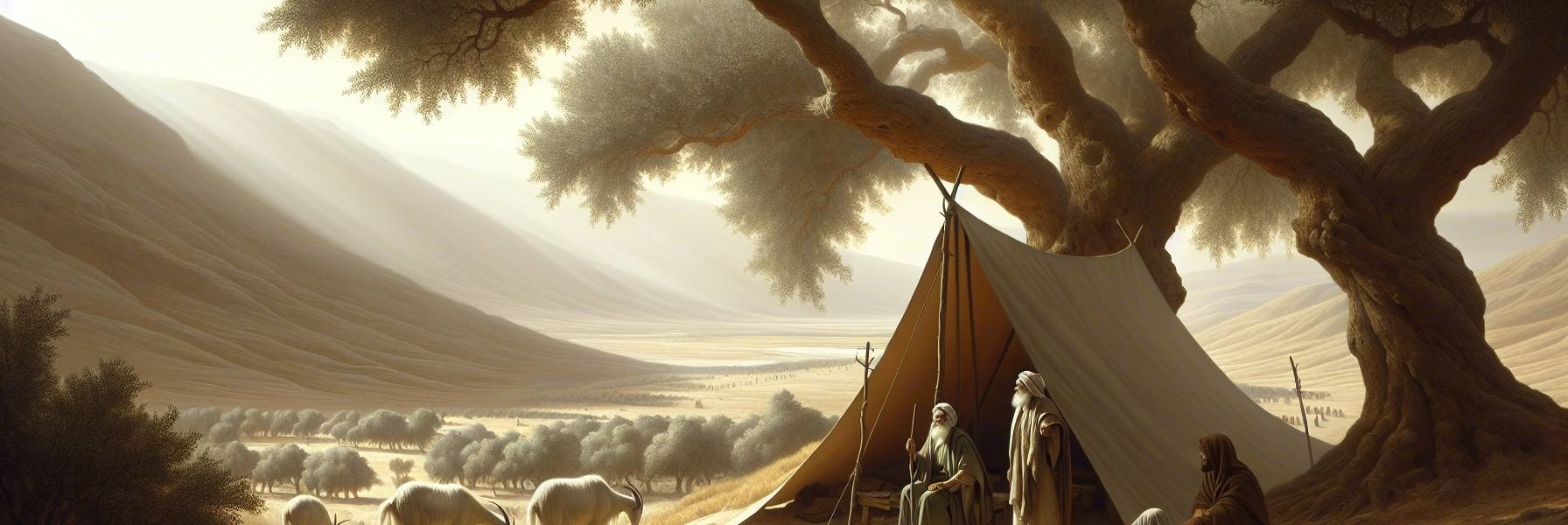

The heat lay heavy over the high country, a palpable thing that shimmered above the grey-green of the olive leaves and pressed the scent of sun-baked earth from the ground. It was the hour when sensible men and beasts retreated into shadow, a still and breathless pause in the day. Abraham, old now and feeling the years in his knees, sat in the entrance of his tent, where a thin, hot breeze occasionally stirred the goat-hair fabric. The great oaks of Mamre stood sentinel, their ancient branches offering a deeper, quieter shade.
He saw them first as a blur of movement against the bleached landscape, three figures resolving slowly out of the glare. They walked with a purpose that seemed untouched by the heat. Abraham did not question the instinct that seized him. It was more than hospitality; it was a recognition, deep and wordless. He rose, his joints protesting, and hurried out toward them, bowing low, his forehead nearly touching the dust.
“My lords,” he said, the words gritty in his dry throat. “If I have found favor in your sight, please do not pass by your servant. Let a little water be brought to wash your feet, and rest yourselves under the tree. I will bring a morsel of bread, that you may refresh yourselves. After that you may pass on—since you have come to your servant.”
They agreed with a simple nod. “Do as you have said.”
Abraham turned and moved with an energy that belied his age. Into the tent he went, to Sarah. His voice was low, urgent. “Quick! Three seahs of fine flour! Knead it, and make cakes.” He did not wait but went out himself to the herd, his eye selecting a good, tender calf. He gave it to a young servant, who ran to prepare it. He fetched curds and milk, the cool white tang of them a promise against the heat, and set the meal before the men where they sat beneath the spreading branches of the oak. He stood near them, a watchful host under the vast bowl of the sky, as they ate.
One of them spoke then, his voice calm and clear. “Where is Sarah your wife?”
“There, in the tent,” Abraham replied, a flicker of surprise passing through him. The tent’s entrance was behind him, private.
Then the voice said, “I will surely return to you about this time next year, and Sarah your wife shall have a son.”
Sarah was listening at the tent’s entrance, just behind him. The words found her like a physical blow. A son? Her body, long ago barren, now worn and dry as a forgotten root, clenched inward. A sound escaped her, not quite a laugh, more a sharp exhalation of disbelief, ironical and bitter. *After I am worn out, and my lord is old, shall I have pleasure?* The thought was a closed circuit within her, a private verdict on the absurdity.
But the one who was speaking—now it was not a guest’s voice, but the Voice—said to Abraham, “Why did Sarah laugh and say, ‘Shall I indeed bear a child, now that I am old?’” The divine question hung in the air, not accusing, but laying bare the hidden truth of the tent’s inner shadow. “Is anything too hard for the LORD? At the appointed time I will return to you, about this time next year, and Sarah shall have a son.”
Fear, cold and sharp, pierced Sarah’s disbelief. She came forward, her face ashen. “I did not laugh,” she said, the denial thin and brittle.
But He answered, the tone leaving no room for the lie, yet not without a strange gentleness. “No, but you did laugh.”
The meal was over. The men rose. Abraham, his mind reeling with the promise and the piercing clarity of the moment, walked with them a way, to set them on their path. They looked down from the heights toward the valley where the cities of the plain lay, a hazy smudge in the distance. Sodom. A silence fell among them, but it was a silence full of unspoken judgment.
Abraham found himself standing alone as two of the figures began to descend the path, their forms growing smaller against the vast landscape. But the One remained. The LORD, for it was unmistakably He, did not move. And Abraham, sensing the weight of what was to come, drew closer. The conversation that followed was not the formal plea of a patriarch, but the desperate, halting negotiation of a man who knew both the horror of justice and the reach of mercy.
“Will you indeed sweep away the righteous with the wicked?” he began, his courage fragile. “Suppose there are fifty righteous within the city…”
The dialogue unfolded there on the blistering ridge, a back-and-forth that wore Abraham down to the raw nerve of hope. Fifty. Forty-five. Forty. Thirty. Twenty. Ten. Each number was a foothold, a stay against the looming conflagration. “Oh let not the Lord be angry, and I will speak just once more…”
And with each reduction, the terrifying, beautiful answer came back: “For the sake of ten, I will not destroy it.”
Then He was gone. The place where they had stood was empty, just heat and light and the rustle of oak leaves. Abraham turned back toward his tents, the dust of the promise and the dread of the verdict clinging to his sandals. Above him, the sky was utterly clear, holding its breath. In the tent, Sarah stood very still, her hand pressed to her abdomen, as if listening for the echo of a laugh that had become a prayer.