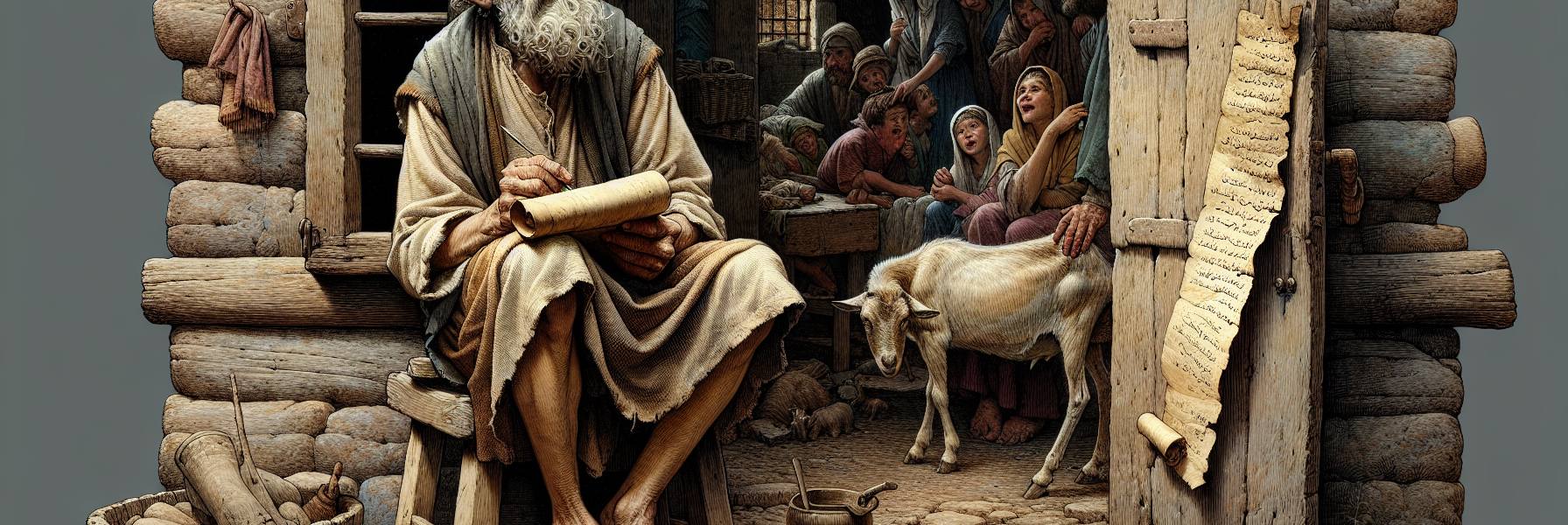

The smell of rain was in the air, a cool, damp promise that did nothing to ease the ache in old Linus’s bones. He shifted on the simple stool by his window, the parchment of Peter’s letter resting on his knee, its corners softened from handling. From the courtyard below came the sounds of the evening—a child’s laugh, the scrape of a pot, the lowing of a discontented goat. Ordinary sounds. Enduring sounds. They were the chorus to the turmoil in his mind.
He’d read the copy of the letter so many times the words felt etched behind his eyes. *Where is the promise of his coming?* That was the question whispered in the marketplace, muttered over cups of wine, even hinted at by his own grandson, Marcus, whose faith was fresh and brittle and craved a spectacle. Linus understood the whisper. He’d felt its cold breath himself on long, silent nights when his prayers seemed to rise no higher than the smoke-blackened ceiling of his room. The world went on. Caesar followed Caesar. The wheat grew and was harvested. People were born, loved, died. Where was the rupture? Where was the glorious, terrifying end?
He looked out at the deepening violet of the sky, remembering Peter’s words about scoffers. They weren’t cartoonish villains, those scoffers. Some were his neighbors—decent men who saw a stable world and mocked what they couldn’t see. *Everything goes on as it always has*, they’d say, spreading their work-roughened hands. Linus used to argue. Now he just listened, and the doubt would sometimes coil in his own belly, a quiet, living thing.
But Peter… Peter had seen. He had walked with the Lord, had seen the transfiguration, had heard the voice from heaven. And Peter, in this final, urgent scrawl, didn’t just deny the scoffers. He took you back. Further back than Rome, further back than the prophets. He took you to the beginning, to the very *word* of God. “By the word of God the heavens existed and the earth was formed out of water and by water,” Linus murmured. His mind conjured not a tidy theological point, but a chaotic, roaring vision: formless void, the Spirit brooding, and then a sound—a speaking—that brought cosmos from chaos. If God’s word could do *that*, then surely his word—the promise of return—held a power beyond the counting of days.
The rain began, a soft patter on the clay tiles. Linus thought of the flood. That was the key, Peter insisted. People forgot. They looked at the solid, sun-drenched earth and forgot it had been judged, undone, remade. The same word that called the world into being had once called the waters over the banks of creation. The world that seemed so permanent was, in God’s economy, stored up for fire. Not annihilation, Peter was careful. Purification. A refiner’s fire. Linus pictured not a hellscape, but a goldsmith’s crucible—a destructive, necessary mercy, burning away the dross to leave only what was true, what was enduring.
A log shifted in the brazier, spitting a spark onto the floor. Linus stamped it out absently. That was the heart of it, wasn’t it? The Lord’s patience. Marcus and the others, they saw delay as failure, as divine forgetfulness. Linus, with his seventy years etched into his face, saw it differently now. He thought of his own daughter, wayward and proud, and how he’d waited, year after year, leaving the door unbarred, not because he didn’t care about justice, but because he loved her. The ache of that waiting was a kind of love itself. “He is patient with you,” Peter wrote, “not wanting anyone to perish, but everyone to come to repentance.” The delay wasn’t a broken promise; it was the very substance of the promise, a space for grace breathed into history.
The rain fell harder now, a steady drumming. Linus rolled the parchment carefully, tying it with a leather thong. His earlier anxiety had quieted, not into certainty, but into a steadier hope. The day of the Lord would come, Peter said, like a thief. Not with fanfare for the ready, but with utter surprise for the smug. And what then? New heavens. A new earth. Righteousness its foundation and its dwellers.
He stood, his joints protesting, and walked to the doorway. The air was clean and sharp. He looked at the puddles forming in the courtyard, glittering with the light from a nearby window. This world was beautiful, but it was a beautiful tent. A temporary dwelling. His home was elsewhere, being prepared. The waiting, then, was not passive. It was active. It was about living—now, in this rain-scented evening—in holiness and godliness. It was about speeding the coming, not by calculation, but by the quality of his life.
Marcus found him there later, standing in the doorway. “Grandfather? You’ll take a chill.”
Linus turned, a slow smile on his face. “Come, sit with me. There is a letter from an old friend I want to read to you again. But this time… this time, I think I might understand it a little better.”
He didn’t speak of cosmic fires or stolen days. He would speak of a word that makes worlds, of a patience deeper than time, and of a hope that shapes how you live in the rain, in the waiting dark, on the solid, temporary earth.