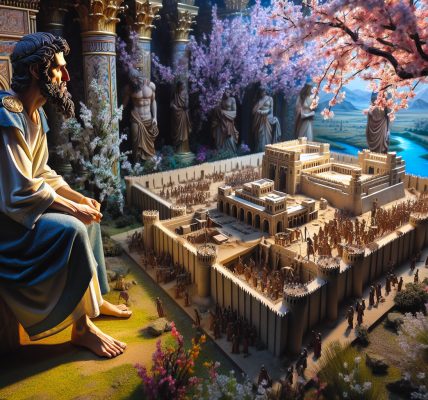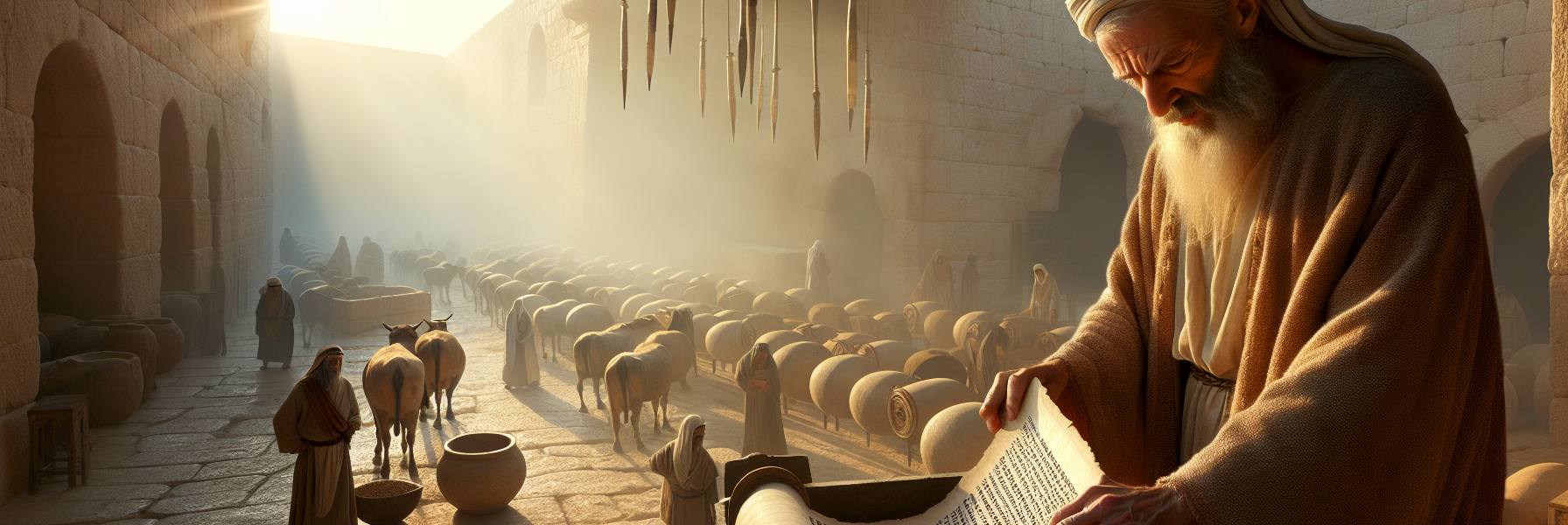

The sun, a pale wafer behind the morning haze, did little to warm the stone of the outer court. Adonijah ben Iddo, Senior Scribe of the Third Rank, felt the chill in his knuckles as he unrolled the latest dispatch from the Sharon district. The papyrus was of good quality, smooth and thick, but his eyes—older now than he cared to admit—struggled in the half-light. Around him, the palace compound was a symphony of low, purposeful noise: the scrape of sieves through grain in the measuring courts, the distant lowing of oxen from the royal stables, the murmur of a dozen other scribes at their benches.
His was a task of numbers and names, a geography of abundance. The dispatch spoke of wheat and barley, of olive oil pressed in stone vats so numerous they dotted the hills like grey sheep. It was one of twelve such reports he would collate today, each from a provision officer appointed over a region of Israel. The system was new, a vast and intricate machine of Solomon’s devising. Azariah son of Nathan over the officers; Zabud son of Nathan, a priest and the king’s personal confidant; Ahishar, over the household; Eliab son of Joab over the army. The names were a litany Adonijah recited under his breath, the scaffolding of a peace so profound it still felt, some mornings, like a dream.
He dipped his reed pen. The ink was a deep, sooty black. *From the Sharon: twenty thousand cors of fine wheat, and twenty thousand cors of barley.* He wrote the figures, his script a disciplined, vertical cascade. It was not the poetry of his youth, copying the songs of David or the prophecies of Samuel. This was the prose of prosperity, thick and substantial as day-old bread.
A memory intruded, unbidden: his own father, Iddo, a minor Levite from Hebron, speaking of the years under Saul—the scarcity, the dread of Philistine raiders, the king’s own grim spasms of fury. Their world then had been narrow, defined by the next meal, the next harvest, the next threat. Now, Adonijah’s world was defined by spreadsheets of plenty. *Judah and Israel were as many as the sand by the sea. They ate and drank and were happy.*
The report from Naphtali mentioned deliveries of “choice fruits” and “green herbs of the field.” A vague term. He made a note to seek clarification from the regional officer, a stern-faced man named Ben-Geber who ruled from the fortified heights of Gilead. It was all part of the machine. Twelve regional officers, each providing for the king’s household for one month of the year. The logistics were staggering. It meant that the palace, the court, the thousands of officials and servants and visiting dignitaries, never knew want. Not for a day. The sheer, relentless continuity of it was a kind of miracle, a daily reaffirmation of the covenant’s favor.
He rose, his joints protesting, and walked to the great arched doorway that looked out over the administrative quarter. Below, in a courtyard paved with cedarwood to keep the damp from the stores, men were stacking leather sacks of lentils and parched corn. The air smelled of dust, of cumin, of the faint, sweet scent of cedar resin. He saw Benaiah son of Jehoiada, the commander of the army, striding past, his face set in its usual granite cast, but there was no urgency in his step. No runners breathless with news of battle. His soldiers, Adonijah mused, were likely overseeing the forced labor crews in Lebanon or manning the quiet garrisons from Gaza to the Euphrates. Peace had turned warriors into quartermasters.
Returning to his bench, he opened the ledger for “Domestic Affairs – Jerusalem and Environs.” Here the entries were more intimate, yet no less astounding. *Solomon’s provision for one day was thirty cors of fine flour and sixty cors of meal, ten fat oxen, and twenty pasture-fed cattle, a hundred sheep, besides deer, gazelles, roebucks, and fattened fowl.* He read the list not as an accountant, but for a moment as a father. He thought of his own small house in the lower city, the single lamb slaughtered for the Passover feast, the careful hoarding of olive oil. The scale of the king’s table was of another order of existence entirely. It was a table for a nation, a symbol that dripped with the fat of blessing.
The theological weight of it settled on him not as a scholar’s thesis, but as a physical sensation—a fullness in the air, a quiet hum of order. This was what it looked like when wisdom ruled. Not just clever sayings, but the practical, grinding, magnificent wisdom of justice and administration. Solomon’s wisdom, people said, was like the sand on the seashore. Adonijah saw it not in grains, but in these stacks of papyrus, in the perfectly timed rotation of regional supplies, in the contented silence of the armed camps.
He finished his notations as the sun climbed higher, the haze burning away to reveal a sky of hard, cloudless blue. The dust motes danced in a sudden shaft of light across his workspace. From the direction of the throne room, carried on a breeze, came the faint, silvery sound of laughter. Some ambassador from Tyre or Egypt, perhaps, being charmed.
Adonijah rolled the Sharon dispatch and tied it with a cord of flax. He placed it in the finished basket, already half-full. There was no grand finale to his day’s work, no epiphany. There was only the next scroll, the next set of numbers, the next testimony to a kingdom so wide and so secure that a man could sit in the cool shade of an administrative hall and, with a faint ache in his writing hand, record the meticulous details of its daily bread. It was, he thought with a quiet, grateful exhaustion, a very good time to be a scribe. The peace was in the paperwork.