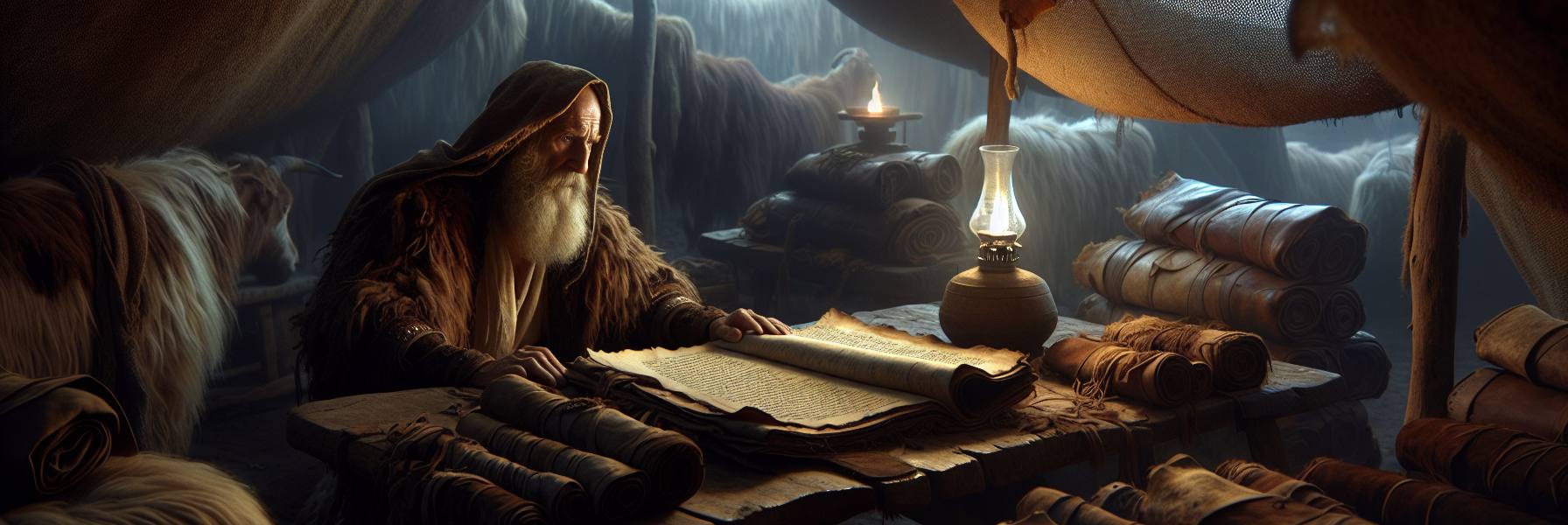

The lamplight was failing. Joshua felt it in his bones more than he saw it—a deep, sedimented ache that had little to do with the cool evening air seeping through the goat-hair walls of his tent. Before him, spread on a rough-hewn table, lay the skins. They were not many, but the writing upon them was dense, the careful, angular strokes of a scribe’s hand recording names that now echoed in the hollows of his memory.
He breathed in, and the scent of the oil lamp, of the leather, of the very dust of Canaan, seemed to coalesce into a single, heavy truth. The list. It had to be made.
His mind did not go to the strategy first, or the glory. It went to the silence after the shouting. That was the thing they never sang about in the victory chants—the profound, ringing quiet that descended on a field when the last enemy had fallen. The way the wind would resume, carrying the smell of blood and crushed grass, and how you could hear, for the first time, the distant cry of a hawk circling high above, indifferent to the covenants of men.
He dipped the stylus. The first entry was not a beginning, but an inheritance.
*Sihon, king of the Amorites, who reigned in Heshbon.*
The name conjured not a face, but a terrain: the vast, rolling plains east of the Jordan, the arrogant message from a king who thought the wanderers from Egypt easy prey. Joshua remembered the reports Moses had received, the tension in the old man’s shoulders before it lifted into a kind of weary resolution. Sihon had not merely refused passage; he had come out against them with his entire army. His defeat felt, even now, like a door swinging open. The plains of Moab, the fords of the river… they had been a gift, a firstfruit of the promise. But it was Moses’ victory, not his own. Joshua recorded it with the reverence of a scribe copying a sacred text, which, in a way, he was.
Then, *Og, king of Bashan, one of the last of the Rephaim.*
A giant. They had all heard the tales. His bedstead, of iron, nine cubits long, had become a relic pointed out to children. Og was a relic of an older, fiercer world, a living fortress. His defeat was a breaking of myths. To stand before a giant and not flinch—that was the lesson. It was not about muscle against muscle, but faith against fear. The great Argob, with its sixty fortified cities, had seemed impregnable. Until it wasn’t. Joshua’s hand moved slowly; the ink for Og’s name seemed darker.
A pause. He shifted on the stool, the stiffness in his knee flaring. Then he turned the skin. This was his own account now. The west.
*The king of Jericho.* No other name was needed. The very word tasted of dust and miracle. He saw not the tumbling walls, but the silent, surreal march of the six days, the palpable confusion seeping from the city like a miasma. The seventh day’s blast was not a sound, but a feeling—a crack in the fabric of the world. Jericho was a paradigm, a lesson in obedience so precise it felt surgical. It was holy ground, and utterly destroyed. He wrote it, and the ghost of Rahab’s scarlet cord flickered at the edge of his thought, a thread of mercy in the judgment.
*The king of Ai, near Bethel.*
A wince, involuntary and deep. This name was written in the bitter ink of failure. The hot shame of the retreat, the stunned silence of the camp, the crushing weight of Achan’s sin. Ai was the correction. It taught them that the land itself was consecrated, that the community was a single body, and that a hidden theft could poison the whole. The second attack, the feint, the ambush—this was cleverness born of humility. They had to learn to fight *after* they had learned to repent.
One by one, they emerged from the well of memory. The southern campaign unfurled like a brutal scroll.
The cunning Gibeonites, with their moldy bread and cracked wineskins, their fear so great it invented a whole false history. Their survival was a knot of complicated grace, a treaty sworn in God’s name that could not be broken, even when it became a burden.
Then the five kings, the coalition of the south. He saw them clearly: the arrogant climb of the Amorite lords to besiege Gibeon, the all-night march from Gilgal, the sudden, terrifying descent of the hailstones—God fighting directly, the very heavens as artillery. And the long, desperate day, the sun standing still over Gibeon, the moon in the valley of Aijalon. He had spoken the command, but the act was not his. It was a day pulled out of time, a gift of daylight bought with faith. He remembered the cave at Makkedah, the five kings hiding in the dark like scared animals, the symbolic gesture of the commanders placing their feet upon their necks. It was not savagery, but sacrament—a enacted prophecy of ultimate victory over the fear they represented.
He recorded them: Jerusalem, Hebron, Jarmuth, Lachish, Eglon. Hebron—city of the patriarchs, finally reclaimed. Lachish, with its heavy fortifications, falling in two days. Gezer, whose king came up to help Lachish and found only the same swift end.
The northern campaign was a different beast: a great, confederated host, numerous as the sand, under Jabin king of Hazor. A smart enemy, one who tried to unite the disparate tribes of the hill country against a common foe. The battle at the Waters of Merom was a blur of chariots mired in mud, of sudden, overwhelming attack that scattered alliance into chaos. The burning of Hazor, the greatest of all those cities, sent a pillar of smoke into the sky that was a message for the whole land. He wrote: *Hazor, Madon, Shimron, Achshaph…*
The list grew. Cities of the hill country, the lowlands, the slopes, the wilderness. Some had fallen in pitched battle, others had been isolated and starved. Some kings had been captured and hanged, others had died in the melee. Kites and ravens had done their work. The land, slowly, had grown quiet.
Joshua put the stylus down. His hand cramped. He looked at the names, thirty-one in all. They were not just names. Each was a stronghold of fear, a citadel of the old ways, a seat of resistance to the promise given to Abraham under a sky full of stars. To read the list was to take a tour of the Lord’s faithfulness. It was a geography of grace, written in the negative space left by vanquished powers.
He did not feel like a conqueror. He felt like a steward. The victories were not his; they had been given. The land was not his; it was being allotted. This list, this dry administrative record, was in truth a psalm—a song of praise spelled out in the names of the defeated.
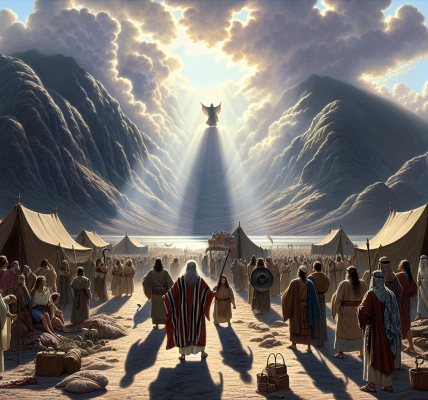
Outside, he could hear the normal sounds of the camp settling for the night: a laugh near a cook-fire, the lowing of a bullock, the soft murmur of the Levites at prayer. It was the sound of rest. An earned rest.
He rolled the skins carefully. The record was complete. It was a testimony for those who came after, for the children who would ask, “What do these stones mean?” It meant that God had been faithful. It meant that giants could fall. It meant that walls could crumble. It meant that a sun could stand still for those who walk in obedience.
The lamp guttered, and in the near-darkness, Joshua, son of Nun, allowed himself a slow, weary exhalation. The writing was done. The remembering, however, that would go on until his last breath.