
The dawn was a pale scratch of light over the eastern hills, too weak yet to burn away the chill clinging to the floor of the desert. Inside the Tent of Meeting, the air hung still and dense, carrying the lingering scent of last night’s incense—sweet, but with an acrid edge, like memory. Aaron stood before the veil, the weight of his linen robes a familiar pressure on his shoulders. He was tired. A deep, bone-tiredness that had little to do with sleep.
The events at Korah’s rebellion had left a silence in the camp, a silence that was somehow louder than the screams that had swallowed the earth. It was a quiet filled with unasked questions, with sidelong glances toward the tabernacle. The holiness of the Lord, they had learned, was not a gentle thing. It was a consuming fire that had taken two hundred and fifty men bearing censers, and fourteen thousand more in the plague that followed. Aaron, himself, had stood between the dead and the living with a censer in his hand. The smoke of that intervention still felt lodged in his lungs.
A shuffle of feet at the entrance. Eleazar, his son, entered, his own priestly garments neat and crisp. The boy—no, the man now—had a solemnity in his eyes that hadn’t been there before the rebellion. “Father,” he said, his voice low. “The camp is stirring.”
Aaron nodded, his gaze drifting over the golden clasps of the veil, the embroidered cherubim that seemed to shift in the lamplight. He felt the burden of it all, the terrible proximity. To be chosen was to live on a precipice. Then the voice came, not in thunder, but as a clear, direct communication to his spirit, a weighty instruction that settled into the space around them. It was for him, and for his sons. A delineation.
“Eleazar,” Aaron said, turning. His voice was gravelly. “Call your brothers. And summon the heads of the Levite families. Kohath, Gershon, Merari. Have them come.”
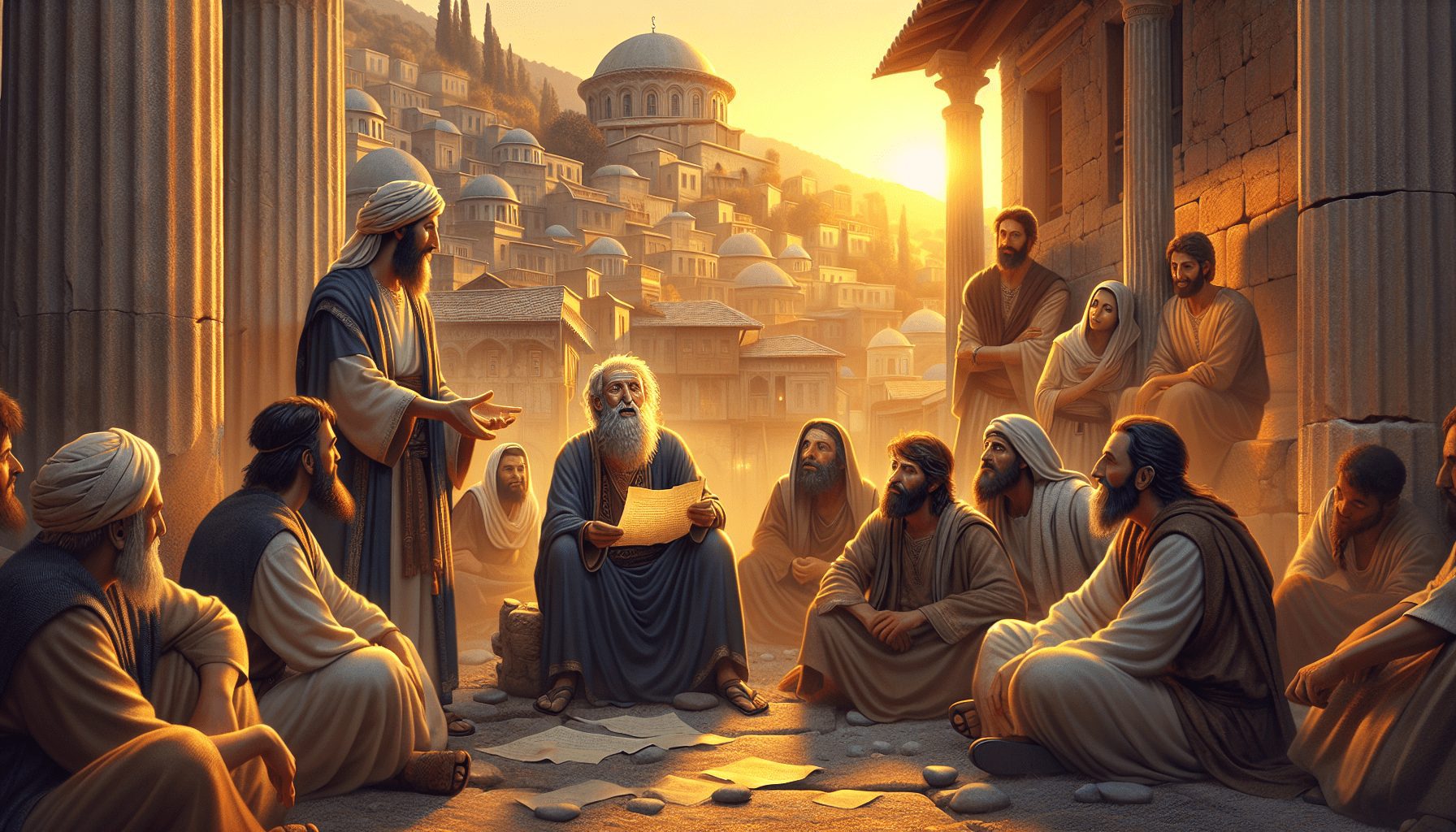
The instructions unfolded in Aaron’s mind as the men gathered, their faces etched with a new wariness. He spoke, and as he did, the structure of their world was drawn with divine clarity. It was a map of responsibility, a wall of separation built not from stone, but from duty and lineage.
“The Lord speaks,” Aaron began, his hands, stained faintly with oil and ash, spread before him. “The guilt of the sanctuary is ours. Yours, and your sons’ with you. And the guilt of the priesthood is ours. But our brothers, the Levites… they are joined to you.” He looked at the Levite chieftains. “They are a gift. Given to the Lord to do the service of the Tent. But you and your sons alone,” he said, his eyes locking with Eleazar’s, then Ithamar’s, “you shall bear the iniquity connected with your priesthood. No outsider, no one not of Aaron’s blood, may come near.”
He saw the understanding dawn, and with it, a grim acceptance. The privilege of standing before the altar, of handling the blood of the sin offering, of entering within the veil—this was their charge, and theirs alone. The consequence of failure was no longer an abstract threat. They had seen the earth open its mouth.
Then, to the Levites, his tone shifted. “And you. Your service is a gift as well. You are to attend to the duties of the tabernacle, but you must not touch the holy vessels or approach the altar. If you do, you will die, and we will die with you. You are to guard, to carry, to labor. But the holy things… they are ours.”
It was a division of sacred labor, a divine containment policy. The Levites were to have no inheritance in the land; the Lord Himself was their portion. And for their service, they were to receive the tithes of Israel. But from those tithes, they themselves were to offer a tithe—the best tenth, like the richest cream lifted from the milk—to the house of Aaron.
Aaron found himself explaining the practicalities, the gritty details of sustenance in the wilderness. “All the finest oil, all the finest wine and grain, the firstfruits that the people give to the Lord, these are yours. Everything devoted in Israel, every firstborn of man or beast—though the firstborn sons and unclean animals you must redeem—they are yours. It is a covenant of salt, everlasting.”
He spoke of the redemption price for a firstborn son, five shekels, and the uneven, bleating sound of a firstborn donkey being redeemed with a lamb. The theology was in the texture of life: wool, grain, coins, the smell of a newborn kid. The Lord was providing, but the provision was wrapped in the fabric of holiness, which could scorch as easily as it could sanctify.
As the men dispersed, the Levites to organize their clans for the transport of the tabernacle frames and curtains, his sons to prepare the morning offering, Aaron remained. The lampstand’s light gleamed on the gold of the altar of incense. The burden felt, for a moment, not lighter, but clearer. It was a heavy yoke, but it was his. The priesthood was not a crown of glory, but a harness of responsibility. It was a means, a bloody, smoky, arduous means, by which a sinful people could dwell in the presence of a holy God and not be consumed.
He thought of the tithe of the tithe, the Levites’ offering that would come to his own household. It was not about wealth; it was about a chain of gratitude, a cascade of grace from the people, to the Levites, to the priests, all flowing from the Lord. They would eat of it in a clean place, his family. A simple meal, but holy.
Outside, the sun had cleared the hills, pouring harsh, clear light over the camp. The noise of morning—goats bleating, children’s voices, the grind of millstones—rose like dust. Life, ordinary and stubborn, went on. But within the confines of the tabernacle court, and in the depths of his own lineage, a line had been drawn in the sand of the desert. Aaron, breathing in the mix of dry air and sacred oil, understood his life was now lived entirely within that line. It was a terrifying and merciful gift. He adjusted the breastplate on his chest, felt the cool stones with the names of the tribes, and went out to meet the day.