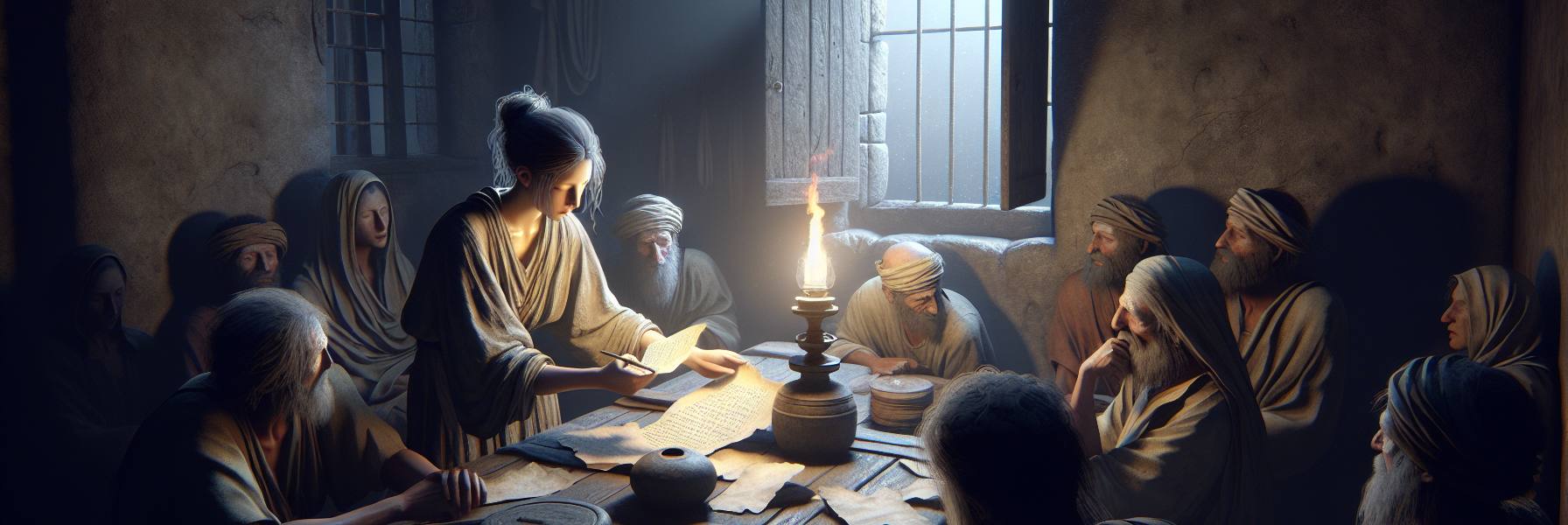

The oil lamp in Marcellus’s house guttered, throwing nervous shadows against the damp plaster wall. A chill, carrying the scent of the Aegean and night-blooming jasmine, seeped through the shuttered window. Around the rough-hewn table, the small assembly leaned in, their faces etched with a fatigue deeper than the late hour. Lydia, her hands still stained from the purple-dye vats, clutched a piece of well-traveled parchment. It was cracked along the folds, soft as cloth from handling.
“Again,” whispered old Silas, his voice like dry reeds. “Read the part about the day.”
Lydia cleared her throat, the words not yet familiar on her tongue. “Now concerning the times and the seasons, brothers, you have no need for anything to be written to you. For you yourselves are fully aware that the day of the Lord will come just like a thief in the night.” A collective, almost imperceptible shudder went through the room. Procorus, the blacksmith with forearms like knotted oak, shifted on his stool. The metaphor was not a gentle one. A thief brought violation, loss, a shocking disruption of peace.
“But we are not in darkness,” Lydia continued, her voice gaining strength, tracing Paul’s hurried Greek script. “We are not, so that that day should overtake us like a thief. For we are all sons of light and sons of the day.”
Marcellus, their host, a merchant whose eyes had seen the breadth of the Via Egnatia, stared at the flame. Sons of the day. It contradicted everything he felt. The anxieties were a nightly tide: the sideways glances in the agora, the sudden silence when he entered a supplier’s shop, the grim news from Philippi of brethren beaten with rods. This felt like darkness, thick and palpable. Yet the letter insisted otherwise. It spoke of an identity, an inheritance, that existed irrespective of the surrounding gloom.
Lydia read on, her finger following the lines. “So then, let us not sleep, as others do, but let us keep awake and be sober.” She glanced at young Timothy, whose head was nodding, heavy with the day’s labors. A gentle smile touched her lips. “For those who sleep, sleep at night, and those who get drunk, are drunk at night.”
Procorus grunted. “Sober. That’s a word for me.” He’d lost a friend to the wine shops just the week before, a man seeking solace in the bottom of a cup. Sobriety here wasn’t just about wine; it was a clarity of mind, a vigilant heart. It was the opposite of the world’s numbing agents, whether drink or idle gossip or the cruel entertainments of the amphitheatre.
“But since we are of the day,” Lydia proclaimed, and the phrase began to sound less like a paradox and more like a rallying cry, “let us be sober, having put on the breastplate of faith and love, and for a helmet, the hope of salvation.” The martial language resonated with Procorus. He knew armor. Faith and love weren’t soft sentiments; they were sturdy, hammered protection for the heart. And hope was the helmet—guarding the mind, the seat of understanding and fear. Without it, a single blow of despair could be fatal.
The letter turned then, from grand metaphor to intimate, practical grace. It was as if Paul, sensing their weary souls across the miles, reached into the room. “For God has not destined us for wrath, but to obtain salvation through our Lord Jesus Christ, who died for us so that whether we are awake or asleep we might live with him.” The finality of that statement—*not destined for wrath*—landed with a profound quiet. The fear of the thief, the anxiety of the coming day, was being gently but firmly displaced. Their destiny was fixed, secured by a death and a life that transcended their own wakefulness.
“Therefore encourage one another,” Lydia read, her eyes meeting each of theirs in turn, “and build one another up, just as you are doing.”
And then, a cascade of final exhortations, like a mother’s last reminders as her children head out the door. They were so human, so specific, it ached. “Admonish the idle, encourage the fainthearted, help the weak, be patient with them all.” Silas nodded slowly; he was both fainthearted and, in his own way, weak. He saw no condemnation here, only an invitation into the patient care of the community.
“See that no one repays anyone evil for evil, but always seek to do good to one another and to everyone.” Marcellus thought of a competitor who had spread lies about his goods. The hot, sharp urge for retaliation cooled, replaced by a bewildering, challenging call to a different economy.
“Rejoice always, pray without ceasing, give thanks in all circumstances.” Timothy, now fully awake, blinked. *Always? Without ceasing? In all circumstances?* It seemed impossible, a recipe for a kind of spiritual exhaustion. But Lydia read on, connecting the command to its source: “for this is the will of God in Christ Jesus for you. Do not quench the Spirit. Do not despise prophecies, but test everything; hold fast what is good. Abstain from every form of evil.”
The instructions were not a checklist for earning favor, but the lived expression of a life already secured. They were how the sons of the day moved through a nocturnal world.
Finally, her voice grew softer, tender. “Now may the God of peace himself sanctify you completely, and may your whole spirit and soul and body be kept blameless at the coming of our Lord Jesus Christ. He who calls you is faithful; he will surely do it.”
The promise hung in the smoky air. *He will surely do it.* The vigilance, the sobriety, the faith, love, hope—the very ability to rejoice and pray and give thanks—was not ultimately their burden to manufacture. It was the work of the faithful God.
Lydia set the parchment down. For a long moment, no one spoke. The fear of the thief was gone, not because the threat was removed, but because their address had changed. They were no longer residents of the night. Procorus placed a heavy hand on Timothy’s shoulder. Silas exhaled a long, peaceful breath. Marcellus looked at the shuttered window, no longer seeing a barrier against a hostile world, but a temporary covering for a people awaiting the dawn.
“Brothers,” Marcellus said, “pray for me.” And one by one, they did. The words were simple, stumbling, real. They built one another up there in the fragile light. They were keeping awake. They were, in their imperfect, weary way, living as who they were: children of the day.